Fashion Meets Art in Natasha Roberts Kay’s “A Room Just So” at Bergdorf Goodman

By Alexandra Goldman

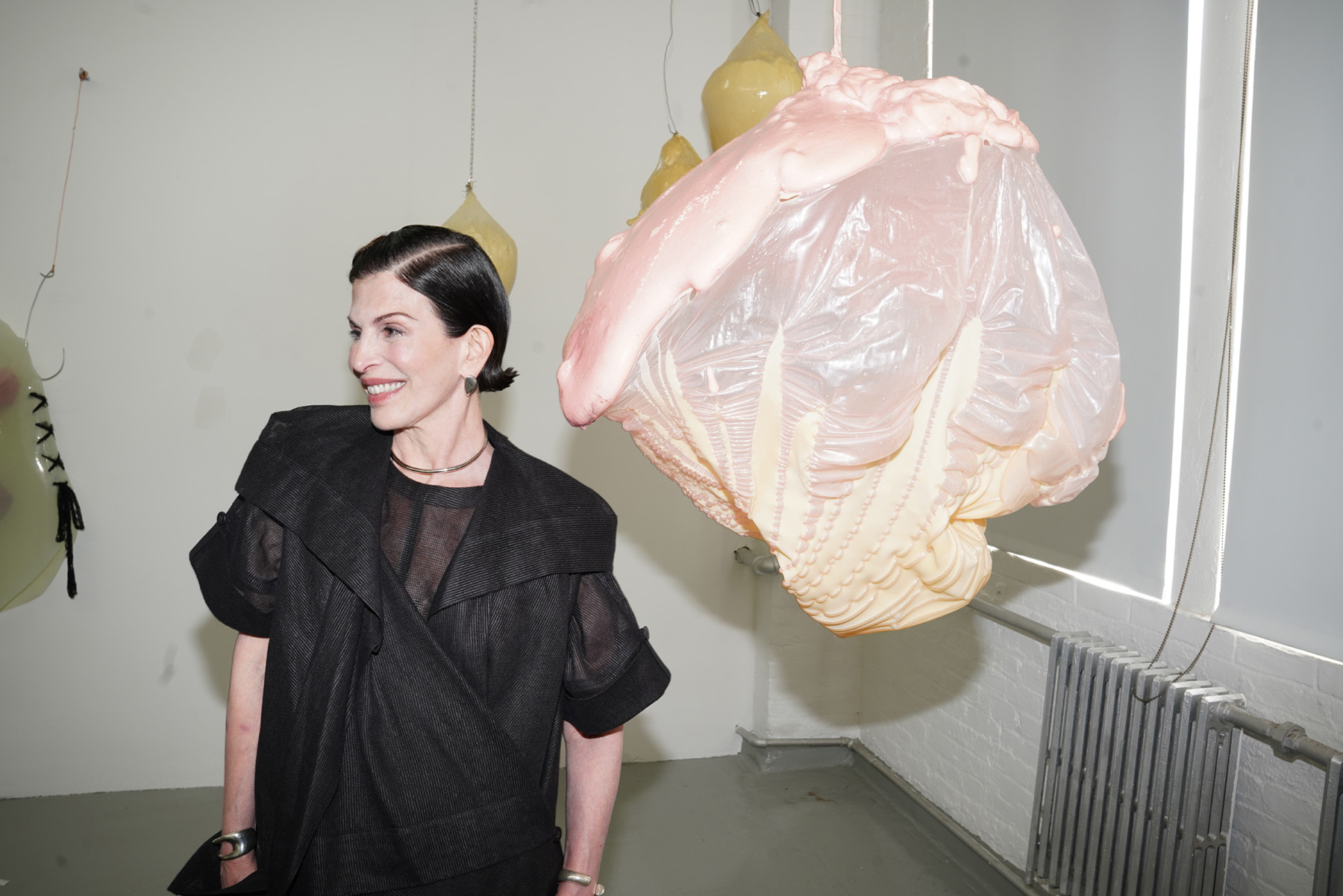
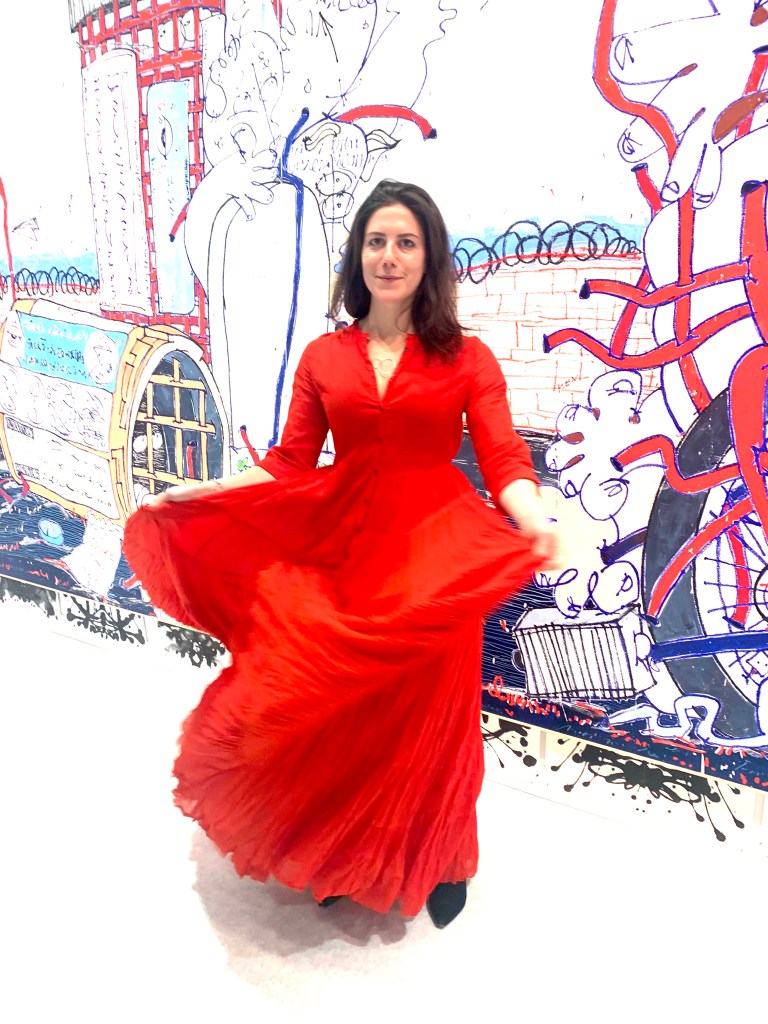
Pictured Above: Natasha Roberts Kay Photographed by Jeanne Paradiso for THE KNOW

As both New York’s Art Week and Fashion Week come to a close, a recent project came to mind that tastefully married the two worlds: A Room Just So, an exhibit of twenty international artists curated by Natasha Roberts Kay at Bergdorf Goodman.

Audrey Schilt, Behind the Scenes at Ralph Lauren (Claudia Being Fitted), Acrylic paint on canvas, 42 x 48 in. Courtesy of the curator.

Roberts Kay—a fashionista herself—wears many hats including curator, sought-after art advisor, new mom, and powerhouse publicist for the Public Art Fund. She can always be found pushing forward courageously with her vision, including regularly curating art exhibitions in New York City’s tallest skyscraper. While some in the art world shy away from embracing the connection between fine art and luxury retail, Roberts Kay orchestrates consonance between the two.
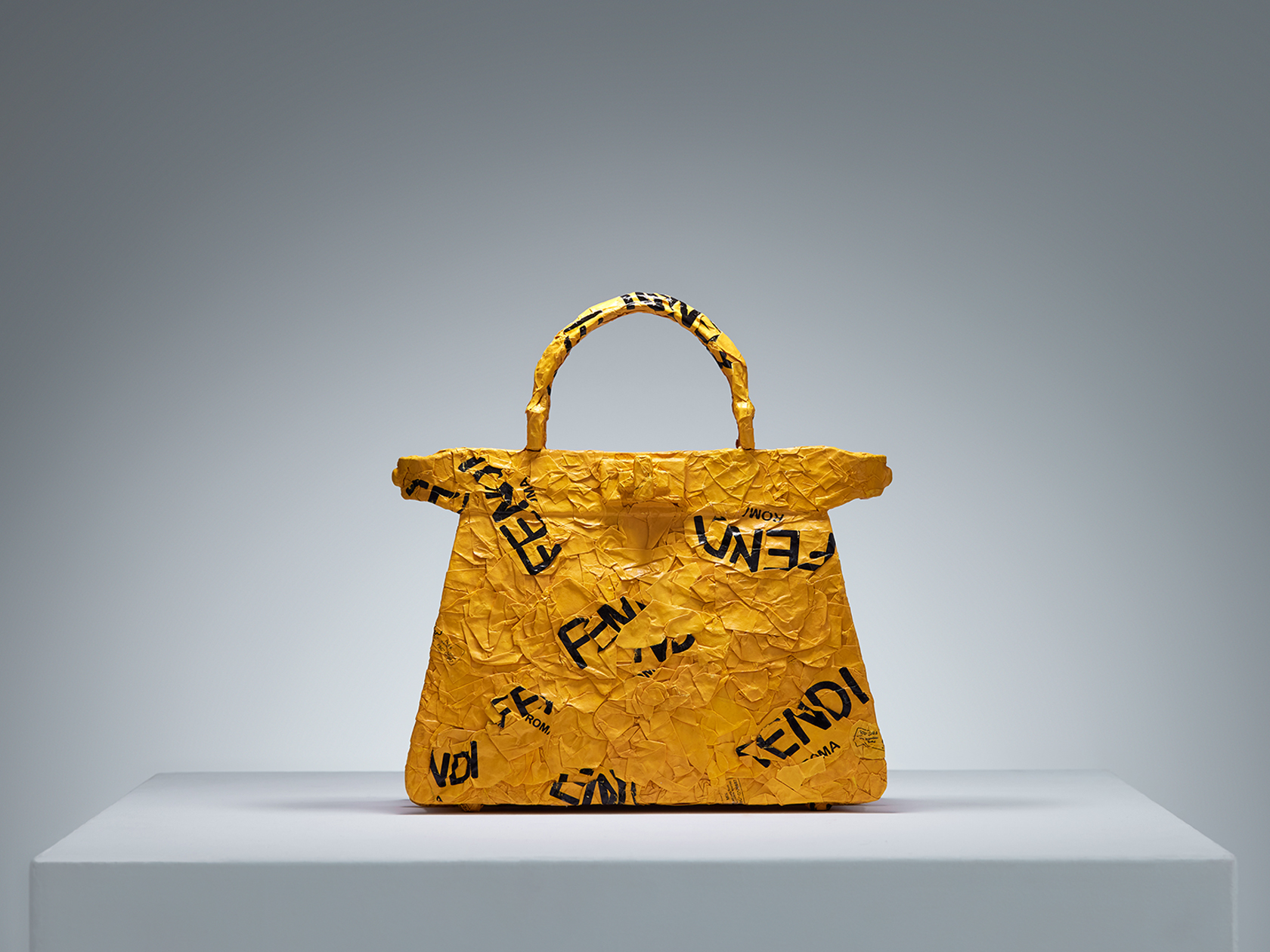
CHiNGLiSH WANG, CHiNGLiSH Brands (Fendi Peekaboo), Paper shopping bags and metal wire, 11 x 4.4 x 11.5 in. Courtesy of the curator.

This was clear to me as soon as I stepped onto the seventh floor of Bergdorf Goodman to see Roberts Kay’s curated summer art exhibition, A Room Just So. Naturally, an environment like Bergdorf’s that successfully blurs the lines between retail and art is an inviting setting for the right exhibit. For A Room Just So, appropriately located on Bergdorf’s interior design floor, Roberts Kay reimagined domestic spaces as living galleries, where paintings, sculpture, furniture, and design objects seamlessly intertwined with the art of home décor”.

Erin Kono, Persimmon I + II, Egg tempera on shaped board, 9.5 in. tondo each. Courtesy of the curator.

The exhibit, which included sixty sculptures, paintings, photography, textiles, and design objects by Alex Anderson, Vicky Barranguet, Edgard Barbosa, C.J. Chueca, Jane Dashley, Jen Dwyer, Kamiesha Garbadawala, Leia Genis, Manuela Gonzalez, Katie Hector, Erin Kono, Kouros Maghsoudi, Thérèse Mulgrew, Hannah Polskin, Gerardo Pulido, Audrey Schilt, Jeremy Silva, CHiNGLiSH WANG, Darryl Westly, and Avery Wheless, added new depth of creative storytelling to the department store’s seventh floor. The works, which ranged from abstraction, to surrealism, to figuration, to functionality, spoke to how art, design, and interior space have the capacity to shape our state of mind. Roberts Kay’s inclusion of thorough information about each artist on view with an impressive detailed audio guide elevated the show to the standards of a top commercial art gallery, while its setting at Bergdorf’s infused it with warmth by simulating living at home with the artworks. A Room Just So positioned the twenty artist’s works in a salable environment with exposure to new clientele, without diminishing their value as original works of art fit for a traditional gallery or museum.

Roberts Kay shared: “With the exhibition, my intention was to assemble a group of traditional artists who are stylish and fashion-forward. For example, Audrey Schilt started her career as Halston’s illustrator at Bergdorf’s—she even sketched Jackie Kennedy in a fitting for her iconic Pillbox hat—and now Schilt paints works inspired by her time in fashion, including her Behind the Scenes at Ralph Lauren series. Artists Leia Genis and Manuela Gonzalez works featured draped and woven textiles that were painted and dyed. CHiNGLiSH WANG sculpted iconic handbags using several major brands’ own shopping bags as material. Many of the works in A Room Just So directly demonstrated a relationship between fine art and design.” 

Gerardo Pulido, Set of #25, Gouache, watercolor, and marker on paper, 12 x 9 in. Courtesy of the curator.

Anecdotally when I entered Bergdorf’s to see A Room Just So on a quiet Friday morning this summer, I overheard a shopper speaking on the phone in the jewelry section to my left, “Hi, I’m at Bergdorf’s,” she said,  “…it’s really the last of the great department stores.” Hearing this, I thought to myself, wow, that really is true, isn’t it. Bergdorf Goodman is iconic; it has its own deeply-rooted historical weight as a bastion of elegance in New York City culture that allows it to seamlessly incorporate a foray into fine art that—with the right people like Roberts Kay on board—can be taken seriously.

Alex Anderson, Rose Vessel, Earthenware, glaze, gold luster, 10 x 12 x 12 in. Courtesy of the curator.

While A Room Just So has come to a close, currently on view in Bergdorf’s seventh floor gallery space is a new exhibit expertly organized by Tribeca-based art and design firm, Todd Merrill Studio, in partnership with de Gournay handpainted wallpaper. This new show features additional artists I love who cross over between the art and design spaces, including Andrea Marquis and Jamie Harris. Bergdorf Goodman’s seventh floor home decor space is open to view seven days a week.

Exploring the Embraceable and Unexpected with Lesley Bodzy

By Alexandra Goldman

Above: Lesley Bodzy in her NYC studio posing for Flaunt Magazine Interview, Photo by Milan Lazovski

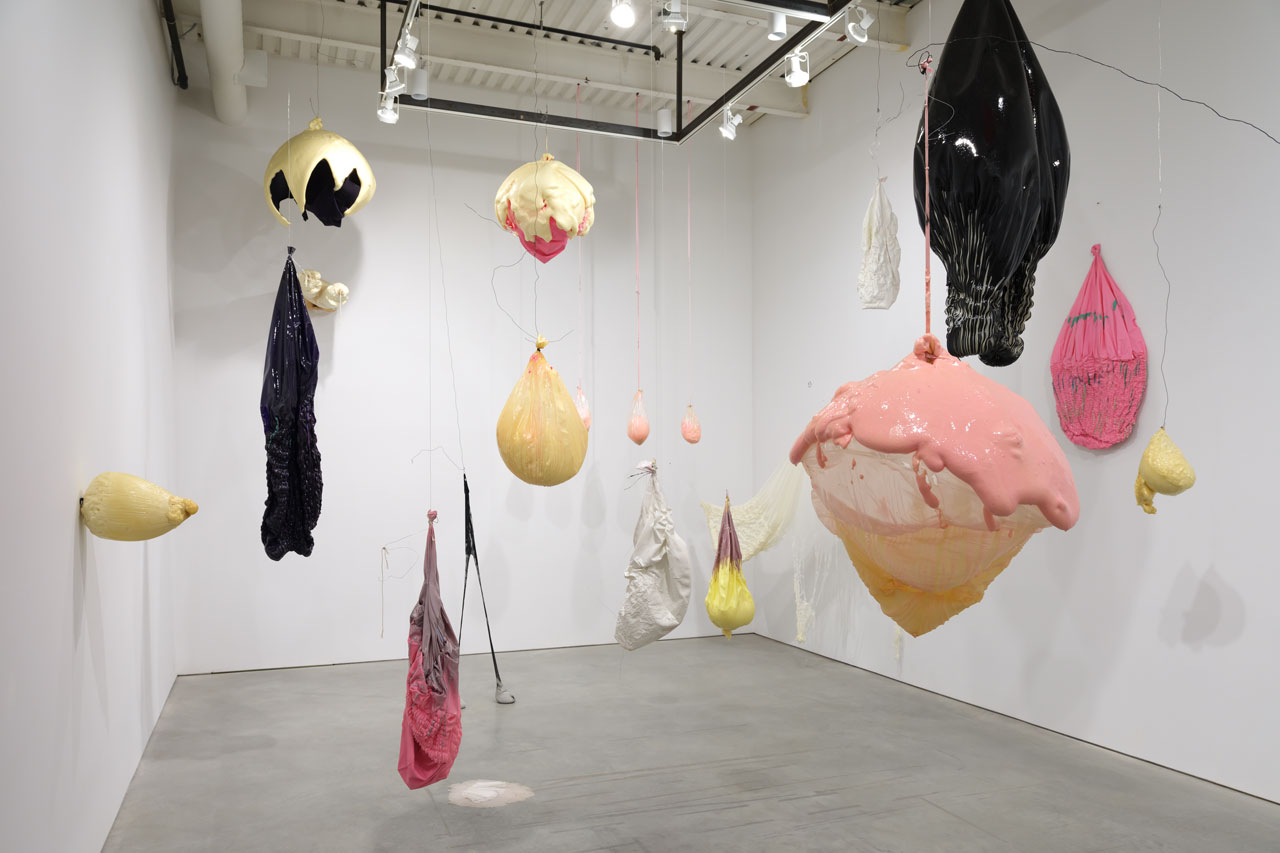
Lesley Bodzy is a mixed-media artist working in Chelsea, New York City and Houston, TX. During our recent studio visit, light pouring into her Chelsea studio bounced off and shined through her menagerie of colorful, translucent, biomorphic sculptures hanging from the ceiling, like giant jellyfish. The studio’s white walls were punctuated with abstract, bodily art objects large and small—some made of dried paint, some 3D printed, and some metallic, among other experimentations. In her sensuous environment that combined beauty with whimsy and the grotesque, it caught my attention that Bodzy had recently participated in a workshop with Judy Pfaff, a trailblazer for mixed media installation art. I noticed the visual and spatial dialogue between Bodzy’s abstract installation artwork on display in her studio, and Pfaff’s legacy. For example, we spoke of Bodzy’s decision to leave her artwork undefined as opposed to classifying it as feminist, even though it critiques patriarchal structures and the beauty industry. That was a decision Bodzy refined with Pfaff, an artist famous for denying narrative meaning to her work.
Bodzy strikes me as an impressive and curious lifelong learner, rigorously working on the refinement and development of her artistic practice. She is great at looking at herself critically, taking action, and growing. Her high level of physical production, innovation, and drive to making art in the studio rivals that of a recent MFA grad, and that’s because she is: she had a lifelong legal career as an attorney, and left it to pursue becoming a full-time visual artist in her sixties with studies at the Art Students League, Hunter College, and the Art Institute of Chicago.

In her studio—as in her exhibitions—Bodzy’s enviable, forever-youthful approach to life is on display alongside her sculpted forms. Following our energizing studio conversation and Bodzy’s immersive solo show, Levity and Depth presented by M. David & Co. at Art Cake, I sat down with the artist for an interview.

Alexandra Goldman: You’ve recently studied with the legendary installation artist and teacher, Judy Pfaff. What did you find most valuable about studying with Pfaff in terms of how she helped you develop your practice? Are there any memorable anecdotes you’re willing to share?

Lesley Bodzy: I was very lucky to work with Judy in 2024-2025 through the Yellow Chair program. She is just brilliant and has been making sculpture for a long time, so she has great insight into the work and the process of making. I was surprised by her down to earth, practical communication style. She treats everyone like a fellow artist and in that way is not intimidating and easy to learn from. She also did not try to make the students make work like hers but she found the key to each of us and worked with us at the level and aesthetic place we were at. 

Lesley Bodzy, Levity and Depth, 2025, photo by Steven Probert

AG: In your spring solo exhibition, Levity and Depth curated by Michael David of M. David & Co. and presented at ArtCake (Cordy and Ethan Ryman’s art production, exhibition and events space in Sunset Park), your whimsical, organically shaped sculptures enveloped viewers in an immersive environment. What do you feel is most important about being “among” your works rather than looking “at” them?

LB: It was surprisingly fun to be among them and this was true for most viewers I think. They became embraceable and unexpected as you walked through them—a bit like the feeling of the installation of teamLab in Tokyo. They also moved in space and are not static. 

Lesley Bodzy photographed for Flaunt Magazine, Photo by Milan Lazovski

AG: You seem to age in reverse! What is your secret, and what advice do you have for artists who struggle thinking about career success in relationship to age?

LB: Let it go. We are all aging and that is just he way it is. Best not to think too much about how much time you have left as one you can’t predict and two its not conducive to making art. 

AG: Whether inflating and popping balloons, working with resin, foam, or metal, or sculpting with paint, you tend to have a unique and experimental approach to materiality in your practice. What does a day in the life of Lesley Bodzy experimenting with materials look like?

LB: It is generally fun. I typically try to have fun with the materials and it’s like a lab. I just don’t care if I make a mess or things don’t come out as hoped because when experimenting with new materials, things seldom go as planned. 

Lesley Bodzy, studio in Houston, 2024

AG: What has making your artwork revealed to you about yourself that you didn’t know before?

LB: That things go better when they are not planned. This is just for me. You know I was an attorney and theres so much planning and detail involved in that. I am happy now to let all that go and just see what happens.

Lesley Bodzy, Levity and Depth, 2025, photo by Steven Probert

Why Hasn’t James Lee Byars Been Exhibited at Dia?

By Alexandra Goldman

This article was originally published in Cultbytes.

Above: Installation view. “James Lee Byars: Perfect is the Question” curated by Vicente Todolí at Reina Sofia Museum Palacio de Velázquez, Madrid, Spain, May 10 – Sep. 1, 2024. Photo: Alexandra Goldman.

James Lee Byars occupies an interesting place at the intersection of minimalism and spirituality. Recalling the spiritual abstract painters Agnes Pelton and Hilma Af Klint who preceded him, there is this idea of the spiritual abstraction of the earlier half of the 20th century seeping into the conceptual minimalist sculpture of the latter half, which coalesces harmoniously in Byars’s work. Within it, he’s secured his unique position in art history, in a way that feels sincere.

Visiting “Perfect is the Question,” the American conceptual installation and performance artist Byars solo exhibition at the Reina Sofia Palacio de Velázquez in Madrid, I became interested in Byars’s unique ideas. I was excited that this was the “old stuff”—the good stuff. Even though his work is large and takes up space, it is quiet and pensive, rather than an overt visual spectacle. Presenting work from the 1950s-1990s, “Perfect Is the Question” at The Reina Sofia was curated by Vicente Todolí, and was the second iteration of a traveling exhibition that began at Pirelli HangarBicocca in Milan.

James Lee Byars. “A Dozen Facts,” 1967, in “James Lee Byars: Perfect is the Question” curated by Vicente Todolí at Reina Sofia Museum Palacio de Velázquez, Madrid, Spain, May 10 – Sep. 1, 2024. Photo: Alexandra Goldman.

The exhibition emphasizes Byars endorsement of the color gold, asserting it is not decorative, but rather, is spiritual, closer to god, like halos in fifteenth-century religious oil paintings. He also worked frequently with the colors white and red, also spiritual and powerful in their own ways – elemental colors. He works with the idea of the perfection of the circle, Da Vinci’s Vitruvian Man and “perfect proportions”, the “perfection” of death, and the physiological effects of minimalist sculpture on the viewer (think Tony Smith’s Die, 1962 as a six-foot gold pillar) He works with the ideas of myths, beliefs, transcendence, religious relics, architecture, and coveted objects. For example, he created a fantastical reliquary-like sculpture based on the once-held belief that narwhal tusks were unicorn horns. He combines the aesthetics of 1960s minimalism with Eastern philosophy, medieval Christianity, and the Renaissance interest in mathematical perfection in aesthetics.

Installation view. “James Lee Byars: Perfect is the Question” curated by Vicente Todolí at Reina Sofia Museum Palacio de Velázquez, Madrid, Spain, May 10 – Sep. 1, 2024. Photo: Alexandra Goldman.

Upon my return to New York, I looked at the “50 Years of Dia” webpage. I could not believe I did not see Byars’s name listed. He seems to fit in perfectly with this group of artists, and his spiritual twist to minimalism deserves recognition at this major establishment for installation art. It is not that Dia Art Foundation is the be-all and end-all of institutions, but for conceptual installation and large-scale minimalist sculpture (especially from the second half of the 20th century), it is hard to beat. Nor did I hear Byars’s name in my 2019 graduate-level Art History course on minimalism at Hunter College.

Michael Werner Gallery’s co-owner Gordon VeneKlasen, who represents the Byars estate, has been working on getting Byars into Dia for years. He thinks that Byars is excluded from the history of U.S. minimalism because of his interest in the immaterial: “Byars had a very different way of dealing with things than the minimalists because of his interest in the dematerial. He spent a ton of time in Japan and wanted to make immaterial work. He wanted to make the work disappear. The Minimalists would make an object and then would write a theory about it. He, conversely, would take an idea and make it concrete. No wonder he connected so closely with Beuys and Broodthaers. He was also really in with Rudi Fuchs and Harald Szeemann—the European curators.”

Byars had a retrospective at MoMA PS1 in 2014, 17 years after his death. Furthermore, he has had a significant exhibition history in the U.S. I might be the last one to the James Lee Byars party, or as the death-obsessed artist might have said—the last guest at his funeral. VeneKlasen emphasized: “He was a hero to so many artists. Dia artist Anne Truitt started every lecture of hers by saying: ‘We need to talk about James Lee Byars.’”

Installation view. “James Lee Byars: Perfect is the Question” curated by Vicente Todolí at Reina Sofia Museum Palacio de Velázquez, Madrid, Spain, May 10 – Sep. 1, 2024. Photo: Alexandra Goldman.

A versatile artist, Byars worked with a lot of natural and found materials; not only the narwhal horn, but dried roses, silk, wood, marble, paper, and sandstone. He was doing performances that involved choreography, geometry, and spirituality. He was experimenting with photography in the ‘60s and ‘70s, photo-documenting his performances as well as incorporating books and written ephemera into his practice. In 1969, his performance “The World Question Center” was broadcast on Belgian national television and comprised of intellectuals asking him significant questions—among them were Marcel Broodthaers and John Cage, writer Simon Vinkenoog, doctor Robert Jungk, and Knesset member Uri Avnery. The piece inspired The Reality Club, a New York-based group of intellectuals who met between 1981-1996.  And, the title of the Madrid retrospective. Byars’s inquisitive practice touched the lives of many artists and intellectuals across the world.

In one of Byars most famous performances, “The Death of James Lee Byars,” the artist symbolically staged his leaving the physical world. It ook place shortly after he had been diagnosed with terminal cancer in 1994. The performance was set in a gilded gold room with crystals configured in a five-point shape representing his body, himself physically absent. It incorporated his ideas of spirituality and Da Vinci’s “five points” theory to represent any human body, as well as Eastern ideas learned from his years spent in Kyoto, Japan in the late 1950s. A couple of years later, in 1997, he died in Cairo where he was making art with artisans.

Installation view. “James Lee Byars: Perfect is the Question” curated by Vicente Todolí at Reina Sofia Museum Palacio de Velázquez, Madrid, Spain, May 10 – Sep. 1, 2024. Photo: Alexandra Goldman.

Byars has been lauded and recognized worldwide for half a century. He was included in Documenta 5, 6, 7, 8, and 9 in Kassel, Germany, and the Venice Biennials of 1980, 1986, and 1999. Apart from “James Lee Byars: Back in Detroit” presenting the artist’s performances at Wayne State University, Byars work is mostly being reexamined in Europe. In Europe, the traveling show “Perfect is the Question” and a dual retrospective held during this year’s Venice Biennial at the Palazzo Loredan, the seat of the Istituto Veneto di Scienze, Lettere ed Arti, alongside works by Seung-taek Lee are incredibly dense in further contextualizing the multi-faceted artist. The exhibition in Venice was a follow-up exhibition to one organized in London by Michael Werner Gallery and Lee’s Seoul gallery, Gallery Hyundai.

Byars left the U.S. in the late 1960s upon an invitation from Anny De Decker to join her gallery Wide White Space Gallery in Antwerp, and he never moved back. Veneklasen, who is based in New York, explains: “He just didn’t really fit in here. His first [seminal] performance was in 1969 in Belgium. He made his career in Europe. He disconnected. He was the American artist who was never an American.” He is quick to add: “But he was and is truly an American artist; he was born in Detroit.”

Byars is more present in European institutions than in the U.S., even though he is American. Is it because he spent a long time living in Japan, or because he died in Cairo? Whatever the reason it is time to bring him back to New York.

Virtual Studio Visit: Emma Balder

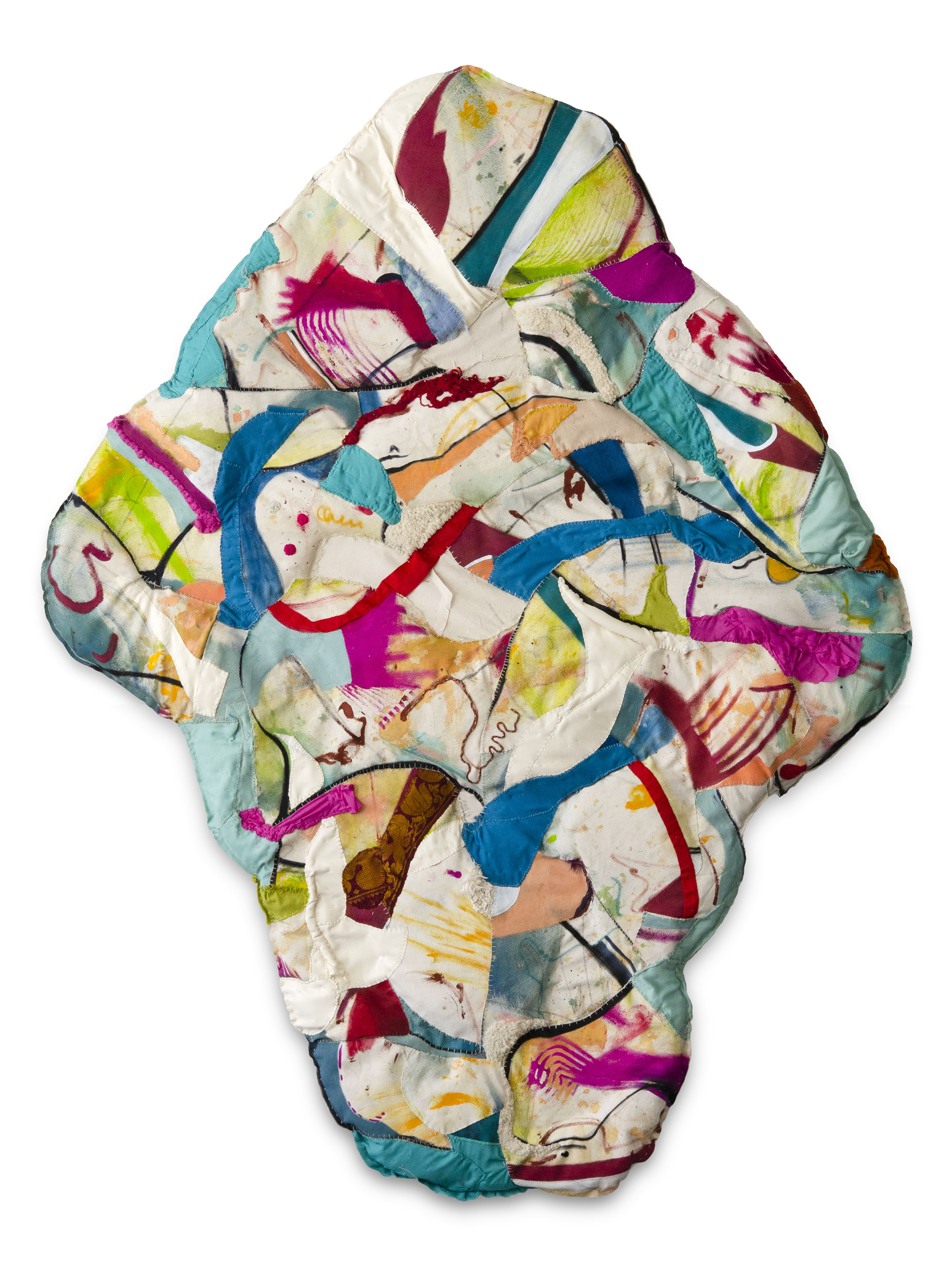
Above: Emma Balder, Harmony, 2020. Recycled fabrics, rope, bungee, paper, acrylic, and thread on canvas, 40 x 81 x 3″. Courtesy of the artist. Photo by Jay Marroquin.

By Alexandra Goldman

This month I was excited to be connected for a virtual studio visit with Houston-based artist Emma Balder by my friend, colleague, and mentor, Dr. Jose Falconi, Lecturer of Latin American art at Brandeis University.

Balder was born in Boston in 1990. She grew up curiously watching her mother sew costumes for her and her siblings, and as a young teen experimented with cutting up and sewing her own clothing. She later earned her BFA from SCAD with a background in painting, and has since shifted toward heavily incorporating sewing and fiber art into her practice using recycled materials.

Emma Balder’s studio, Houston, TX. Courtesy of the artist.

She began integrating textile waste into her practice during her formative year-long residency at the Vermont Studio Center, where she was given bags of the recycled scrap cloth material as a gift by a fellow resident who had an excess of it and couldn’t take it traveling overseas. Since then, Balder has continued to collect textile waste from seamstresses and fashion designers. “There is so much waste, and it bothered me, but I saw beauty in it,” Balder noted. Additional examples interesting artists who work with recycled textiles include Tamara Kostianovsky and Linda Friedman-Schmidt. The interpretations of the medium by these three artists is vastly different, showing off its vast potential.

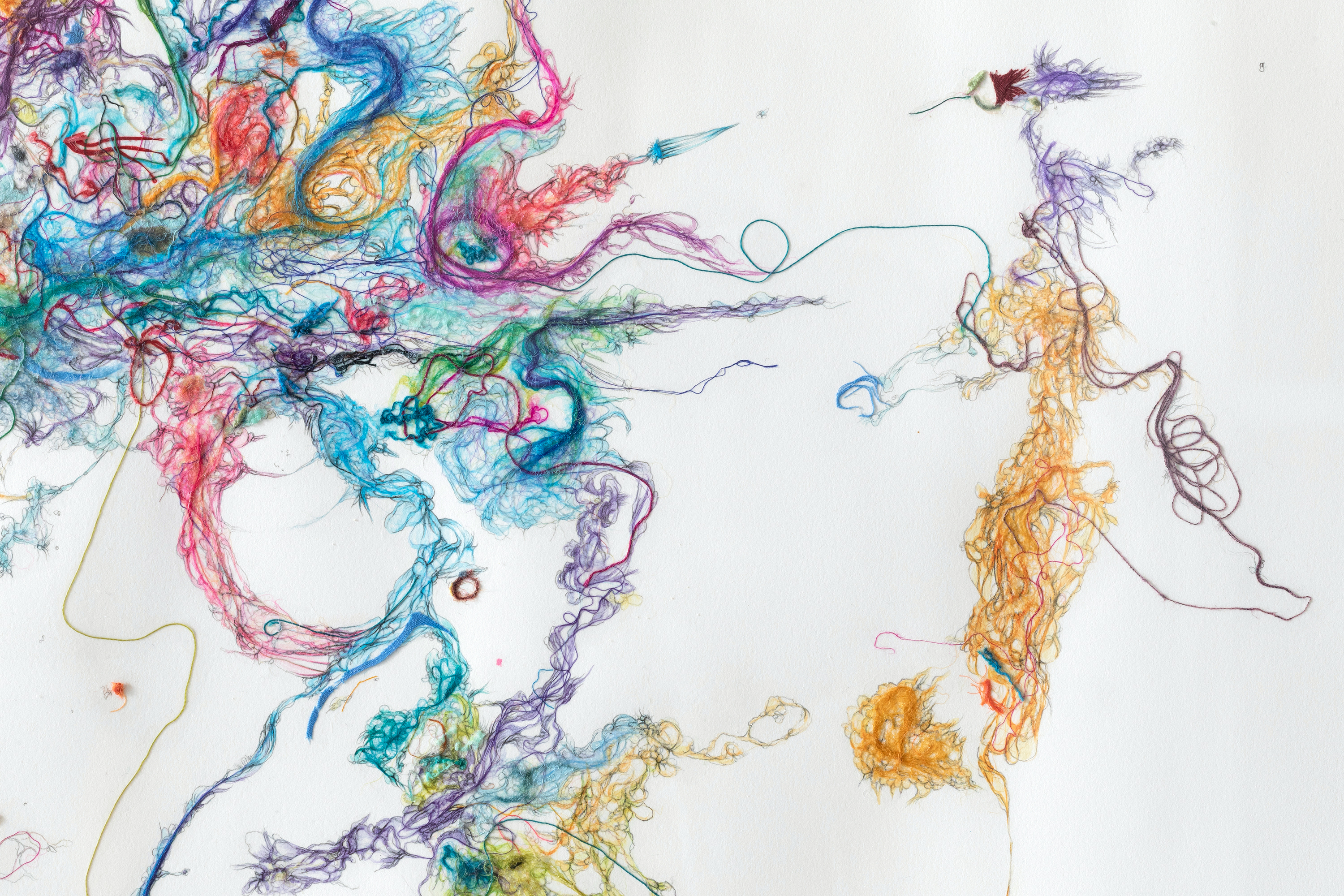
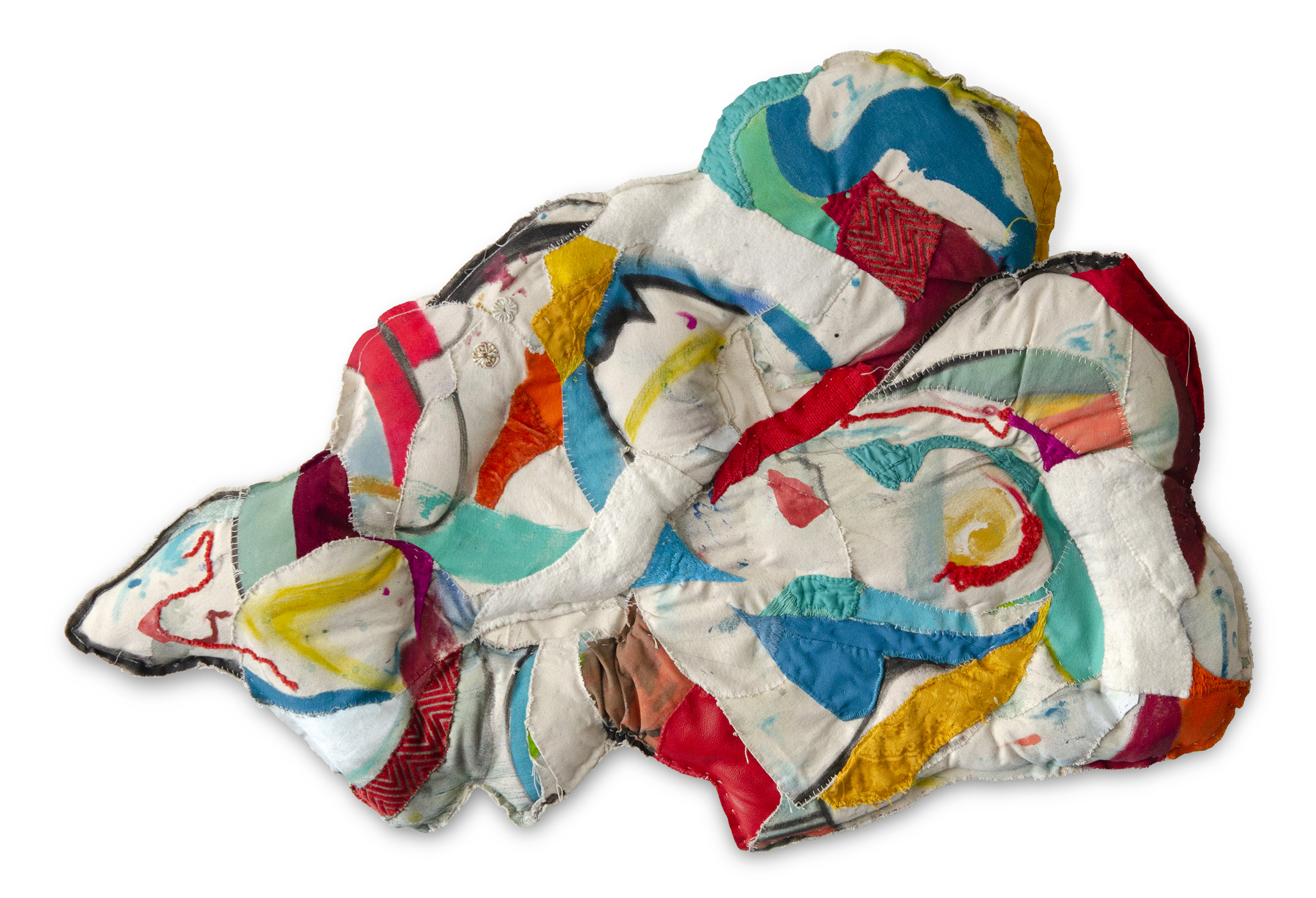
Her colorful organically shaped works fall into two main categories: “Pinglets”, which are (often stuffed) three-dimensional wall pieces that Balder creates by completing a painting, cutting it up, and re-stitching it together in new compositions mixed with other recycled textiles, and “Fiber Paintings”, in which Balder “paints” on paper and panel with colorful thread, using the thread itself as the paint. A fervent environmentalist, working with recycled fiber materials is of utmost importance to Balder.

Emma Balder, Magnet of Hope (detail), 2019. Fibers, graphite, acrylic and micron on paper, 30 x 40″. Photography © Jay Marroquin; Artwork © Emma Balder

On her website, Balder notes, “The Pinglet project documents a process of regeneration. This project began with the physical deconstruction of one painting, the Ping. The disjuncture of parts were then rearranged and reconstructed with needle and thread to form small baby paintings, called Pinglets.” Pings are usually abstract landscapes of around 12 x 8 ft. Balder knows to cut up the Ping at the moment she is satisfied with it, believing the moment that you become complacent, it is time to catalyze change and reignite the creativity that comes from vulnerability.

Following our studio visit I’ve come to understand why Balder has named one of her main artwork styles a made up word such as a “Pinglet”: Balder is principally interested in creating artwork as a manifestation of her own world on her own terms: a place to escape to and live in; both a new world and a new home. In a Derridean sense, this logically begins with creating and defining her own language to refer to her new world without relying on preexisting terms. In her work she creates a beautiful synergy by deconstructing and reconstructing both the physical materials she is utilizing to create the works, and the language she uses to describe them.

Emma Balder, Remains 2, 2020. Fabric, paper, wool, yarn, acrylic and thread on canvas and linen, 29 x 38 x 3″. Photography © Jay Marroquin; Artwork © Emma Balder

Pinglets are filled with vibrant bursts of shape and color caught in a balancing act throughout the composition channeling an unlikely yet successful combination of Vasily Kandinsky and Howardena Pindell. The Pinglets look like stuffed animals in the shapes of clouds, human organs, puddles, or the symbols for hills in Aztec Codices. Balder’s work also visually recalls the legacy of Marta Minujín and her stuffed, bright hanging wall pieces that look like Fruit Stripe gum got into a pillow fight. The difference is that Balder’s gum is chewed.

Both Balder’s Pinglet and Fiber Painting abstractions appear to be dancing or blowing in the wind. They are free, and Balder found both freedom and home in the creation of her own combinations and interpretations of media that don’t stick to traditional definitions of painting or sculpture.

Emma Balder, Juggling, 2020. Fibers, graphite, acrylic, and micron on paper, 22 x 30″. Photography © Jay Marroquin; Artwork © Emma Balder

Interestingly, when asked about her main artistic inspiration or influence, Balder, without hesitation, mentioned that she is often thinking about and inspired by Catalan architect Antonio Gaudi. As a Barcelonaphile who has experienced Gaudi’s architecture in person, this resonated with me on multiple levels: bright playful colors, organic forms, structure, and the fact that architecture can be a site where art, home, and nature coalesce. Balder’s works are each like small architectures.

Through our conversation, I learned that Balder intends to generate the abstract feeling of home throughout her oeuvre. I asked her if she wouldn’t mind revealing the source of the importance of home in her work. She mentioned she moved around a few times as a child, and what she always missed most and returned to in her mind was her favorite place: the natural environment that surrounded her first house, where she would play amidst a cluster of trees, have secret meetings with friends or siblings, and carve into or decorate the tree trunks. She felt at home in nature, in these trees, more than the house itself. If you look at Balder’s Pinglets, they are formally reminiscent of horizontal slices of tree trunks.

Emma Balder, Remains 3, 2021. Recycled fabric, wool yarn, graphite, embroidery, ink, acrylic and thread on canvas, recycled fiberfill and foam filling, 30 x 42 x 3″. © Emma Balder

Balder’s commitment to the environment has also attracted the attention of large brands. She was selected in 2019 by PepsiCo as one of the three environmentally-focused artists chosen to have their artwork featured on the series of 100% recycled plastic LIFEWTR water bottles. Sweeping visuals of Balder’s Fiber Paintings can still be found on the bottles today. The series marked a moment of transition for LIFEWTR to go from using regular plastic bottles to recycled ones. While it is still not good for the environment to have single-use plastics in circulation, the massive shift of a company like Pepsi to transition their bottles from new to recycled materials is a step in the right direction. Last week I serendipitously came across Balder’s LIFEWTR bottle at JFK Airport en route to Miami, and was thrilled to have the chance to take in the visual of it with in-depth insight into Balder’s practice, rather that looking at it as an image on a product without context.

LIFEWTR Series 9.3 “The Art of Recycling”, Emma Balder, Image courtesy of the artist.

Looking ahead as Balder continues to develop her practice, she desires to focus even more intently on creating space, and inviting viewers in. “I don’t know how much longer the wall is going to serve me. I have been playing around with sculpture, and I would really like to create an immersive space where the viewer can feel like they are part of that world, and feel that sense of coming home,” she revealed. I look forward to seeing the worlds Balder has in store.

Emma Balder, Watching the World Turn, 2021. Recycled fabric, webbing, wool yarn, paracord, thread, hand embroidery, acrylic on canvas, recycled foam filling, 78 x 60 x 3”. © Emma Balder

Merry Polish Christmas: The Tenth Anniversary of Olek’s “Project B (Wall Street Bull)”, 2010

Above image: Olek installing Project B in 2010. Image courtesy of Olek on Vimeo.

By Alexandra Goldman

If you never saw it in person, you’ve probably seen an image of Project B at least once. The original guerrilla art installation was only up for a few hours before it was taken down by the city, but its viral visuals live forever online. For the ten-year anniversary of Project B this Christmas, I’ve decided to take a closer look at the project and the person who created it, the Polish artist Olek, née Agata Oleksiak, (b. 1978, Staszow, Poland). I’ve found it is a story about ritual, iconoclasm, and two different New York-based immigrant artists who wanted to see the United States doing well. It’s also strongly connected to Olek’s Polish roots.

Charging Bull has become a known site of protest on its own in New York and the subject of several acts of iconoclasm, especially since the 2011 Occupy Wall Street movement. It has had paint doused on it in 2017, and had dye poured on it, and its head bashed with a spiked banjo in 2019, for causes ranging from anti-financial corruption, to protecting the environment, to anti-Trump demonstrations. Because of this, there is a current conversation about relocating it. Olek’s wrapping of the bull with yarn has been the most peaceful form of altering the statue while still having a big impact. It is similar to how the artist Dustin Klein created a light projection of a portrait of Breonna Taylor to project onto the controversial statue of Robert E. Lee in Richmond in July 2020 as part of the BLM movement. Both yarn and light can be used as peaceful strategies for acts of iconoclasm on monuments.

Olek installing Project B in 2010. Image courtesy of Olek on Vimeo.

For background, in 1989, Italian immigrant sculptor Arturo Di Modica (b. Sicily, 1941) originally installed Charging Bull on Wall Street at Christmas time. He had a studio on Crosby street, and without city permission he and a group of friends delivered by truck the self-funded sculpture in front of the New York Stock Exchange. He intended the sculpture of the known market symbol as a “Christmas gift” to the city symbolizing “the strength and power of the American people”, two years after the October 19, 1987 stock market crash known as “Black Monday” (the worst crash since 1929). Within hours, Charging Bull was removed by the city and taken to a warehouse for storage, before it was later legally relocated to Bowling Green.

Twenty-one years later, at around 2:00 am on Christmas Day 2010, without city permission, Olek wrapped Di Modica’s sixteen-foot, 3.5-ton, bronze Charging Bull with bright pink (with hints of purple, teal and gray), camouflage-pattern, hand-crocheted yarn that they created without assistance. Olek titled the guerrilla intervention Project B or Project B (Wall Street Bull), which is actually absent from the majority of articles about the project.

Replicating Di Modica’s timing, two years after the severe 2008 market crash and also at Christmas time, Olek revived Di Modica’s original guerrilla intervention through Project B by wrapping Charging Bull with their camouflage crocheted yarn. Similar to Di Modica, Olek considered Project B their “Christmas gift” to the city or a “Christmas sweater” for the bull, in effort to uplift the country following the most recent financial crisis. According to the artist, Project B was a symbolic public gift for all those who couldn’t afford holiday presents that year or were unable to visit their families. Olek’s strategic reenactment of Di Modica’s timing (both after the financial crash and time of year), guerrilla-style action, and gift-intention categorize Project B an act of ritual. Olek later confirmed that it was a ritual, and prior to wrapping Charging Bull with yarn, they carried out a series of Polish Christmas rituals: “Christmas eve is a special day for Polish hearts. That night, animals speak human voice. I cooked a traditional dinner, and went to pasterka (midnight mass),” they explained.

The idea of revitalizing statues through ritualistic actions such as wrapping them with colored cloth is not new. It even dates back to Ancient Egypt, during which kings and priests would drape colored cloths around statues of deities during their daily offering ritual ceremonies to the gods to revive their ka, or, inner spirit. In Ancient Egypt, the colors of the cloths during the daily ritual had specific meanings for the ceremony to either refresh the deity (green cloth) or reaffirm its holiness (red cloth).

Olek’s use of the color pink for ritual cloth statue wrapping, when combined with the historically feminine medium of crochet, has given cause for some to consider Project B a political, iconoclastic act by the artist amidst Wall Street’s hyper-masculine environment. While noting Olek prefers to avoid the limitations of categorizing their art as “yarn bombing”, yarn bombing (street art involving yarn), is historically rooted in third-wave feminism during which domestic arts were celebrated. Project B is therefore on one hand, Olek’s public critique of the imbalance of the hyper-masculine environment of Wall Street and the failures of power imbalance.

However, rather than pitting the genders at war with one another through Project B, Olek was expressing maternal caretaking, the need for balance, the importance of self-love, and love of others. Olek, an immigrant from a formerly communist country, felt the need to symbolically take care of a failing capitalist system and lift it back up. Olek created a Yin-Yang duality whereas before there was only Yang energy.

Olek also believes all art is a self-portrait. Through spiritual exploration, Olek identified in recent years as gender nonbinary and considers themself to be a “two-spirit being”, fully male and fully female simultaneously. Wrapping the masculine, muscular, bronze bull with the feminine, soft, pink, crochet resulted in the temporary creation of a powerful, mirroring, two-spirit being in the public space of NYC’s Financial District.

Olek hugging Project B. Image courtesy of Olek on Vimeo.

Furthermore when I first met Olek at Art Basel Miami Beach last year, I became interested in their work because it immediately felt very Polish to me, and I was interested in the fact that none of the articles I was reading about Olek’s work spoke about how Polish it was. I have Polish heritage, and traveled to Poland in 2009.

I was driving from Czestochowa to Krakow in 2009, and noticed all the buildings were Brutalist gray rectangles or squares. However, every so often some stretches of buildings, that seemed to be apartment complexes, were painted over with wide, vertically striped swathes of rainbow colors. I asked my Polish friend why some of the buildings were painted over like this. She replied that after communism fell some cities and towns celebrated by painting buildings bright colors since the government didn’t allow any deviation from uniformity during communism. Similarly, Olek’s art intervention tactic of using a bright burst of color in homogenous gray public space with Project B represents their Polish way of expressing freedom from oppression.

The idea of combining the media of fiber art and sculpture also has roots in Poland. The artist Magdalena Abakanowicz (b. 1930) is a famous Polish sculptor who works with fibrous materials. According to the MoMA, “Abakanowicz and many artists of the Eastern Bloc were drawn to craft and textile traditions as expressive mediums less regulated by Soviet censorship.” When Olek first came to the U.S. with no money in 2000, their sculpture professor at La Guardia Community College also encouraged them to begin sculpting using any material, including yarn.

In our recent Zoom interview, Olek explained that while growing up in communist Poland, being an artist – or expressing individuality of any kind – was highly discouraged, and art galleries and museums were reserved for the elite. Olek believes they never could have fully become who they are as an artist, or individual, if they had stayed in Poland and not made the courageous decision to emigrate to New York. While Olek critiqued the failing power imbalance that Charging Bull came to represent with Project B, Project B was also Olek’s renewal of Di Modica’s celebration of possibilities and resilience available in a capitalist country, presented by an immigrant artist who couldn’t have had their career without its benefits. Their own experience of feeling excluded from art institutions while growing up poor in Poland led to their dedication to public art that can be accessed by anyone.

Art and Style: A Photo Essay

By Rose Hartman

For over four decades, I have visited New York’s annual art fairs — from ADAA to The Armory Show — along with many other fairs that showcase galleries’ best and most innovative artists. Artworks look even more exciting when contrasted with the stylish women of all ages (from gallerists, to collectors, to fashionistas who fill the piers, the Armory, lofts, and exhibition spaces) wearing distinctive attire that blends into colors and patterns displayed on the walls.

Artwork: Vanessa German at Pavel Zoubok Fine Art, ADAA 2020

The Armory Show 2020

Artwork: Luisa Rabbia at Peter Blum Gallery, The Armory Show 2020

Artwork: Jiro Takamatsu at Whitestone Gallery, The Armory Show 2020

Artwork: Timothy Curtis at Benda Gallery, The Armory Show 2020

Artwork: Viktor Popovic at C24 Gallery, The Armory Show 2020

Artwork: Amy Schissel at Patrick Michail Gallery, The Armory Show 2020

ADAA 2020

ADAA 2020

Artwork: Nina Chanel Abney at Pace Prints, ADAA 2020

Artwork: Vanessa German at Pavel Zoubok Fine Art, ADAA 2020

Rose Hartman. Photo by Marsin Digital.

For the past four decades, Rose Hartman has photographed the rich, the famous and the stylish in some of the most legendary settings of New York nightlife, from Studio 54 to the Metropolitan Museum’s Costume Institute Gala, fashion shows, and models backstage. Her arresting pictures have been published in countless international publications, including Vogue, Stern, Harper’s Bazaar, Vanity Fair, Panorama, the NY Times, New York, & Art & Auction. Hartman’s photos have been exhibited in international galleries from Beijing to Moscow. Her iconic photos are currently on view at the Morrison Hotel Gallery in SoHo and at The Brooklyn Museum in a group exhibition titled, “Studio 54: Night Magic,” open from March 13—July 5, 2020.

Molars in the Sky

By Alexandra Goldman

“I paint with my left hand,” Brooklyn-based Canadian artist Krista Louise Smith explained, after telling me about chronic pain that she experiences in her dominant right hand due to a rare nerve condition. Rather than feeling discouraged that her pain makes it difficult for her to paint righty, Smith has instead embraced the soft, childlike freedom that for her, could only have emerged with her less controlled, left hand painting. “With my right hand, I tended to be neurotic, second-guessing every brushstroke. With my left, I don’t impose those same judgments on myself, and let the paintings unfold more organically.”

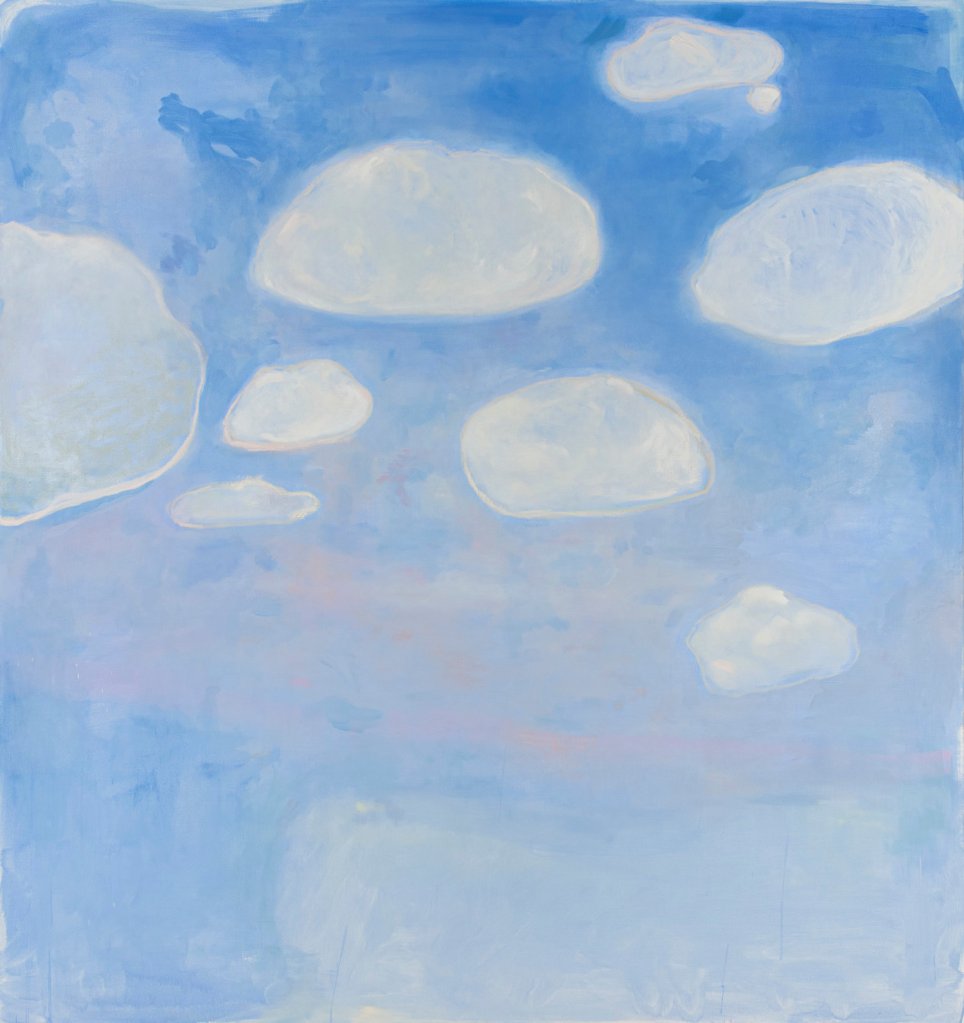
Krista Louise Smith, Blue Dream, 2019. Oil and acrylic on canvas, 72 x 68 inches.

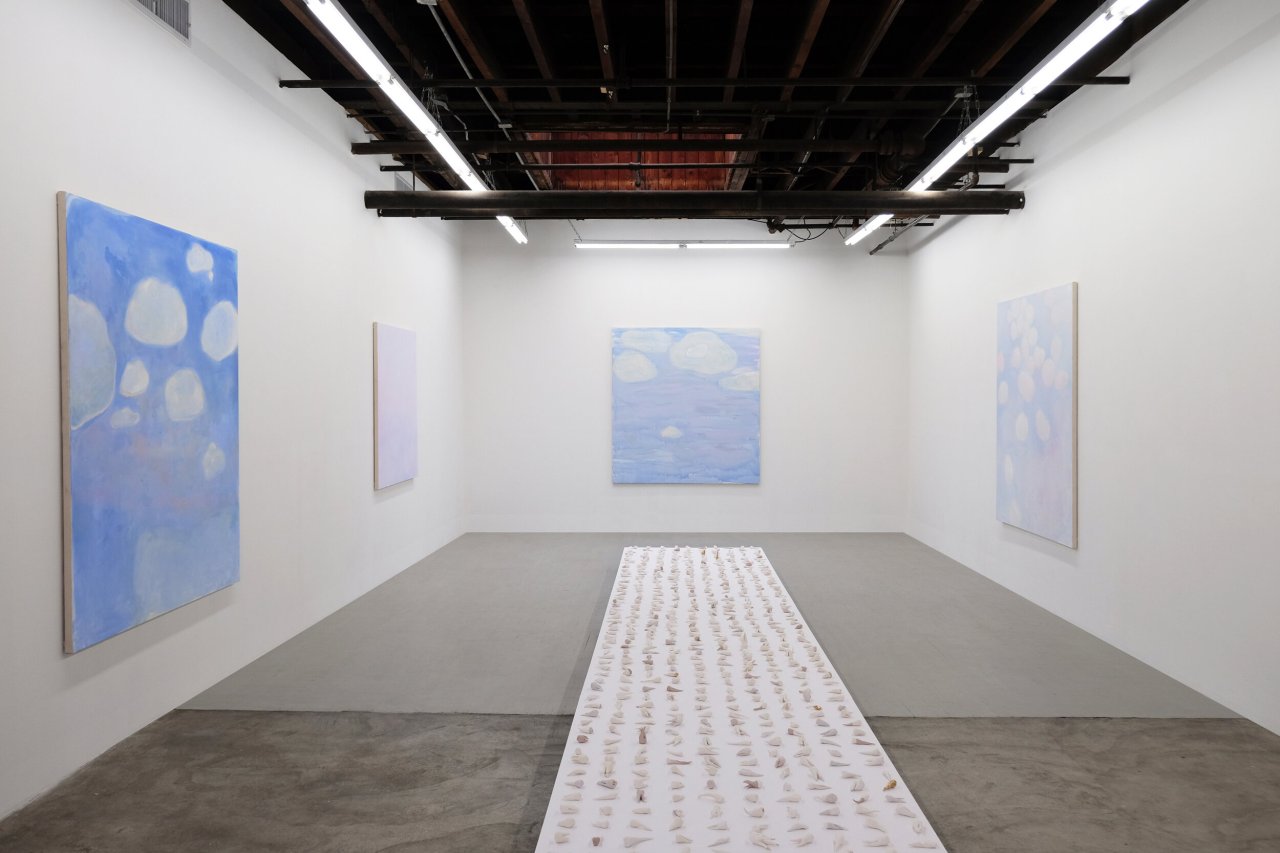
Softness is arguably an important quality when depicting clouds, Smith’s chosen subject matter for her newest body of work. Her older work tended toward more realistic paintings and sculptures that represented the human figure. The new paintings feature mostly perky, individual clouds in layered, glowing cotton candy atmospheres, that exist somewhere between a cartoon realm and an idea of a cloud in the mind’s eye rather than a photorealistic cloud or background of a Turner painting. “I paint with colors that I like and naturally gravitate toward, like baby blues and pinks,” Smith said, reaffirming the self-judgment-free nature of her current artistic process. The exhibition title, Sonnets of the Subconscious, in which the paintings are now on view at Carvalho Park in East Williamsburg, reinforces the idea that the works don’t necessarily depict the literal physical world.

Krista Louise Smith, Lavender Night, 2020. Oil and acrylic on canvas, 56 x 54 inches.

In Smith’s painting Lavender Night, a glowing tiny moon and subtle surrounding stars peek through a layer of whitewashed ultraviolet altostrati. She creates a sublime creamy world like that in Matthew Wong’s 2019 painting Morning Mist on view earlier this winter at Karma Gallery.


Krista Louise Smith, Float, 2019. Oil and acrylic on canvas, 72 x 68 inches.

In a recent studio visit with Smith, she shared that the only components of each painting she pre-plans are the general composition, and her color palette, which she assembles in advance by collaging paint swatches and pinning them to the wall. “The color palette I choose sets my parameters for each painting and it’s how I create cohesion in the piece as opposed to working with line.”

Krista Louise Smith, Dayglow, 2020. Oil and acrylic on canvas, 72 x 68 inches.

Dayglow is a good example of one of Smith’s paintings in which she uses oil crayon and pink/blue color layering to create texture and depth. While her brushstrokes are visible, the work doesn’t rely on the bravado of the gesture for its strength. Instead her hand creates a believable atmosphere, like a thick pastel humidity that you can breathe in.

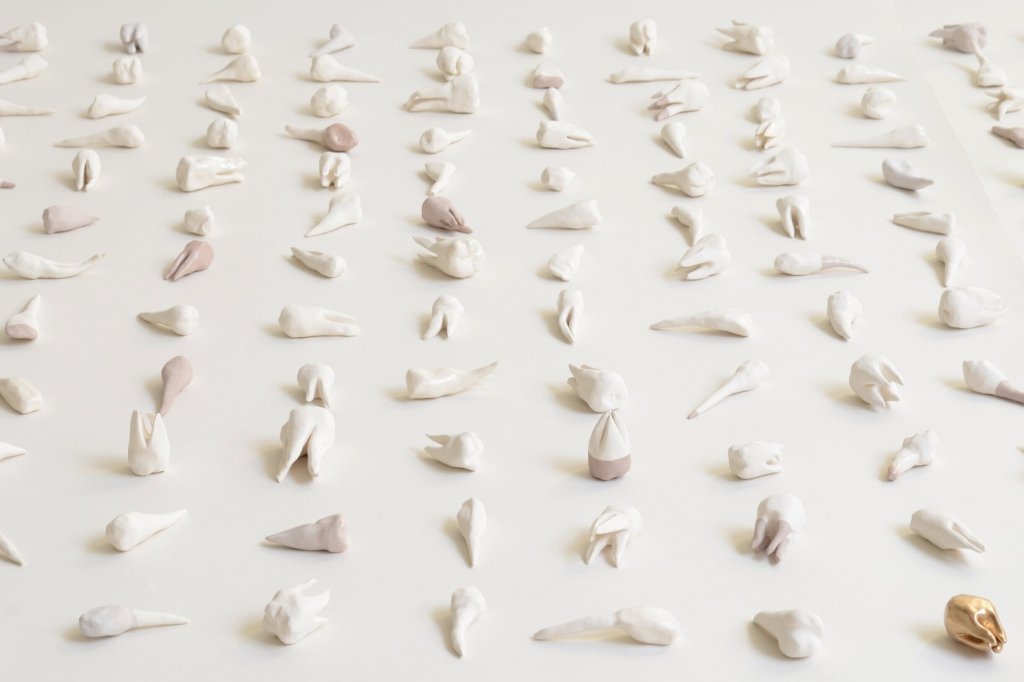
Krista Louise Smith, Bad Dreams (detail), 2018 – 2020. 680 ceramic sculptures, dimensions variable.

In the center of the gallery, enveloped by Smith’s transcendent womb of cloud paintings, rests a floating plinth that supports Bad Dreams, a choreographed grid of 600 ceramic sculptures of abstracted teeth. The sculptures look like little living organisms that are about to jump up and begin dancing a tooth ballet the moment no one is watching. “I was going to the dentist a lot, and had teeth on my mind,” Smith explained. There is a refreshing purity, simplicity and directness that Smith translates into her artistic decisions.

Krista Louise Smith, Bad Dreams (detail), 2018 – 2020. 680 ceramic sculptures, dimensions variable.

Smith’s teeth and clouds also strangely resemble each other. The tops of some of the ceramic teeth look like little clouds, and some of Smith’s clouds looked like molars in the sky. Each ceramic tooth sculpture is unconventionally painted with acrylic paint made for porous surfaces rather than traditional glaze, which gives them a silky smooth pottery quality. As in the artist’s own mouth, there are a few gold teeth that punctuate her sculpted dental display.

Sonnets of the Subconscious is on view at Carvalho Park until March 15.

All images in this article courtesy of Carvalho Park.

John Torreano: Dark Matters Without Time at Lesley Heller Gallery

Above: John Torreano: Dark Matters Without Time (installation view, Lesley Heller Gallery, New York, 2018). © John Torreano courtesy Lesley Heller Gallery.

By Jonathan Goodman

Now in his late seventies, painter and sculptor John Torreano has been well known as an artist for half a century. He is recognized particularly for his inclusion of acrylic gemstones in his art. His studios are set up in New York and Abu Dhabi, where he has been teaching in the last few years. In this show at Lesley Heller Gallery, Torreano is exhibiting both paintings and wall reliefs; he remains an unrepentant abstractionist, someone whose art connects with the well-established history of the New York School. His synthetic gemstones, though, add a bit of decorative play to his nonobjective language; because of their artificial character, the gems provide Torreano’s efforts with a partially ersatz character that undercuts the high romance of the abstraction. This is likely a good thing, late in the second decade of the twenty-first century, as we seem to have tired of the idea of noble motives alone. But, whatever the intentions behind the paintings and wall reliefs, we see that Torreano is not only a craftsperson of note, he is also an esthetician of considerable ambition. His works stand out both as examples of skill and as efforts meant to communicate a paramount belief in beauty. Perhaps his experience in the Middle East is leading him further in the direction of beauty; the long horizontal wooden panel painting, titled Sea Sky Gold (2018), feels like it owes its exquisite colors–dark blue and gold–to a geography we do not find here in New York.

JohnTorreano_SeaSkyGold_2018_300dpi (1)John Torreano, “Sea Sky Gold,” 2018. Acrylic paint and gold leaf on plywood 45 x 180 inches. © John Torreano courtesy Lesley Heller Gallery.
Sea Sky Gold is the major work of this excellent show. Its dimensions are more than considerable: 45 by 180 inches. The work consists of four panels of deep blue, with numerous oval gouges, clumped in groups and covered with gold. Its appearance begins with a surface of decorative flair, but then moves beyond that to a place of elegance and artistry (not that decoration always excludes such qualities!). Torreano appears to have learned something about the inherent attractiveness of well-appointed color–an insight evident throughout the exhibition. The danger exists that this painting, a genuine tour de force, would end up overwhelming the show, but this doesn’t happen; instead, it serves as an anchor for a body of works that cumulatively appeal to the audience. For example, DM’s & Hot Stars (2015), a large painting in a small space at the front of the gallery, works its effects seamlessly within an allover compositional field. The squared painting, consisting of four large panels, exists in a matrix of organically shaped contours–mostly tan and blue, with a bit of black. Although the work’s title skews it toward science, it very much exists within the established language of abstract expressionism. It can be easily argued that we have been revisiting this movement too often and too long, but, as still happens regularly in New York, Torreano’s painting establishes itself without bowing excessively to the past.

JohnTorreano_DarkMattersWithoutTime_2018_InstallView04_300dpiJohn Torreano: Dark Matters Without Time (installation view, Lesley Heller Gallery, New York, 2018). © John Torreano courtesy Lesley Heller Gallery.

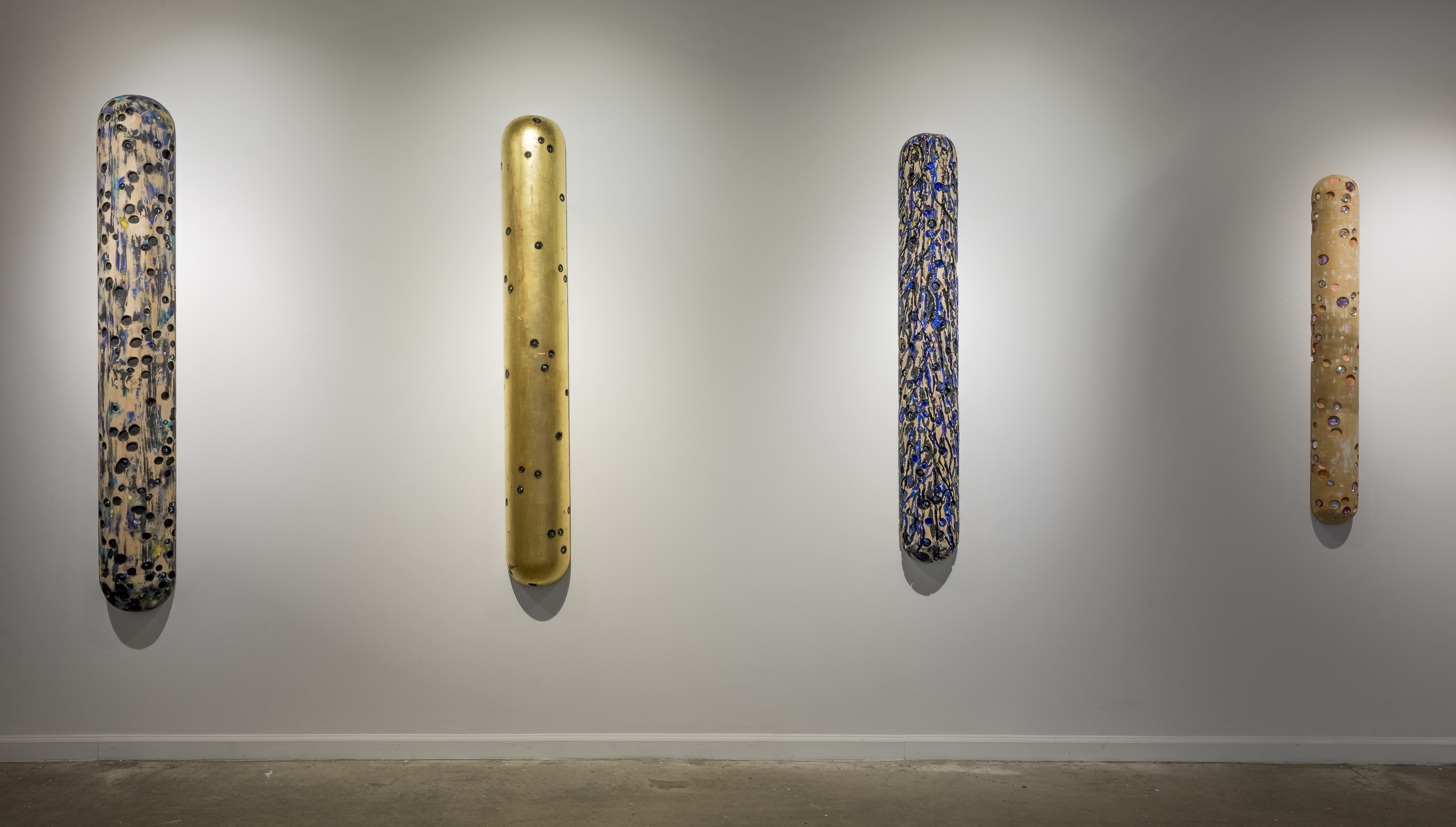
The column wall sculptures–thin sticks of color studded with mock jewels–look at first like objects of deliberate desire (they range in dates from 2014 to 2017). And so they are, up to a point! These four works, arranged on a side wall, descend slightly in size from left to right. The acrylic gemstones stud all of them, adding to the surfaces’ sculptural intricacy and presenting an alluring, albeit entirely synthetic, exterior. They do enact a singular attractiveness, but that doesn’t really matter–what counts is the artist’s willingness to undercut the abstraction with an imagery that clearly is counterfeit. This is likely an attempt to remain resistant to the pull of something overly attractive. Even as the show refers to high culture, there is a healthy disregard for its imagistic excesses, driven as they are by ego here. But, at the same time, for the more seasoned among us, the use of such fakery causes some anxiety–at what point does the falsehood take over and make barren the eminent history that precedes it? This is a question for philosophers and art historians more than it is a query for the general public, composed as it is of artists and, usually, connected viewers who want the simple chance to enjoy what they see. Torreano’s art does this wonderfully well, providing admirers with the chance to lose themselves within a language both established and new. And his slight disregard for the fulsomeness of New York’s painterly past is a welcome reminder of its historical limitations.

View John Torreano: Dark Matters Without Time at Lesley Heller Gallery through Sunday, April 8, 2018.

Screen Shot 2018-03-28 at 11.55.18 AM.png

Jonathan Goodman is an art writer based in New York. For more than thirty years he has written about contemporary art for such publications as Art in America, Sculpture, and fronterad (an Internet publication based in Madrid). His special interests have been the new art of Mainland China and sculpture. He currently teaches contemporary art writing and thesis essay writing at Pratt Institute in Brooklyn.

Louise Bourgeois’ Legacy: Four Living Women Rocking Surrealism

Above: Installation View, “Louise Bourgeois: An Unfolding Portrait” At MoMA. Image © Artifactoid. 

I love artwork by Louise Bourgeois. Her recent show at the MoMA was beautiful and you can see her sculptures in the permanent collection  at Dia: Beacon. Up to and following her death in 2010, her dark, sensuous surrealism (consciously or not) continues to influence a new generation of artists. While not always as heavy nor activist as Bourgeois in their subject matter, these artists each reference certain elements of her style in original ways. Here are four that are remarkable.

1. Rita Ponce de Leon (80m2 Livia Benavides)

Rita Ponce de Leon, image from the drawings on paper series, “Nuestros, Nosotros,” 2015. 25 x 25 cm each. Image © Rita Ponce de Leon courtesy 80m2 Livia Benavides.

Rita Ponce de Leon‘s  (b. Lima, 1982) work comprises surreal drawings and sculptures that gain power from their delicate intimacy. She works with pen on ink, clay, and Papier-mâché among other media. Last year I saw her beautiful installation at Proyecto AMIL in Lima that showcased many of her techniques, including heated sculptures to hold in your hands and drawings directly on the wall that scaled from floor to ceiling in the ample exhibition salon. Ponce de Leon is represented by Galeria 80m2 Livia Benavides based in Lima, Peru.

2. Geng Xue (Klein Sun Gallery)

Geng Xue, “Oceans Roar,” 2016. Porcelain and sound installation. 39 3/8 x 13 3/4 x 7 7/8 in. Image © Geng Xue, courtesy Klein Sun Gallery.

Geng Xue‘s (b. China, 1983) visceral ceramics captivate the imagination and bring us closer to our humanness. Attuned to sensory experience, Geng Xue often incorporates elements such as sound into the works, as in the above pictured piece, “Oceans Roar.” Geng Xue also creates animations that bring the pieces to life.

3. C.J. Chueca (Y Gallery)

Ceramic,  9 1/4 × 3 1/2 × 2 in, 23.5 × 8.9 × 5.1 cm, Unique. Image © C.J. Chueca and Artsy.

C.J. Chueca (b. Lima, 1977) grew up moving nomadically between Perú and México, where she frequently came into contact with homeless people, nursing home residents, and psychiatric patients. According to a 2016 exhibition essay on her work authored by critic Eleanor Heartney, these experiences “stoked a deep sympathy for the dispossessed” in Chueca. Chueca’s porcelain wall reliefs are portraits of homeless men and women from her memory, modeled after assemblages of found objects.

4. Jasmine Little (Johannes Vogt Gallery)

larger.jpg

Installation view, “Hoodoos,” at Johannes Vogt Gallery. Image © Johannes Vogt Gallery.

Jasmine Little (b. Virginia, 1984) is a technically gifted surrealist painter and sculptor whose works draw from emotion, memory and nostalgia rather than physicality. While most often related to Chagall or Matisse, there is something about the visual style and sensitivity of the pieces that recalls Bourgeois for me. Little is currently having a solo show, Hoodoos, at Johannes Vogt Gallery on the Lower East Side through April 28th, 2018.

When 1960s Sci-Fi and Surveillance Collide in 21st Century Sculpture: Björn Schülke Vision Instruments at bitforms gallery

Above: Björn Schülke, Beam Engine #1, 2016, Brass, mirror, paint, electronics, solar cells, motors, laser, 7.1 x 15 x 9.9 in / 18 x 38 x 25 cm

This article was originally published in Whitehot Magazine

Would there be world peace if aliens attacked Earth? After all, doesn’t everyone get along better once they share an enemy?

In the divisive global political environment confronting us, I find myself wishing for the aliens to appear.

I started thinking about this after learning about Raumpatrouille Orion, or, “Space Patrol Orion,” (1966), the first ever German science fiction TV series, which inspired Vision Instruments, a collection of sculptures by Björn Schülke currently on view at bitforms gallery on NYC’s Lower East Side. According to bitforms gallery, Raumpatrouille Orion reflected a certain Cold-War era global attitude of idealistic utopianism, and the mentality of conquest and emphasis on space travel, which is also present in a lot of Schülke’s work.

Schülke was born in Cologne, Germany in 1967. Perhaps as an artist he was drawn to exploring the collective psychology of the environment into which he was born, utilizing Raumpatrouille Orion as his case study. But, what can we learn from Raumpatrouille Orion now? I think that some of the answers might lie in what else Björn Schülke focuses on in his sculptures.

Björn Schülke, Vision Machine #8 , 2016, Brass, steel, wood, mirrors, paint, camera, display, sensor, electronics, 15.75 x 11.8 x 14.2 in / 40 x 30 x 36 cm, Edition of 3, 1 AP (variant)

The other central theme of much of Schülke’s work is questioning the ways in which we interact with technology. To us in 2017, the “technological frontier,” its own universe without borders, can be compared to the physical universe within which exploration was idolized during the Cold War. At that time, we worshipped astronauts like rock stars. Today, we worship tech innovators like rock stars. That is absolutely not to say that we have stopped revering our astronauts, but rather to say that when it comes to astronauts versus tech innovators, the media has switched their “it girl” over the decades and the technologists are their latest sweetheart.

So, how are we interacting with technology, this thing that we worship? I think that one thing that Schülke is trying to say with his art is that we are giving it too much power.

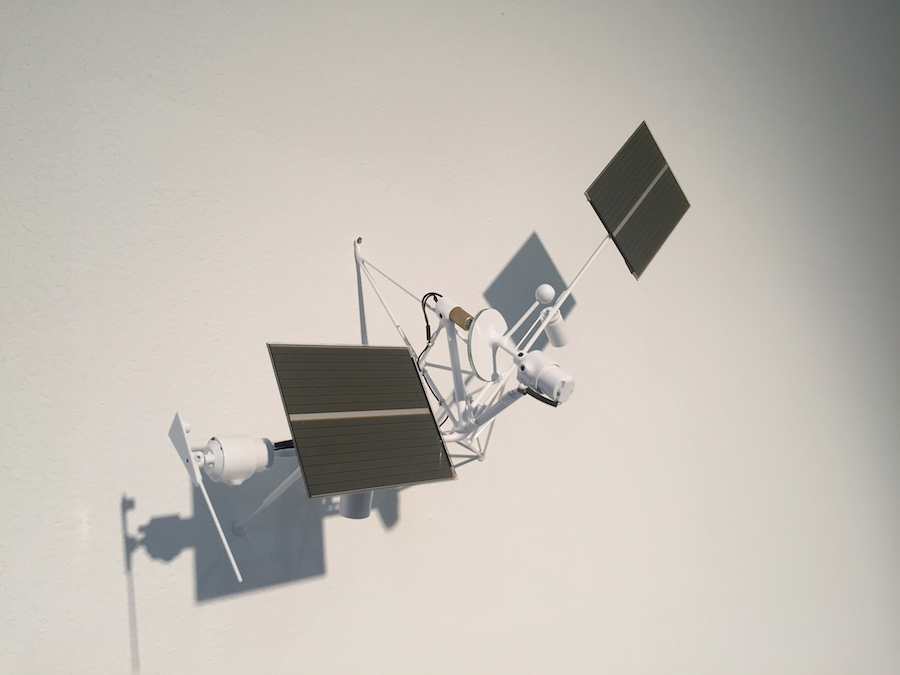
His shiny, white, mechanical, stick bug shaped kinetic sculptures range from about the size of a football to the size of a refrigerator, and are mounted on the walls, floor, and ceiling of the gallery, surrounding viewers from all sides. They each have unique sleek, futuristic designs, but are futile in function, clearly separating them from the product design prototypes of the tech world and setting them firmly in the art category.

Although futile, they each beckon us to interact with them. For example, we look to find our reflections in the tiny circular mirrors that some of them have, and look to see our images picked up by their cameras, even though their cameras are operating in connection with a surveillance system. This evokes the Privacy Paradox, in which we are tempted to upload mass quantities of information about ourselves onto the Internet, almost like a mirror of ourselves, even if it is at the risk of our own security – which we then express simultaneous concern about.

drone9

Björn Schülke, Drone #9, 2016, Fiberglass and epoxide, wood, mirrors, aluminum, display, camera, electronics, sensors, video transmitter, 43.4 in / 110 cm, height, 118.2 in / 300 cm, diameter

In addition, many of the sculptures are equipped with small solar panels that take in light and charge the small batteries within them. Once the charge of the battery reaches a certain level of fullness, the sculpture moves, and is brought to life, like a little anthropomorphic creature that we created, but that now has a mind of its own and operates without our assistance, catching us off guard.

This is not the first time I have seen the issue of surveillance explored in art. In fact I have seen it utilized many times, and have written about it on several occasions as I consider it one of the interesting current themes that the global creative community is having an active discourse about. You can see some of my prior explorations of this topic in my articles about The Privacy Paradox 2016 group show at Reverse Gallery, the artist Joel Holmberg at New Museum, the artist Lorraine Oades and her project TV Tracker (a part of a 2015 group show of artists from Quebec at Knockdown Center). To note, there is also a radio show on NPR right now called The Privacy Paradox.

unnamed

Björn Schülke, Supersonic #3, 2008, Fiberglass, plywood, steel, motion sensors, theremin, woofer, tweeter, amplifier, paint 22 x 46 x 15 in / 56 x 117 x 38 cm

So, back to my original question, what can we learn today from Schülke’s revival of ideas from Raumpatrouille Orion? I think that the obvious conclusion is that while it was the first German sci-fi television show, from over fifty years ago, those same issues in the show apply now. Today it seems that it might still require this threatening, alien outside force to attack for all of us humans to band together to achieve peace on earth. What shape and form would that “force” take if the show were remade today? Could it be something like climate change, or related to technology?

Björn Schülke, Drone #9, 2016, Fiberglass and epoxide, wood, mirrors, aluminum, display, camera, electronics, sensors, video transmitter, 43.4 in / 110 cm, height, 118.2 in / 300 cm, diameter

Finally, it is this issue of surveillance resurfacing in both the outer space universe and the technology universe. During the Cold War era of Raumpatrouille Orion, sci-fi fear of aliens was this major allegory for xenophobia, fear of other countries, and fear of apocalyptic nuclear disaster. Sound familiar? At that time, a person might have asked, who are the aliens from outer space who are watching us, spying on us, maybe ready to attack? Today, we could think in those same terms, but digitally. Who is watching us, spying on us, maybe ready to attack, replete with our data?