One Hundred and Fifty Layers of Laura Owens

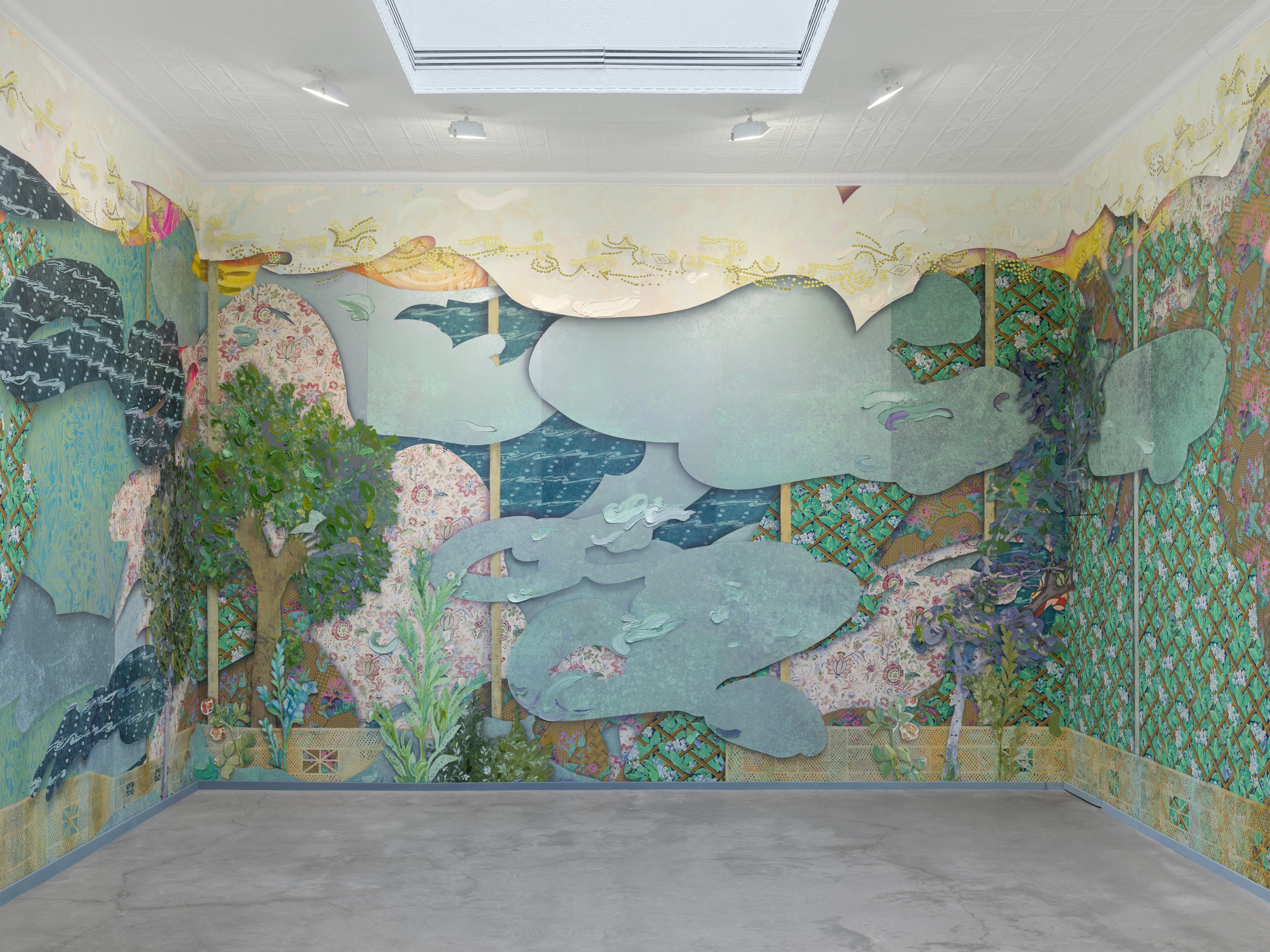
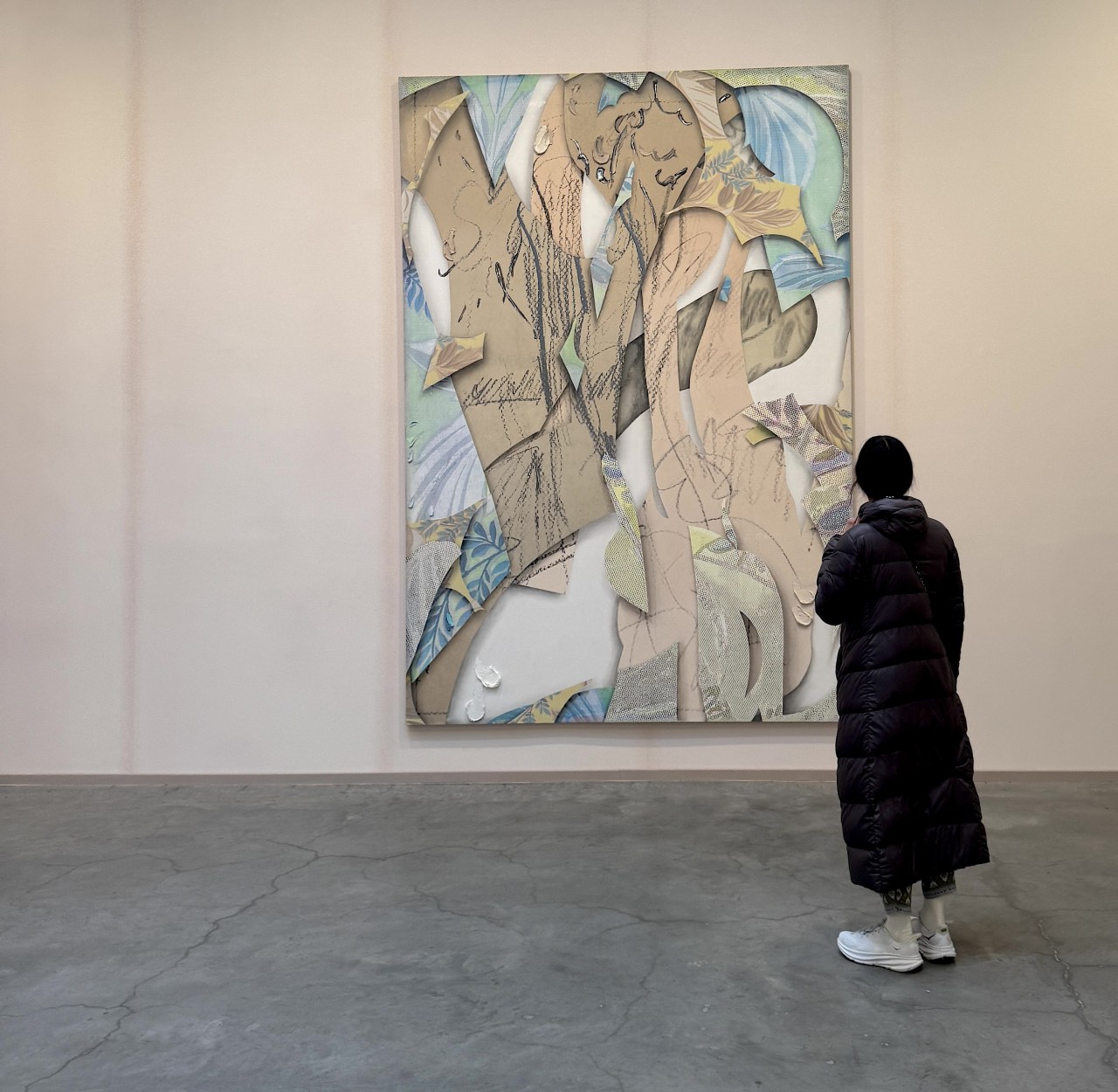
Above image: Installation view of Laura Owens, Matthew Marks Gallery, New York, February 13 – April 19, 2025. Photo by Bailey Coleman.

By Bailey Coleman

“Have you seen Laura Owens yet?”

Opening the door to the gallery I am welcomed by a nearly manic energy. Gallery goers are thrilled with themselves that they have finally made it to Chelsea to see the show everyone is talking about. Laura Owen’s eponymous exhibition at Matthew Marks has been widely lauded as a tour-de force of art making and I was just as excited as those around me to see what all the fuss was about. There is a swarm of people hovering around the gallery attendant’s desk with anticipation as the artist casts her first spell. An older woman with a fresh, blonde, blowout squeals with excitement, as a roll of tape magically moves across the desk. Suddenly, a drawer opens when her friend removes a pen from its holder. Having been witness to these moments of fantasy, we are baptized and free to pass through to the magical world of Laura Owens in her first solo show in New York City since her 2017 mid-career survey at The Whitney. 

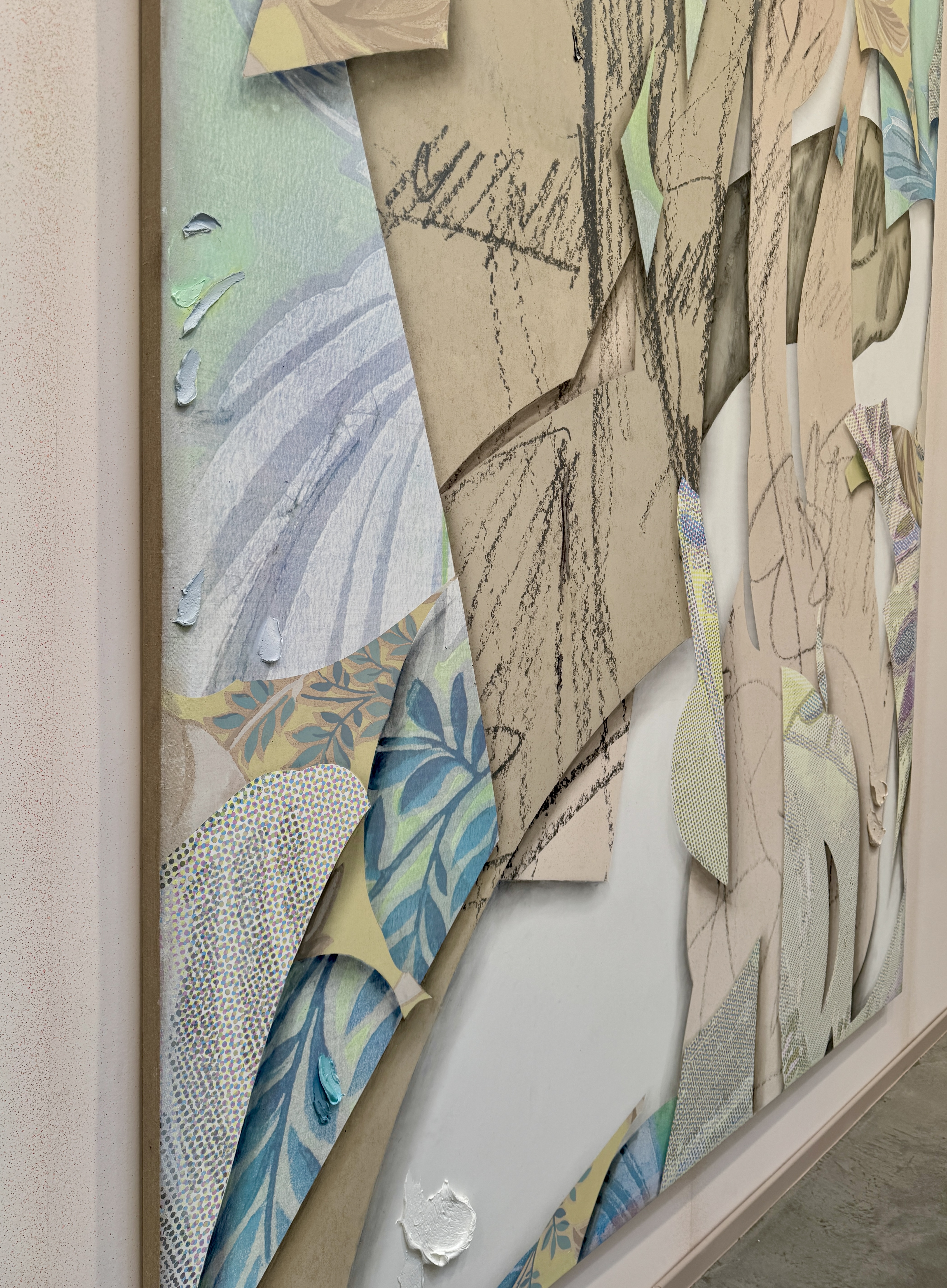
Laura Owens, Untitled (Detail), 2025, Oil, pastel, charcoal, graphite, and silkscreened Flashe on linen, 130 x 90 inches. Photo by Bailey Coleman. 

In the first gallery, ten-foot tall vertical pastel paintings hang in effigy of Laura Owens. Though not intended to burn in sacrifice, these impressive works on canvas are singular retrospectives of Laura Owens’s unique style. Collage, digital media, hand-made silk screen prints and heavy daubs of oil paint compete and complement one another in an effort to excavate the nature of contemporary abstraction. Articulated in light teal cubist forms, the painting on the gallery’s farthest wall is a combustive battleground of style and technique. The result is a soft pixelation of abstracted shapes that superimpose each other and create the illusion of material layering. Her work has been likened to artists such as Picasso and de Kooning by The New York Times and others. These artists were interested in the integrity of the picture plane and celebrating the medium specific flatness inherent to its two-dimensionality. Owens, of course, adheres to these Greenbergian ideals, however, her degloving of the picture plane goes one step further. By outlining formal elements of her composition in shadow, Owens emphasizes that these shapes, designs, and motifs are, indeed, painted, suggesting that qualities that contribute to the illusion of three-dimensional painting can extend to elements usually thought of as contributing to flatness.

Installation view of Laura Owens, Matthew Marks Gallery, New York, February 13 – April 19, 2025. © Laura Owens. Courtesy the Artist and Matthew Marks Gallery. Photo: Annik Wetter.

Once ushered through the large vault-like doors at the rear of the first gallery, I entered into what appeared to be a secret garden with hide-and-seek mechanical pop-outs that reveal small paintings. This exhibition is a surprise departure from Owens’s previous solo shows in many ways. Owens’s 2017 Whitney mid-career retrospective featured her impressive paintings on typical white walls. Now, at Matthew Marks, Laura Owens invites the viewer into an immersive environment that the artist herself has dictated. Floor to ceiling aluminum panels boast one hundred and fifty layers of her silkscreen prints, oil painting, and clay-coated paper that showcases a complex botanical motif with a lattice gate and overflowing greenery. The intricacy of the design layers and subtle shifts in depth perspective become an enveloping environment of the artist’s imagination. Suddenly, a gallery attendant opens a final hidden door to reveal a video installation in a dark, tiny, 3 x 4′ closet-like room. Craning my head upwards in the claustrophobic cinema, I watch as two black crows wax philosophical on the fall of the Roman empire and the prevalence of misogyny throughout ancient history – acting as a subtext of sorts. It felt like type of fever-dream talk show I’ve always craved, but never realized was missing from my life until I saw it.

After a moment of surreal and comedic bird-watching, I exited the principal gallery space and went next door to the annex to catch the exhibition’s final act. There, large boxes with handles, pulls, and knobs hold books and other curios. Fingering through the objects, the printed matter tells a narrative of existential exploration and metaphysical interest beyond the scientific. To my nostalgic delight, I am reminded of show-and-tell in elementary school, sharing memories tied to objects. Overall, the exhibition affirms Laura Owens as an alchemist of painting. She melds painterly skill, an eagerness to adapt unique technologies, art history, and humor, to create something entirely new and wholly her own. 

Laura Owens” is on view at Matthew Marks Gallery through April 19th, 2025.

Bailey Coleman

Bailey Coleman is a contributing writer to Artifactoid and is the founder of her own art publication: Bin Day Art. She is an art advisor and writer based in New York working with clients to curate private collections that speak to both individual desire and market interest. She received her MA in the History of Art & Curating from the University of London and her BA in Art History from Barnard College of Columbia University. 

Why Hasn’t James Lee Byars Been Exhibited at Dia?

By Alexandra Goldman

This article was originally published in Cultbytes.

Above: Installation view. “James Lee Byars: Perfect is the Question” curated by Vicente Todolí at Reina Sofia Museum Palacio de Velázquez, Madrid, Spain, May 10 – Sep. 1, 2024. Photo: Alexandra Goldman.

James Lee Byars occupies an interesting place at the intersection of minimalism and spirituality. Recalling the spiritual abstract painters Agnes Pelton and Hilma Af Klint who preceded him, there is this idea of the spiritual abstraction of the earlier half of the 20th century seeping into the conceptual minimalist sculpture of the latter half, which coalesces harmoniously in Byars’s work. Within it, he’s secured his unique position in art history, in a way that feels sincere.

Visiting “Perfect is the Question,” the American conceptual installation and performance artist Byars solo exhibition at the Reina Sofia Palacio de Velázquez in Madrid, I became interested in Byars’s unique ideas. I was excited that this was the “old stuff”—the good stuff. Even though his work is large and takes up space, it is quiet and pensive, rather than an overt visual spectacle. Presenting work from the 1950s-1990s, “Perfect Is the Question” at The Reina Sofia was curated by Vicente Todolí, and was the second iteration of a traveling exhibition that began at Pirelli HangarBicocca in Milan.

James Lee Byars. “A Dozen Facts,” 1967, in “James Lee Byars: Perfect is the Question” curated by Vicente Todolí at Reina Sofia Museum Palacio de Velázquez, Madrid, Spain, May 10 – Sep. 1, 2024. Photo: Alexandra Goldman.

The exhibition emphasizes Byars endorsement of the color gold, asserting it is not decorative, but rather, is spiritual, closer to god, like halos in fifteenth-century religious oil paintings. He also worked frequently with the colors white and red, also spiritual and powerful in their own ways – elemental colors. He works with the idea of the perfection of the circle, Da Vinci’s Vitruvian Man and “perfect proportions”, the “perfection” of death, and the physiological effects of minimalist sculpture on the viewer (think Tony Smith’s Die, 1962 as a six-foot gold pillar) He works with the ideas of myths, beliefs, transcendence, religious relics, architecture, and coveted objects. For example, he created a fantastical reliquary-like sculpture based on the once-held belief that narwhal tusks were unicorn horns. He combines the aesthetics of 1960s minimalism with Eastern philosophy, medieval Christianity, and the Renaissance interest in mathematical perfection in aesthetics.

Installation view. “James Lee Byars: Perfect is the Question” curated by Vicente Todolí at Reina Sofia Museum Palacio de Velázquez, Madrid, Spain, May 10 – Sep. 1, 2024. Photo: Alexandra Goldman.

Upon my return to New York, I looked at the “50 Years of Dia” webpage. I could not believe I did not see Byars’s name listed. He seems to fit in perfectly with this group of artists, and his spiritual twist to minimalism deserves recognition at this major establishment for installation art. It is not that Dia Art Foundation is the be-all and end-all of institutions, but for conceptual installation and large-scale minimalist sculpture (especially from the second half of the 20th century), it is hard to beat. Nor did I hear Byars’s name in my 2019 graduate-level Art History course on minimalism at Hunter College.

Michael Werner Gallery’s co-owner Gordon VeneKlasen, who represents the Byars estate, has been working on getting Byars into Dia for years. He thinks that Byars is excluded from the history of U.S. minimalism because of his interest in the immaterial: “Byars had a very different way of dealing with things than the minimalists because of his interest in the dematerial. He spent a ton of time in Japan and wanted to make immaterial work. He wanted to make the work disappear. The Minimalists would make an object and then would write a theory about it. He, conversely, would take an idea and make it concrete. No wonder he connected so closely with Beuys and Broodthaers. He was also really in with Rudi Fuchs and Harald Szeemann—the European curators.”

Byars had a retrospective at MoMA PS1 in 2014, 17 years after his death. Furthermore, he has had a significant exhibition history in the U.S. I might be the last one to the James Lee Byars party, or as the death-obsessed artist might have said—the last guest at his funeral. VeneKlasen emphasized: “He was a hero to so many artists. Dia artist Anne Truitt started every lecture of hers by saying: ‘We need to talk about James Lee Byars.’”

Installation view. “James Lee Byars: Perfect is the Question” curated by Vicente Todolí at Reina Sofia Museum Palacio de Velázquez, Madrid, Spain, May 10 – Sep. 1, 2024. Photo: Alexandra Goldman.

A versatile artist, Byars worked with a lot of natural and found materials; not only the narwhal horn, but dried roses, silk, wood, marble, paper, and sandstone. He was doing performances that involved choreography, geometry, and spirituality. He was experimenting with photography in the ‘60s and ‘70s, photo-documenting his performances as well as incorporating books and written ephemera into his practice. In 1969, his performance “The World Question Center” was broadcast on Belgian national television and comprised of intellectuals asking him significant questions—among them were Marcel Broodthaers and John Cage, writer Simon Vinkenoog, doctor Robert Jungk, and Knesset member Uri Avnery. The piece inspired The Reality Club, a New York-based group of intellectuals who met between 1981-1996.  And, the title of the Madrid retrospective. Byars’s inquisitive practice touched the lives of many artists and intellectuals across the world.

In one of Byars most famous performances, “The Death of James Lee Byars,” the artist symbolically staged his leaving the physical world. It ook place shortly after he had been diagnosed with terminal cancer in 1994. The performance was set in a gilded gold room with crystals configured in a five-point shape representing his body, himself physically absent. It incorporated his ideas of spirituality and Da Vinci’s “five points” theory to represent any human body, as well as Eastern ideas learned from his years spent in Kyoto, Japan in the late 1950s. A couple of years later, in 1997, he died in Cairo where he was making art with artisans.

Installation view. “James Lee Byars: Perfect is the Question” curated by Vicente Todolí at Reina Sofia Museum Palacio de Velázquez, Madrid, Spain, May 10 – Sep. 1, 2024. Photo: Alexandra Goldman.

Byars has been lauded and recognized worldwide for half a century. He was included in Documenta 5, 6, 7, 8, and 9 in Kassel, Germany, and the Venice Biennials of 1980, 1986, and 1999. Apart from “James Lee Byars: Back in Detroit” presenting the artist’s performances at Wayne State University, Byars work is mostly being reexamined in Europe. In Europe, the traveling show “Perfect is the Question” and a dual retrospective held during this year’s Venice Biennial at the Palazzo Loredan, the seat of the Istituto Veneto di Scienze, Lettere ed Arti, alongside works by Seung-taek Lee are incredibly dense in further contextualizing the multi-faceted artist. The exhibition in Venice was a follow-up exhibition to one organized in London by Michael Werner Gallery and Lee’s Seoul gallery, Gallery Hyundai.

Byars left the U.S. in the late 1960s upon an invitation from Anny De Decker to join her gallery Wide White Space Gallery in Antwerp, and he never moved back. Veneklasen, who is based in New York, explains: “He just didn’t really fit in here. His first [seminal] performance was in 1969 in Belgium. He made his career in Europe. He disconnected. He was the American artist who was never an American.” He is quick to add: “But he was and is truly an American artist; he was born in Detroit.”

Byars is more present in European institutions than in the U.S., even though he is American. Is it because he spent a long time living in Japan, or because he died in Cairo? Whatever the reason it is time to bring him back to New York.

PODCAST: Women As/In Art Episode 25, Alexandra Goldman

Pictured above: La Chola Poblete, La virgen de la leche, 2023, Photography, 59.8 x 63.4 in / 152 x 161 cm. Courtesy of Barro New York.

Emerald Gruin and Leah Schrager interview Alexandra Goldman, Managing Director of Barro New York.

In this episode, we discuss the importance of relationships, the art market, and inspiring female artists on our radar.

Listen here, and on Spotify.

Alexandra Goldman is a writer, curator, and art dealer living in New York. She is Founder of the art publishing platform Artifactoid, and Managing Director of Barro New York, a contemporary art gallery with locations in New York and Buenos Aires. Goldman writes for Artifactoid, Whitehot Magazine, Cultbytes, ArteFuse, Vice-Versa, and Revista Jennifer. She received her M.A. in Art History from Hunter College and received her bachelor’s degree from NYU in Media, Culture, and Communications. Her Instagram is @Artifactoid.

Artists featured in this episode include:

Installation view, Monica Giron “Elemental Vortex” at Barro New York, 2023. Photo by Mikhail Mishin.

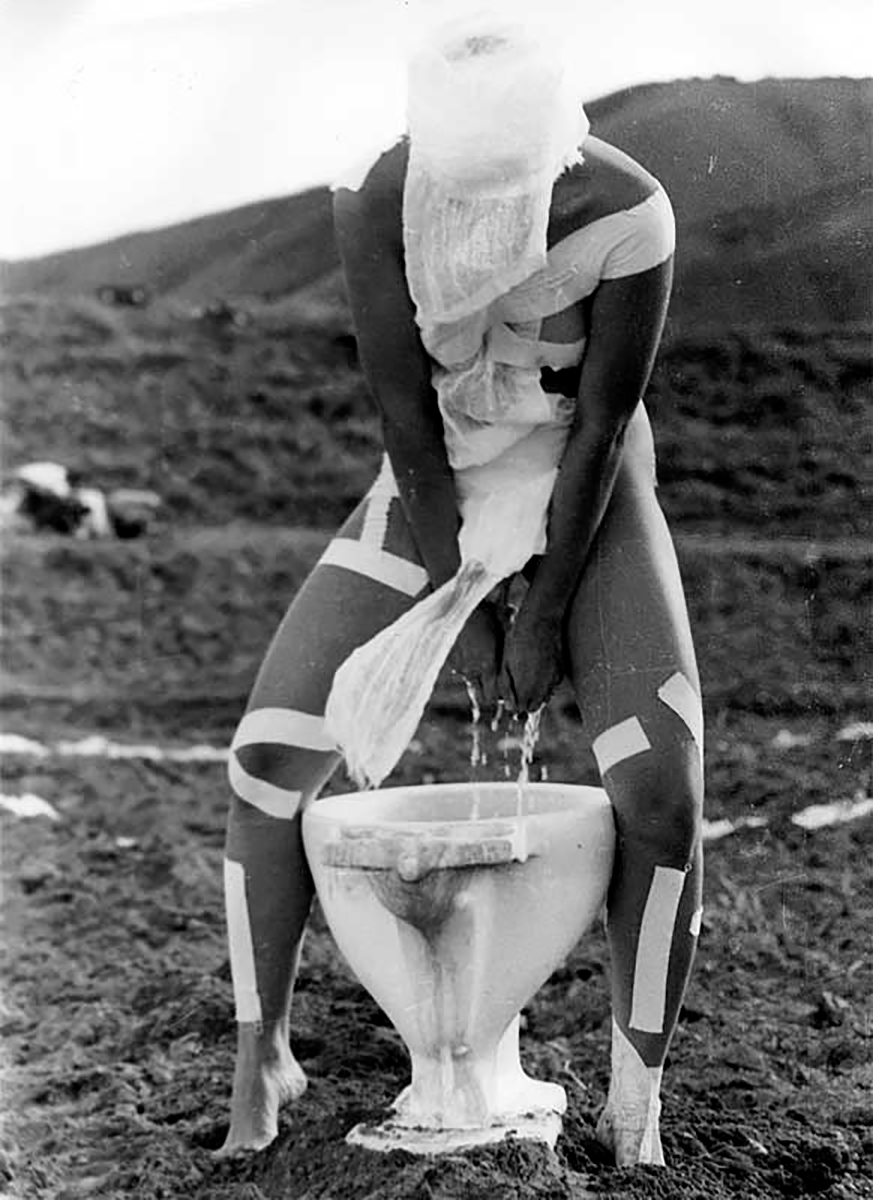
Maria Evelia Marmolejo, Anonymous 3, 1982. Performed on the polluted banks of the Cauca River, Valley Cauca, Colombia. Documentary photograph. Photo: Nelson Villegas. Courtesy of ArtNexus.

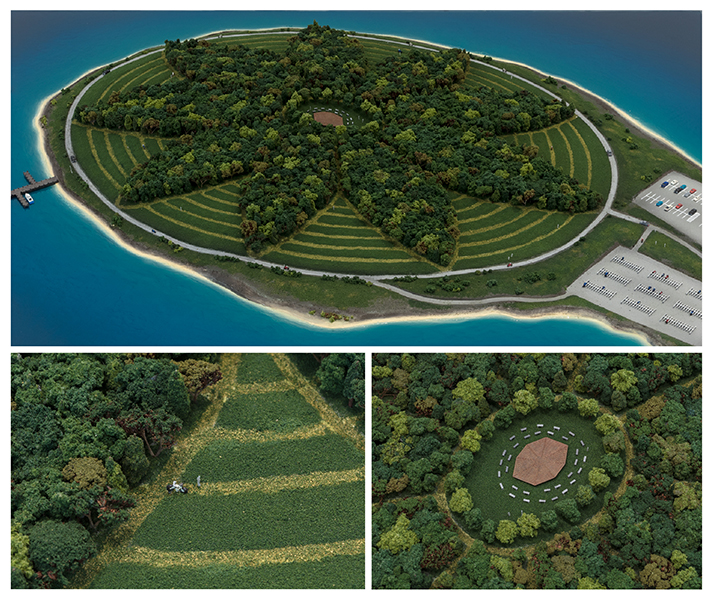
Agnes Denes, Model for A Forest for New York, Commissioned by The Shed, New York ©2014-2019 Agnes Denes. Courtesy of the artist.

Installation view, “Alejandra Seeber: Interior with landscapes” on view at Americas Society, curated by Aimé Iglesias Lukin. Courtesy of Americas Society.

Catalina Schliebener Muñoz, Coloring Book Series, Minnie II, 2023, Vinyl, colored pencil and embroidery on mat board, 33 3/10 × 33 3/10 in | 84.6 × 84.6 cm. Courtesy of Barro New York.

Chellis Baird, Lady Danger II, 2021, Silk, acrylic, wire, birch panel, mahogany frame with black finish 28 x 20 x 4 inches
71.1 x 50.8 x 10.2 cm. Courtesy of the artist.

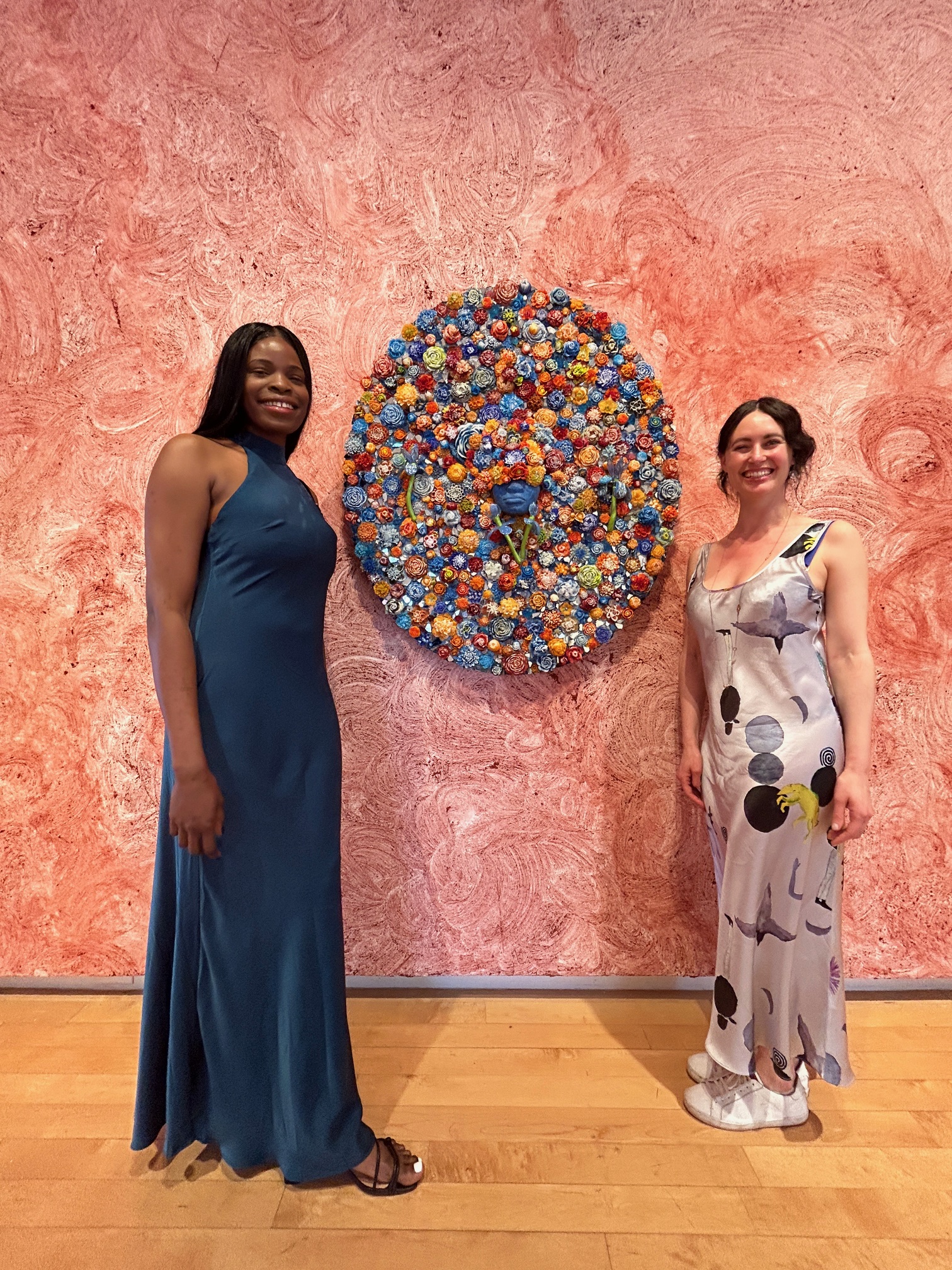
Me and Layo Bright with her sculptural glass artwork, now on view in her solo show “Dawn and Dusk” at The Aldrich Museum curated by Amy Smith-Stewart. Photo by Ferguson Amo.

Body Spirit Geology: Women Artists Working with Metaphysical Presence

By Alexandra Goldman

This article was originallly published in Cultbytes.

Hanae Utamura. “Into the Light,” 2023. Acrylic on Paper. 57.5 x 42 inches. Courtesy of the artist.

In a life-changing instant—the sudden death of her husband—Japanese artist Hanae Utamura went from creating artwork that spoke to geopolitical collective memory in Japan, to exploring the realm of the personal through the body and the metaphysical. Her prior series of projects looked outward to the world and spoke to collective pain, suffering, death, loss, and trauma. Her newer work looks inward to our spiritual being, birth, grief, and the biological earthly entities that create us. Despite this challenge, Utamura is light-hearted and thoughtful. We met while welcoming El Salvadoran artist Beatriz Cortez’s time-based visual art project, Ilopango: The Volcano that Left: a Calder-stabile-like metal sculpture to Troy. In the shape of a volcano—a symbol in both Salvadoran culture and in Mesoamerican codices—it brings ideas of the Mayan underworld to the fore. In Troy, we participated in a ceremony to bless the Native American burial site with tobacco while Ilopango passed by us on the river.

Unbeknownst to Utamura’s recent loss, I was drawn to her bubbly and friendly nature and intrigued by her knowledge of indigenous practices. Perhaps it was our proximity to other realms that connected us—my mother lost her mother at a young age and has explored modes of communication with spirits, exposing me to conversation and practice surrounding energetic transitions. In recent years, spiritual art by women tracing back to modernist and proto-modernist abstraction is more widely known, facts that  Jennifer Higgies writes about in her new survey The Other Side: A History of Women in Art and the Spirit World. As we offered tobacco to the land, Utamura invited me to visit her studio on the Rensselaer PoIytechnic Institute’s (RPI) nearby campus, where she is enrolled in a practice PhD program, and I accepted.

At her studio, Utamura told an unexpected and moving story about the recent transition in her artwork style. Her husband, Robert Phillips, was an American new music composer. They were an artistic couple who met in 2014 at Akademie Schloss Solitude, an international artist residency in Stuttgart, Germany. Within a very short period after the world entered the pandemic, Utamura experienced bringing life into the world, giving birth to their son, Kai, in 2021. Shortly thereafter, in 2023, she saw life leave the world with Robert’s death due to sudden illness. It was a devastating and unexpected tragedy for the young couple and their family.

On the 49th day after Robert’s passing, which in Buddhist tradition marks the day when one’s spirit and energy are fully released, Utamura performed a ritual to honor him. She had saved the placenta from Kai’s birth (which is dried in the shape of a bowl), placed Robert’s hair inside the placenta, and buried both together beneath a tree. When Utamura and Robert spent their last moments with each other, they exchanged locks of hair. The placenta provides oxygen and nutrients to the child through the umbilical cord, which also brings waste products away. It is shaped like a brain, or as Utamura describes it, a “half-cut earth,” and symbolizes growth and birth. “Placenta is treated as medical waste after birth in the Western medical world, but many cultures have a sacred, spiritual relationship to the placenta,” she commented. The placenta is often referred to as the “tree of life” for the branch-like patterns made by its blood vessels. The site continues Robert and Utamura’s life together, as the placenta’s nutrients—parts of their DNA—enrich the grass and tree roots, and other, in her words, “non-human species.” And, Utamura’s ritual symbolized Kai protecting Robert’s spirit, and carrying him into spiritual transcendence, with the eternal protection of his son.

Maria Evelia Marmolejo. “Anónimo 4,” 1982. Performance. Photo by Nelson Villegas. Image courtesy of Maria Evelia Marmolejo.

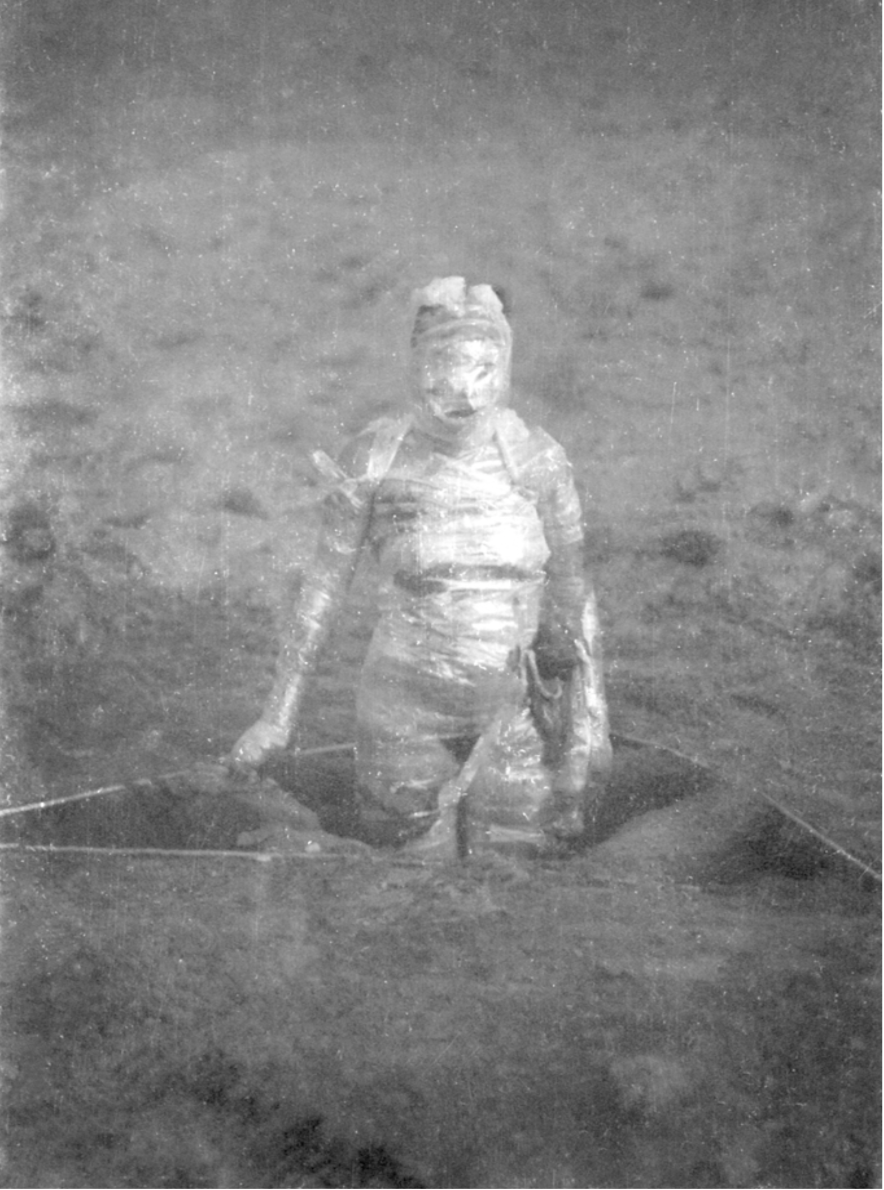
Pioneering feminist artists from the early eighties also worked with the idea of the placenta as considered “medical waste” in Western medicine, while it is spiritual, such as Colombian artist Maria Evelia Marmolejo (who was included in the 2017-2018 exhibition Radical Women: Latin American Art 1960-1985 Hammer Museum and Brooklyn Museum). For Marmolejo’s 1982 performance, Anónimo 4, she dug a 1.5-meter triangular pit into the ground and filled it with sewer water and the placentas of all the babies born that day in hospitals near the performance site, in Cali, Colombia and Guayaquil, Ecuador. She wrapped her body in the placentas, and submerged herself in the hole, “embarking on a psychological and sociological self-exploration of the fear of being born in a society in which there is no guarantee of survival,” she explains in an interview. Artists like Marmolejo and Utamura observe the importance of the placenta by incorporating them into their performance rituals in meaningful, powerful, spiritual, and symbolic ways, whereas at the hospitals, they tend to be discarded.

Understandably, Utamura could not entirely let go of her partner. Because of these sudden extreme encounters with life and death, which now flow, in her words, “like the confluence of the river with raising Kai,” her perspective was instantaneously transformed, altering her artistic practice. Before Robert’s death, she created more geo-political artworks, often performances and films. One work Uncanny Valley – Study for Future Strata (see image below) raises questions around the dominant historical narrative of nuclear history by juxtaposing images of the elements that surrounded the atomic mushroom clouds of the bombing in Nagasaki, with the mining site in Congo where uranium was sourced for nuclear production – positioned above, and the military storage site near Niagara Falls where nuclear waste from the Manhattan Project was secretly disposed – positioned below. But, after she experienced the life-altering sequence of birth and death events, she felt compelled to turn inward to the body and spirit. Abstract painting helped her overcome “the unspeakable”—I immediately drew a parallel to the shift to abstraction in Western art after World War II. She believes in abstract painting as a powerful medium for channeling the energetic transitions relating to birth and death. 

Hanae Utamura. “Uncanny Valley – Study for Future Strata,” 2022- Mixed Media. 21 x 16 inches. Courtesy of the artist. 

“This has also very much been a collaborative process with Robert,” Utamura added, “Aur means ‘light’ in Hebrew. I feel that his symbolic composition, Aur, for string quartet and electronics, is the light that he transcended into. It transforms death into a departure. When painting, I hear his music inside my ear—his essence is expressed even more through his music in his physical absence. The music truly starts to live in eternity within me.” Having followed my mother’s journey to stay in touch with my grandmother after her death Utamura’s will to stay connected as a source of comfort resonated with my own experiences.

The first several paintings Utamura created exploring her feelings of grief were watery representations of a body, dissolving. After creating several of these more figurative paintings, she was invited to a séance by Tamar Gordon, a professor of Anthropology in the Communication and Media department at RPI, and a member of her doctoral committee. The séance would help her further shift her focus from grief to communication.

Hanae Utamura. “The Limb,” 2023. Acrylic on Paper. 24 x 18 inches. Courtesy of the artist.

At the séance, the physical medium Gary Mannion, headed a circle under controlled conditions, alternating between complete darkness and red light. Physical mediums, as opposed to mental mediums, produce materializations of spirits while mental mediums interpret and channel them. Physical mediums produce ectoplasms which are viscous manifestations of spirits that exude from their body taking on any form, including apparitions. Encircled by the participants and sitting in a cabinet, tied down to a chair, Mannion produced an ectoplasmic hand and invited members to touch and hold it. Utamura described the experience as having felt like “touching a wet hand.”

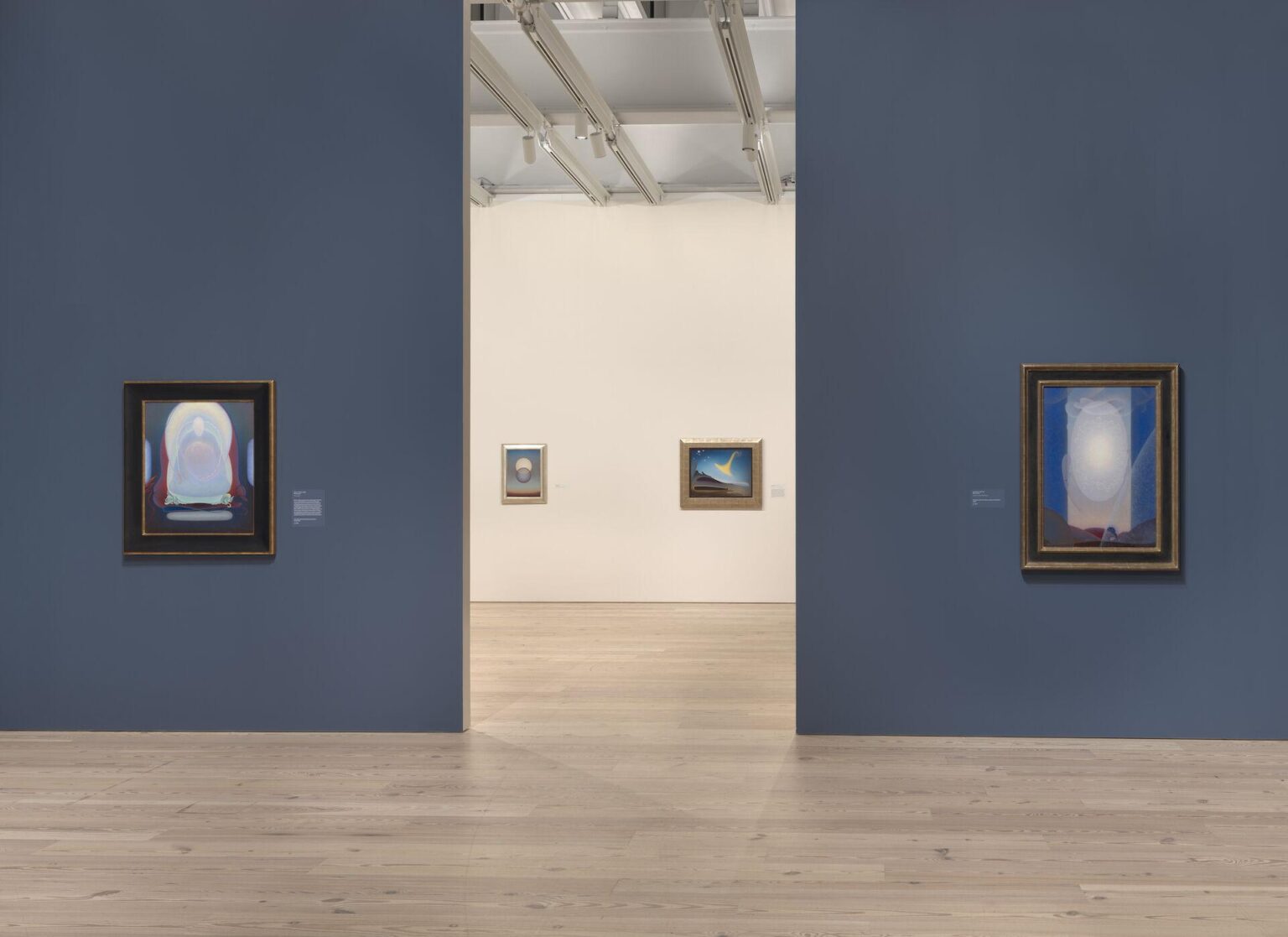
Installation view of “Agnes Pelton: Desert Transcendentalist” (Whitney Museum of American Art, New York, March 13–November 1, 2020). From left to right: Mother of Silence, 1933; Departure, 1952; Awakening (Memory of Father), 1943; Light Center, 1947-48. Photograph by Ron Amstutz. Courtesy of The Whitney Museum of American Art.

Séances were an American phenomenon popularized by the Spiritualist movement in the 1850s. They spread to Britain, other parts of Europe, Brazil, and Australia, and consisted of circles of sitters who gathered to channel the realm of spirits. Today, they are less common, but exist and Mannion is a leading figure in the field.

Utamura’s new work is also influenced by Shannon Taggart, a photographer and artist who authored a popular book depicting sitters in various states of transfiguration. Taggart recently had an exhibition of her work at the Opalka Gallery in Albany, NY. The two-day public opening included a dialogue between Taggart and Dr. Anne D. Braude, the director of Women’s Studies in Religion at Harvard Divinity School, and the author of the book, Radical Spirits: Spiritualism and Women’s Rights in Nineteenth-century America, which explores the close engagement of Spiritualism with the women’s rights movement. There is also a growing recognition in recent years of female artists like Hilma af Klint and Agnes Pelton, who employed art as a language to explore spirituality. Utamura considers her work as in alignment with these artists and thinkers.

Hanae Utamura. “Presence of Absence #3,” 2023. Acrylic on Paper. 24 x 18 inches. Courtesy of the artist.

After the séance with Mannion, Utamura created another series of paintings in which she began to depict the imaginary body that evolves to a more abstract state in its process, like energies and colors (rather than a dissolving figure), with rich, cosmic dark blues or brighter florals. Often she incorporates a bit of iridescent pigment “inspiring to channel, as it reflects light” she explains. The composition of Utamura’s new more abstract paintings on paper are vaginal and womb- or placenta-like. Some of these images incorporate a hand and a tree branch, perhaps referencing the tree under which she performed the ritual for Robert, or the sensation of touching a wet hand in the séance.

Serendipitously, a few months before Robert’s passing, she also found a book lying in a classroom at RPI titled The Perfect Medium: Photography and the Occult published by Yale University Press. It is the catalog from an exhibition in 2005 at the Metropolitan Museum of Art that showcased the history of photography on mediumship channeling with the spiritual realm, with imagery dating back to the nineteenth century. There is a page in the book that shows photography which captured ectoplasmic emissions, and the composition of these images have similarities to the composition of Utamura’s new paintings. She has a feeling that her spiritual involvement with the other realm was and is still being presented to her from many different angles.

Both of these newer series explore what comes before, what happens during, and what comes after, an extreme moment—global or personal. “We are living through dark times with a lot of death,” Utamura remarked sensitively in her studio, putting aside her personal loss and experience, knowing that this is going on all around us. “We’ve learned to accumulate, but we are not taught much about how to face loss. I think it is time for us to face this; exploring these spaces would also bring us more understanding of life in its complexity, and knowledge of how to nourish life. It will prepare us with strong grounds for the future to come. The more darkness that falls upon us, we also need light that illuminates our world.”

In Memory of Robert Phillips. 

Merry Polish Christmas: The Tenth Anniversary of Olek’s “Project B (Wall Street Bull)”, 2010

Above image: Olek installing Project B in 2010. Image courtesy of Olek on Vimeo.

By Alexandra Goldman

If you never saw it in person, you’ve probably seen an image of Project B at least once. The original guerrilla art installation was only up for a few hours before it was taken down by the city, but its viral visuals live forever online. For the ten-year anniversary of Project B this Christmas, I’ve decided to take a closer look at the project and the person who created it, the Polish artist Olek, née Agata Oleksiak, (b. 1978, Staszow, Poland). I’ve found it is a story about ritual, iconoclasm, and two different New York-based immigrant artists who wanted to see the United States doing well. It’s also strongly connected to Olek’s Polish roots.

Charging Bull has become a known site of protest on its own in New York and the subject of several acts of iconoclasm, especially since the 2011 Occupy Wall Street movement. It has had paint doused on it in 2017, and had dye poured on it, and its head bashed with a spiked banjo in 2019, for causes ranging from anti-financial corruption, to protecting the environment, to anti-Trump demonstrations. Because of this, there is a current conversation about relocating it. Olek’s wrapping of the bull with yarn has been the most peaceful form of altering the statue while still having a big impact. It is similar to how the artist Dustin Klein created a light projection of a portrait of Breonna Taylor to project onto the controversial statue of Robert E. Lee in Richmond in July 2020 as part of the BLM movement. Both yarn and light can be used as peaceful strategies for acts of iconoclasm on monuments.

Olek installing Project B in 2010. Image courtesy of Olek on Vimeo.

For background, in 1989, Italian immigrant sculptor Arturo Di Modica (b. Sicily, 1941) originally installed Charging Bull on Wall Street at Christmas time. He had a studio on Crosby street, and without city permission he and a group of friends delivered by truck the self-funded sculpture in front of the New York Stock Exchange. He intended the sculpture of the known market symbol as a “Christmas gift” to the city symbolizing “the strength and power of the American people”, two years after the October 19, 1987 stock market crash known as “Black Monday” (the worst crash since 1929). Within hours, Charging Bull was removed by the city and taken to a warehouse for storage, before it was later legally relocated to Bowling Green.

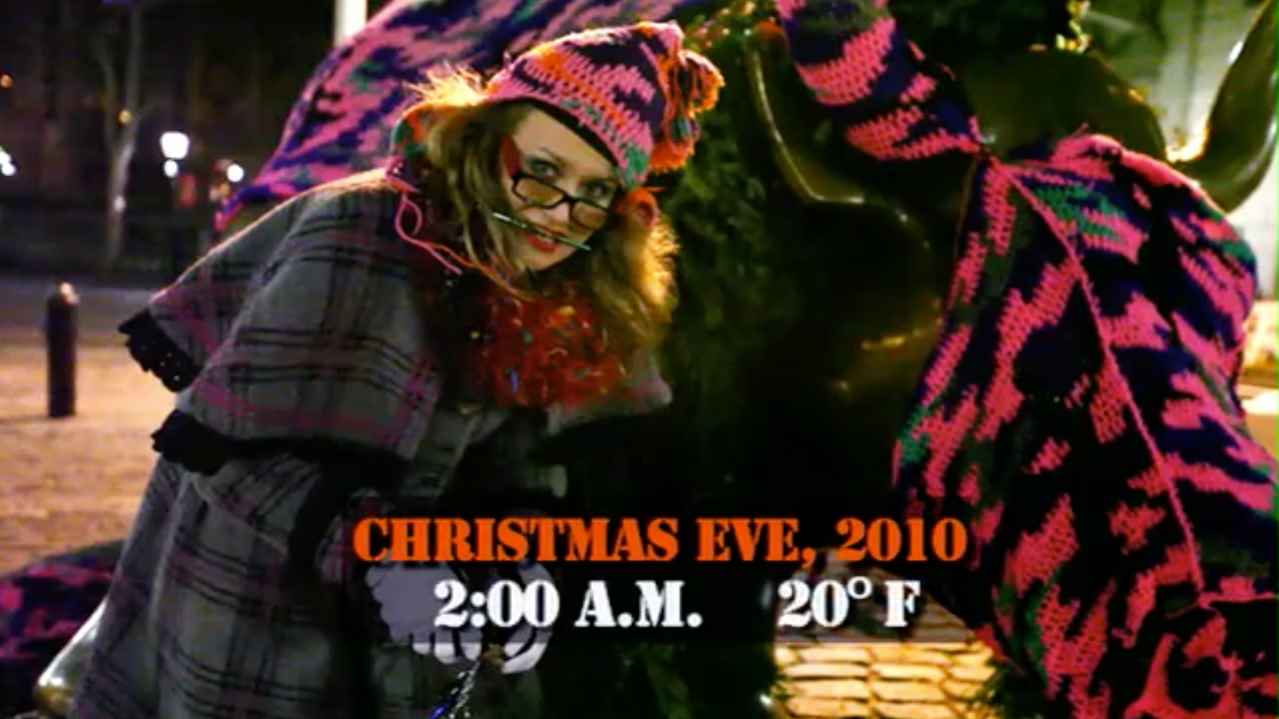
Twenty-one years later, at around 2:00 am on Christmas Day 2010, without city permission, Olek wrapped Di Modica’s sixteen-foot, 3.5-ton, bronze Charging Bull with bright pink (with hints of purple, teal and gray), camouflage-pattern, hand-crocheted yarn that they created without assistance. Olek titled the guerrilla intervention Project B or Project B (Wall Street Bull), which is actually absent from the majority of articles about the project.

Replicating Di Modica’s timing, two years after the severe 2008 market crash and also at Christmas time, Olek revived Di Modica’s original guerrilla intervention through Project B by wrapping Charging Bull with their camouflage crocheted yarn. Similar to Di Modica, Olek considered Project B their “Christmas gift” to the city or a “Christmas sweater” for the bull, in effort to uplift the country following the most recent financial crisis. According to the artist, Project B was a symbolic public gift for all those who couldn’t afford holiday presents that year or were unable to visit their families. Olek’s strategic reenactment of Di Modica’s timing (both after the financial crash and time of year), guerrilla-style action, and gift-intention categorize Project B an act of ritual. Olek later confirmed that it was a ritual, and prior to wrapping Charging Bull with yarn, they carried out a series of Polish Christmas rituals: “Christmas eve is a special day for Polish hearts. That night, animals speak human voice. I cooked a traditional dinner, and went to pasterka (midnight mass),” they explained.

The idea of revitalizing statues through ritualistic actions such as wrapping them with colored cloth is not new. It even dates back to Ancient Egypt, during which kings and priests would drape colored cloths around statues of deities during their daily offering ritual ceremonies to the gods to revive their ka, or, inner spirit. In Ancient Egypt, the colors of the cloths during the daily ritual had specific meanings for the ceremony to either refresh the deity (green cloth) or reaffirm its holiness (red cloth).

Olek’s use of the color pink for ritual cloth statue wrapping, when combined with the historically feminine medium of crochet, has given cause for some to consider Project B a political, iconoclastic act by the artist amidst Wall Street’s hyper-masculine environment. While noting Olek prefers to avoid the limitations of categorizing their art as “yarn bombing”, yarn bombing (street art involving yarn), is historically rooted in third-wave feminism during which domestic arts were celebrated. Project B is therefore on one hand, Olek’s public critique of the imbalance of the hyper-masculine environment of Wall Street and the failures of power imbalance.

However, rather than pitting the genders at war with one another through Project B, Olek was expressing maternal caretaking, the need for balance, the importance of self-love, and love of others. Olek, an immigrant from a formerly communist country, felt the need to symbolically take care of a failing capitalist system and lift it back up. Olek created a Yin-Yang duality whereas before there was only Yang energy.

Olek also believes all art is a self-portrait. Through spiritual exploration, Olek identified in recent years as gender nonbinary and considers themself to be a “two-spirit being”, fully male and fully female simultaneously. Wrapping the masculine, muscular, bronze bull with the feminine, soft, pink, crochet resulted in the temporary creation of a powerful, mirroring, two-spirit being in the public space of NYC’s Financial District.

Olek hugging Project B. Image courtesy of Olek on Vimeo.

Furthermore when I first met Olek at Art Basel Miami Beach last year, I became interested in their work because it immediately felt very Polish to me, and I was interested in the fact that none of the articles I was reading about Olek’s work spoke about how Polish it was. I have Polish heritage, and traveled to Poland in 2009.

I was driving from Czestochowa to Krakow in 2009, and noticed all the buildings were Brutalist gray rectangles or squares. However, every so often some stretches of buildings, that seemed to be apartment complexes, were painted over with wide, vertically striped swathes of rainbow colors. I asked my Polish friend why some of the buildings were painted over like this. She replied that after communism fell some cities and towns celebrated by painting buildings bright colors since the government didn’t allow any deviation from uniformity during communism. Similarly, Olek’s art intervention tactic of using a bright burst of color in homogenous gray public space with Project B represents their Polish way of expressing freedom from oppression.

The idea of combining the media of fiber art and sculpture also has roots in Poland. The artist Magdalena Abakanowicz (b. 1930) is a famous Polish sculptor who works with fibrous materials. According to the MoMA, “Abakanowicz and many artists of the Eastern Bloc were drawn to craft and textile traditions as expressive mediums less regulated by Soviet censorship.” When Olek first came to the U.S. with no money in 2000, their sculpture professor at La Guardia Community College also encouraged them to begin sculpting using any material, including yarn.

In our recent Zoom interview, Olek explained that while growing up in communist Poland, being an artist – or expressing individuality of any kind – was highly discouraged, and art galleries and museums were reserved for the elite. Olek believes they never could have fully become who they are as an artist, or individual, if they had stayed in Poland and not made the courageous decision to emigrate to New York. While Olek critiqued the failing power imbalance that Charging Bull came to represent with Project B, Project B was also Olek’s renewal of Di Modica’s celebration of possibilities and resilience available in a capitalist country, presented by an immigrant artist who couldn’t have had their career without its benefits. Their own experience of feeling excluded from art institutions while growing up poor in Poland led to their dedication to public art that can be accessed by anyone.

Women Photographers in Exile: A Conversation With Curators Christina De León and Michel Otayek

Images by Kati Horna, “Bombed! Shelled! Besieged for two years – but Life goes on!,” The Weekly Illustrated, December 3, 1938 [author unknown]. Private collection, New York.

This article was originally published in Whitehot Magazine of Contemporary Art.

I had had this event on my calendar for weeks, looking forward to unofficially celebrating the election of our first woman president at the NYU Institute of Fine Arts, coinciding with this wonderful panel discussion on the topic of women photographers in exile. When the night of November 8th turned into the morning of November 9th , and election results were in, there was a different somber attitude across New York City than I’d ever seen before. As shocked and devastated as I was about the results of the election, I decided that I needed to go to the event that I had been looking forward to for so long. When I headed toward the subway to go uptown, the weather outside was grey, drizzly, and dark, and then the energy inside the subway car felt like that of a funeral. But when I got to this panel event put on by Americas Society in the gorgeous ornate colonial building of the NYU Institute of Fine Arts on 5th Avenue, celebrating the work and accomplishments of these incredibly powerful women photographers during wartime during the earlier parts of the 20th century, I was absolutely uplifted and inspired again in a way that I really needed to be at that moment. It was a night of applauding courageous and creative women who broke boundaries, fought for what they believed in and revealed acute insights on dark times with their art and activism.

In the following interview, I sat down with the curators of both the panel discussion and the exhibition, Michel Otayek and Christina De León, to speak about their motivation and inspiration behind shining the spotlight on incredible talents Kati Horna (Hungary), Lee Miller (United States), Grete Stern (Germany), and Margaret Michaelis (Austria-Hungary; Poland), among others. Each have such an incredible story that I have linked to their Wikipedia pages, but in short, from what I’ve gathered, all of these women, in face of the political turmoil of Europe mostly in the 1930s including the rise of Nazi-ism and the Spanish Civil War, fled from and moved between different countries, in regions including Europe, Latin America, Africa, Australia and the U.S., to take action photographing in often treacherous zones. They produced images for everything from mass publications like Vogue, to activist anarchist propaganda in Spain, to art photography which also sometimes included shared common interests in both surrealism and architecture.

8_-helen-escobedo-1960

Kati Horna, Helen Escobedo, 1960; gelatin silver print, 8 x 8 in. Private collection, Mexico City.  © 2005 Ana María Norah Horna y Fernández.

Artifactoid: What led to your focus on Kati Horna? What most intrigued you about her work at the onset, and what were some of the most interesting things you discovered about her through your research putting this show and panel together?

Michel Otayek: Kati Horna’s work during the Spanish Civil War was the subject of my master’s thesis at Hunter College a few years ago. My doctoral dissertation at New York University, currently in progress, takes a more expansive view at her trajectory by means of a comparative analysis between her work, before and after exile, and that of Grete Stern. Early on in my research about Horna, it became clear to me that the meaning of her images was inextricable from their circulation in print. Throughout her career, she produced work specifically for the press. In a way, the true medium of her practice was the printed page, rather than the photographic print. In the pages of print materials, text and design bring to bear on what we are to make of photographic images. At the same time, one must also consider of the specificity of the audience (for whom is this magazine crafted?) when thinking about the sense-making power of images. Our exhibition at Americas Society stays close to these ideas. By presenting a rather eclectic array of print materials in dialogue with a selection of vintage prints, we argue that Horna was keenly aware of how circulation determines meaning—a circumstance she was sometimes able to exploit to great effect.

Christina De León: I was familiar with photographs by Kati Horna’s that were mostly taken in Mexico, however I was not aware of her earlier career in Spain with anarchist publications and through research for this exhibition I came to discover the story of a deeply complex and fascinating photographer. What most intrigued me about Horna’s work were her portraits, specifically of women, because she never relied on sensationalism or angst.  Her photographs invited viewers to look deeper into their own reality and served as a reflection of human conditions that encompass all of us. She also displayed an extraordinary depth of field for real-life phenomena generally viewed as banal or otherwise routinely overlooked, which she often captured with a clever sense of humor. Our archival research uncovered an incredibly diverse amount of photographic work, much of which will probably never be seen, because it is not associated with her formal production, but it’s an interesting insight into her practice and how she maintained herself financially. For instance she took wedding photographs, society portraits, images for popular photo-novela magazines, and she took innumerable picture of animals—there are many amazing photographs of cats.

Artifactoid: For the panel presentation, you discussed Horna’s work in the context of several other female photographers from the perspective of mobility and exile, including Lee Miller, Grete Stern, Margaret Michaelis, Marianne (Gast) Goeritz. What would you say is the single most outstanding quality about each of these artists, and what would you characterize as some of the most important threads between them that connect and amplify each of their bodies of work?

MO: I try not to reduce a photographer’s practice to a single, characteristic trait. I think there’s more to Henri Cartier-Bresson, for example, than the decisive moment, or to Robert Capa than battlefront intrepidness. As a remarkably versatile craft, photography gave women such as Kati Horna and Grete Stern a great deal of mobility—across national borders, most obviously, but also across communities of artists, intellectuals, and political activists. There are significant commonalities in the work of these two Jewish women, including the fact that both learned their craft from photographers specializing in advertising work (József Pécsi and Walter Peterhans), which I think gave them a sense of photography as a tool to construct images rather than just document reality. Having lived in Berlin in the final years of the Weimar Republic, both were led to exile by the rise of National Socialism. But whereas Stern left Europe for Argentina in 1936 and was celebrated early on as a pioneer of modernist photography in her adopted country, Horna’s involvement with the anarchist fringe of the Spanish Civil War resulted in a much more precarious exile to Mexico, where she arrived in late 1939—and into which culture she struggled to assimilate for a long time. For a variety of reasons, while Stern has long been part of the canon of modern Argentine photography, Horna’s work continues to be, in my opinion, unfairly underappreciated, even in Mexico.

CDL: It’s difficult to point to a single outstanding quality for each of these photographers, because there are so many! But an interesting commonality among all of them was their ability to seize the opportunities offered by the growing field of photography as a means for personal, political, economic, and artistic emancipation.

Artifactoid: Since you focus on foreign female photographers active in Latin America during the postwar period, I wanted to ask you, what are some of the biggest risks and dangers that these women faced in doing what they were doing, during the time they were doing it? What were some of the biggest challenges they had to overcome that may not be obvious at first glance?

MO: In addition to Horna and Stern, I am also currently researching the work of Bárbara Brändli and Thea Segall, both of whom arrived in Venezuela in the late 1950s. Though a generation younger and having arrived in Latin America two decades later than Horna and Stern, Brändli and Segall also had to carve out their own spaces, as émigrés, in an occupational field still largely dominated by men. Something I find in common among all four is somewhat of an inclination towards the countercurrent. What I mean is that in their trajectories one notices either an engagement with themes ignored by the greater culture or, conversely, a disinterest in some of the topics most conspicuous in the work of other photographers in their adoptive countries. For example, between 1958 and 1964, Grete Stern committed herself to the production of an extensive photographic record of the indigenous communities of the Argentine Great Chaco. Driven to photograph the living conditions of these communities by a personal desire to help improve them, Stern was later greatly disappointed by she perceived as a generalized indifference towards the plight of Argentina’s indigenous cultures by the country’s elites. Meanwhile, it is noteworthy that in Mexico, a country with a robust tradition of folklorist photography, Horna should have remained largely unconcerned with popular and indigenous traditions—themes that have fascinated generations of photographers there, from Hugo Brehme to Graciela Iturbide.

12d_-un-mariage-chez-les-oeufs-a-marriage-of-eggs-1936

Kati Horna, Un mariage chez les œufs [A Marriage of Eggs], 1936; gelatin silver print. Private collection, Mexico City. ©2005 Ana María Norah Horna y Fernández.

Artifactoid: What are some of the most surprising photographs taken by any of these artists?

MO: Much of Kati Horna’s work speaks to her refined sense of humor. The more of it one looks at, the more sensitive ones becomes to her penchant for infusing even the soberest or most mundane series with an understated layer of comicality. Oftentimes, the humorous streak of her work is not immediately apparent. But on occasion, she produced series that were downright hilarious. Such is the case of a delightful photo essay about city fashions such as bulky mini-skirts, published in July 1962 in the Mexican weekly Tiempo, in which every photograph is taken from the ground looking up, monumentalizing the subjects’ rears while keeping most of their upper bodies invisible. We were not able to include this series in our exhibition at Americas Society but it is certainly one of my favorites. While we are in the subject of personal preferences, one of the works by Bárbara Brändli I like the most is her 1981 book Los páramos se van quedando solos, in which photographs and interview transcripts document the vanishing rural communities and linguistic patterns of the Venezuelan Andes. While not a bold statement of design such as the celebrated 1975 photobook Sistema Nervioso (produced collaboratively by Brändli, John Lange and Roman Chalbaud), Los páramos se van quedando solos manages to convey the melancholic allure of agrarian life in the highlands of Western Venezuela. It is a visually austere but surprisingly sublime photographic pastoral.

CDL: I think I would say I was more inspired than surprised by the photographs taken by these artists.  In viewing these images it’s obvious that they did not hold back and you can see the urge to push further and go beyond conventionality. Their work reflects a raw individuality and a complexity that mirrored their lives.

Artifactoid: What were some of the biggest curatorial challenges that you faced when putting this presentation together, and how did you overcome them?

CDL: When organizing an exhibition it’s always a challenge conveying a person’s life’s work through a small and subjective selection of pieces. The goal is always to highlight key moments in a manner that is both engaging and thoughtful, but when you enter an artist’s archive the decision process can be daunting. While our exhibition is focused on Kati Horna’s relationship with the illustrated press, it was important for us to show her professional and personal transitions, as well as her vast networks in Europe and in Mexico, which was something we kept in mind throughout the entire process. Conveying Horna’s images within a framework that spoke to her political ideas, artistic curiosities, and deft eye was crucial to understanding the work we selected. In addition, it was essential to show the circulation of her images and their ever-changing contexts. For us the exhibition design and the display devices played a paramount role in helping to create a dialogue among the images and publications on view. The design was especially important because many of the images were printed in a small format and we wanted visitors to engage with its intimate nature. In many museum and gallery settings there is a tendency to keep a distance from the work, but in this case our intention was for the public to get close and become familiar with Horna’s images and her photographic practice.

Artifactoid: What new meaning, if any, is added to how you view these photographers and their work, in the context of our current, intense global political situation right now? Is there anything about their work that you see in a new light, due to current events? And, which current artists, if any, would you say could be considered modern equivalents of the photographers you focused on in this exhibit/panel?

MO: Perhaps we should put it the other way around. Thinking about what a handful of truly remarkable women were able to do with their cameras as they traversed some of the great upheavals of the 20th century has given me solace as we wake up to a global state of affairs in which, suddenly, it seems acceptable again to disparage minorities, and influential figures feel emboldened to express their contempt for the equal dignity of women. As you know, our panel at the Institute of Fine Arts about women photographers in exile was held the day after the presidential election in the United States. Many of us in attendance were shocked and deeply pained by the election’s results. The timing could not have been more apt for an evening of serene, almost therapeutic conversation about talented, courageous women and the challenges they had to overcome in their own times. Their careers can be looked at from so many different angles that one could establish pertinent comparisons with numerous artists working today. Someone that comes to mind in regards to Kati Horna is Zoe Leonard, whose phantasmagoric photographs were recently on view at an exquisite show at Hauser & Wirth, just a few blocks from Americas Society. Although conceived to operate within very different parameters of public display and circulation, Leonard’s work is concerned with preoccupations that come through in some of Horna’s most personal series: the condition of statelessness and the need to reconstruct personal history.

CDL: In light of the current political unrest, I think its clear that although there has been significant progress, women continue to face many of the same challenges and prejudices they did seventy or eight years ago. Nevertheless, women are still pushing ahead and working to defy stereotypical notions about what kind of work they should or shouldn’t be doing. This defiance has been happening throughout centuries and endures today. The objective for us as a society is to continue to shed light on their work and integrate these women within a greater canonical narrative and not refer to them just as historical anomalies.

View the exhibition of works by Kati Horna, “Told and Untold,” at Americas Society through December 17th, 2016.

About Christina De León and Michel Otayek:

Christina L. De León is a doctoral candidate at the Bard Graduate Center: Decorative Arts, Design History, Material Culture. From 2010 to 2016 she was the associate curator at Americas Society where she worked on modern and contemporary art exhibitions and publications. She co-curated the shows For Rent: Marc Latamie (2012), Cristóbal Lehyt: Iris Sheets (2013), and Told and Untold: The Photo Stories of Kati Horna in the Illustrated Press (2016). She contributed to the catalogue Moderno: Design for Living in Brazil, Mexico, and Venezuela 1940–1978 and has written articles for Review and Americas Quarterly periodicals. De León held previous positions at the Metropolitan Museum of Art and the Cloisters Museum and Gardens. She holds an M.A. from New York University and a B.A. from Hobart and William Smith Colleges.

Michel Otayek is an art historian and doctoral candidate at New York University’s Department of Spanish and Portuguese. He holds a degree in Law from the Universidad Católica Andrés Bello in Caracas, and an M.A. in art history from Hunter College in New York. Otayek’s research addresses the role of practices of visual culture, including photography, in the articulation of discourse. His work is particularly concerned with collaboratively produced cultural artifacts such as illustrated periodicals and photobooks. Currently in progress, Mr. Otayek’s dissertation undertakes a comparative analysis of the work in exile of photographers Kati Horna in Mexico and Grete Stern in Argentina. As part of his interest in foreign female photographers active in Latin America during the postwar period, he is also at work in research projects pertaining the work of Bárbara Brändli and Thea Segall in Venezuela.
What Makes a “Keeper”? New Museum Curator Natalie Bell on Collecting as Art

Original article published in Whitehot Magazine of Contemporary Art

The New Museum’s current show The Keeper, curated by Massimiliano Gioni, pushes the boundaries of the definition of art by exploring practices of collecting and preserving objects as the subject of a museum exhibition.

The Keeper features expansive collections of items compiled by artists, scholars, collectors and hoarders over the past century which provide viewers with opportunities to muse on how the things that people amass and safeguard speak to their identities. How does what we decide to keep reflect upon who we are? Themes of memory, struggle, loss, the need for comfort, and the passing of time also pervade the four-story exhibition.

keeper2Installation view of The Keeper, featuring a sculptural installation by Carol Bove and Carlo Scarpa, and paintings by Hilma af Klint

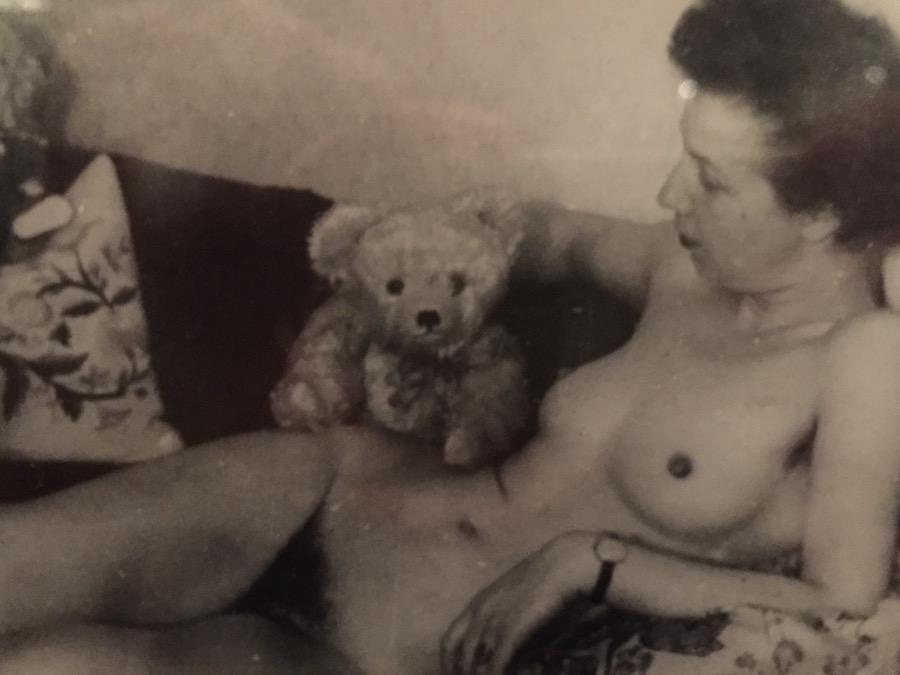
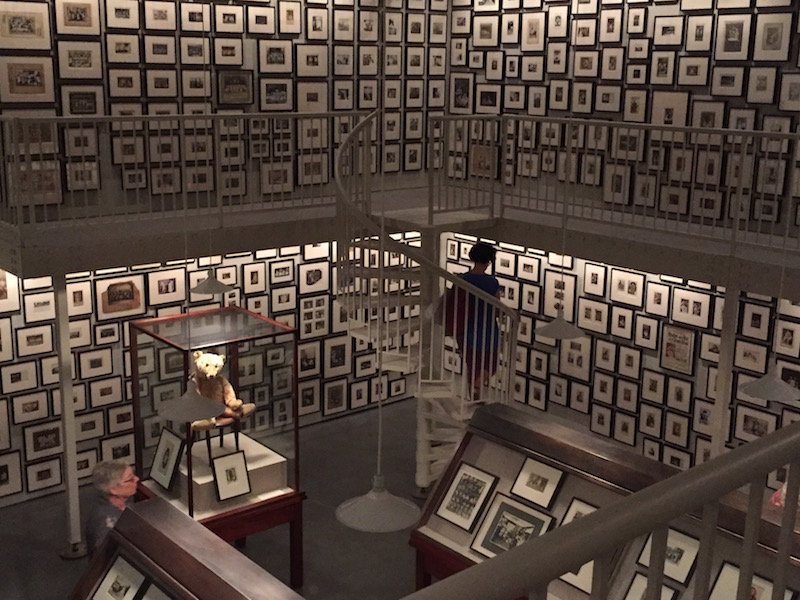
Included are works like Canadian artist-curator Ydessa Hendele’sPartners “The Teddy Bear Project” (2002), which comprises more than 3,000 antique portraits of people and their teddy bears, Shinro Ohtake’s manic collaged scrapbooks (1979-2016), and Susan Hiller’s “The Last Silent Movie” (2007-2008), an audio work sounding the voices of the speakers of twenty-five extinct or dying languages.

While many of the collections of items included in the show are impressive and thought provoking, it’s not difficult, as a viewer, to wonder: Is simply compiling a quantity of something enough to call it art? Jose Falconi, postdoctoral fellow at the Department of History of Art and Architecture at Harvard University, critiques:

“Some of the pieces, most notably Ydessa Hendeles’s “Partners (The Teddy Bear Project)” are pieces which do not have much more merit than the mere act of collecting itself. An act that is, as we all know, one of the most basic tricks in the artist book: any object starts acquiring new meaning when they are collected — just as any object starts acquiring a new meaning when they are rendered in a different scale (very big, very small). In that way, The Keeper does very little to show that there is anything beyond putting into motion such a trick and conflating many different possible readings of the works gathered in it. What is, for example, the critical difference between hoarding and collecting? Is one simply the result of an impulse gone astray?

keeper3

 Installation view of Ydessa Hendele’s “Partners (The Teddy Bear Project)” (2002)

Supposedly the show is about showing that behind such repetitious acts there is something else lurking around, but I didn’t see it; the exhibition almost presents as mere celebration of collecting without any criticality. In other words: it suffers from what it is trying not to show.”

The answer to the question of the validity of collecting or amassing objects as art may certainly be up for debate, but one idea that seems to be paramount in understanding the value of a show like this, according to Writer and former New Museum Technician Matthew Blair, could be considering curating as the art form itself:

The Keeper either raises the status of curating to a form of art-making, or blurs the lines between collecting and creating; between curating and art-making. The curators at The New Museum have always had an interest in mounting shows that tend to [utilize] more than just content and juxtaposition. They organize shows that put more of the onus on the curators — changing the role of curating to being the dominant mode of exhibiting.”

Therefore, in part, it could be said that it is The New Museum’s commitment to allowing for experimental curatorial practices that is one of the elements most on display in The Keeper, more so than any individual work.

keeper4Shinro Ohtake, “Scrapbooks” (1979-2016)

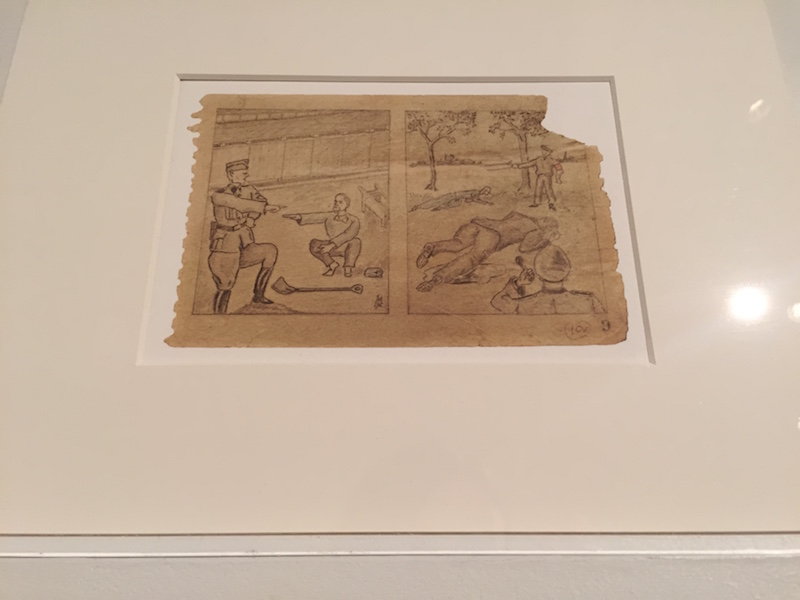
keeper5Reproduction of drawing from “The Sketchbook from Auschwitz” (original drawing included in the collection of the Auschwitz-Birkenau State Museum), (ca. 1943) 

In the following interview, New Museum Assistant Curator Natalie Bell, who collaborated on The Keeper with Mr. Gioni provides further insight on collecting, identity, and explorations of preserving and protecting as art.

Artifactoid: From your perspective, what do you think are some of the most important things that The Keeper reveals in regards to how collecting objects relates to our identity? Are there any works that you think make some of the biggest statements? Which ones and why?

Natalie Bell: Well, almost by definition, any collection is going to reflect its collector, whether it’s merely a matter of taste or representative of a unique philosophy or set of beliefs.  In this show, of course we were interested in collections that tell a story about someone’s beliefs, or an unlikely faith that certain objects and images could prove or validate an otherwise irrational or obscure idea, which is not true of everything in the exhibition, but is a significant recurring feature of many of its “keepers.” The first that comes to mind is Roger Caillois, a French theorist who collected rare stones because he believed they could reveal a shared cosmic history — which is not such a far-fetched thought if you think about the cosmic scope of geological formations. Or Wilson Bentley, who pioneered microphotography and amassed over five thousand negatives of snowflakes to prove his hypothesis that no two snowflakes are alike. But these are instances in which collecting relates to identity, if identity is understood as one’s beliefs, which is not always how we think about identity.

keeper6Oil on canvas paintings by Hilma af Klint (1914-1915)

Which works make the biggest statements? An important footnote to Hilma af Klint’s luminous abstract paintings from 1914-15 is that she had stipulated, at the time of her death, that they be withheld from the public, or basically kept secret until twenty years after her death. So essentially she believed that her work, which was not so well received in her lifetime, would only be truly appreciated in the future. But maybe the most powerful work for me is one that combines a belief in a future discovery and an enormous moral imperative to bear witness, which are the drawings from an author known by the initials “MM,” which were found hidden in a bottle in the barracks near the gas chambers at Auschwitz and are among very few images made in Auschwitz that actually depict the atrocities of abuse, torture, and mass extermination. Clearly, the artist who made these knew the severity of punishment he would encounter if he was caught making these images, and he took enormous risk to document what was so impossibly horrific and was otherwise being assiduously hidden by the Nazis.

Artifactoid: In what ways is the idea of collecting and quantity important in art? When we call a collection of things art, what, in your opinion, are the effects or significances of that?

NB: Personally I don’t think quantity or collecting are virtues in themselves, but one way to think about how collecting or quantity have importance in art is that a dedicated accumulation of anything reflects someone’s passion, and maybe at times, their obsession — and alongside that, we tend to regard an artist’s zealousness or compulsiveness as a creative virtue. In a sense, this exhibition is maybe guilty of exploiting the legacy of romanticism, but the effect is perhaps visitors come away from the show with a new way of thinking about what it means to be creative. But it wasn’t a particular agenda of ours to anoint these bodies of work or collections as “art,” but rather to reflect on what is essential and universal about our emotional attachment to things, and how forming bonds with things helps us cope with our mortality.

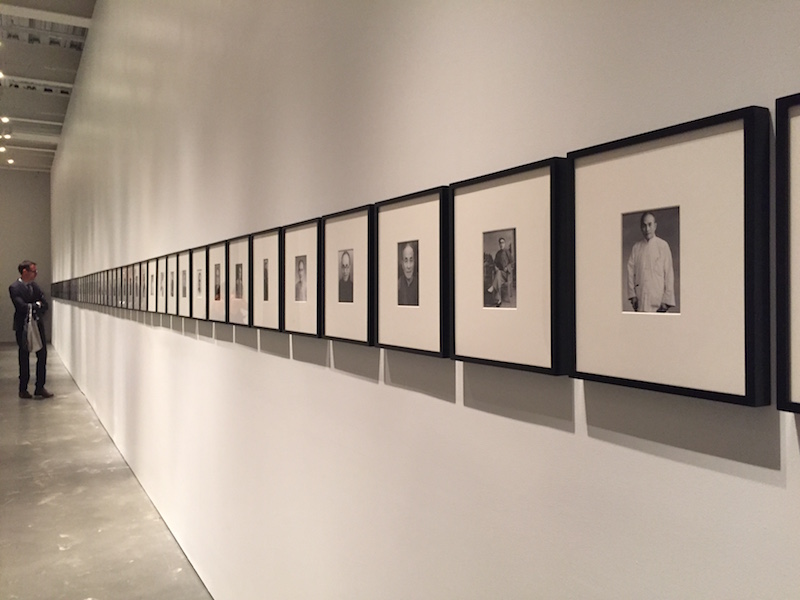
keeper762 consecutive annual studio portraits of Ye Jinglu, collected by photography collector Tong Bingxue, (1901-1963)

Artifactoid: When considering the compiling of objects as art (which I was speaking about with Jose Falconi about), are there some important distinctions in your opinion about the practice of collecting versus hoarding?

NB: There are important distinctions, some of them arguable, but first of all I think you could call collecting a practice in the sense that it’s intentional and a collector might have to make decisions about what to acquire and what not to acquire, what’s worth keeping and what’s not worth keeping. Hoarding, on the other hand, is regarded as a pathological condition, and people who hoard have a compulsion to keep everything and suffer enormous anxiety about parting with anything. In other words, it comes down to being judicious about what you surround yourself with and having a capacity to refine one’s collection, rather than just keeping everything.

But in the framework of our thinking about the show, maybe the matter of preserving and protecting opens up something more contentious — which is that people who hoard often believe that they’re preserving the things that they keep for some future opportunity, and that their guardianship is essential. And there’s also maybe a shared psychological impulse in which amassing things can be a way of coping. But the arguable difference in my mind is that if you hoard, you’re constantly compromising your capacity to actually take good care of the things you have. That, and the fact that no one wants to become a hoarder. It’s considered a condition for good reason!

Artifactoid: There was a connection of several of the works to World War II and the Holocaust. Who decided to include multiple of those works, and why do you think that the idea of “collecting” is important related to that period in history?

NB: There are a few works that may stand out because of their relationship to the Holocaust, but I don’t think the idea of “collecting” is more related to that period in history than to others. Of course, it’s interesting generally to think about people’s relationship to material culture vis-a-vis larger historical events. It can manifest as a pragmatic approach, like how many Americans who came of age during the depression and remember the rationing of WWII have a tendency to reuse and salvage things that we might otherwise consider disposable. But this is more a trauma of poverty or scarcity that spurs collecting as a preventative measure. In other words, is my grandpa’s drawer full of golf pencils the product of his emotional attachment to these objects? Not really, considering that he has the same attitude toward saving ketchup packets from fast food restaurants.

keeper8Detail from Henrik Olesen’s “Some Gay-Lesbian Artists and/or Artists relevant to Homo-Social Culture Born between c. 1300–1870″ (2007)

keeper9The 387 Houses of Peter Fritz (1916-1992), Insurance Clerk from Vienna, preserved by Oliver Croy and Oliver Elser (1993-2008)

But, that said, in this exhibition we weren’t so interested in the idea of collecting in a broad sense, but in something quite specific, which is a desire to preserve and protect and care for certain objects and images, so rather looking for instances where there’s a certain desire or love that’s motivating someone to action. This is a very different sort of mandate — and one that’s as subjective as it is emotional. But to return to the parts of the show that touch on the Holocaust, I think that there are potentially a lot of connections to collecting. Obviously, collecting as a form of bearing witness takes on a real urgency when there is a genocide that attempted to leave no evidence of mass exterminations, but on an emotional and psychological level, forging emotional attachments to objects is a common way of coping with the trauma, so it should be no surprise that WWII and the Holocaust stand out as something of a focal point in a show whose historical scope includes the last century.

Floors 1-3 of The Keeper will be on view at The New Museum (235 Bowery, New York, NY 10002) through Sunday, October 2nd, 2016. The fourth floor of the exhibit will be open through Sunday September 25th.

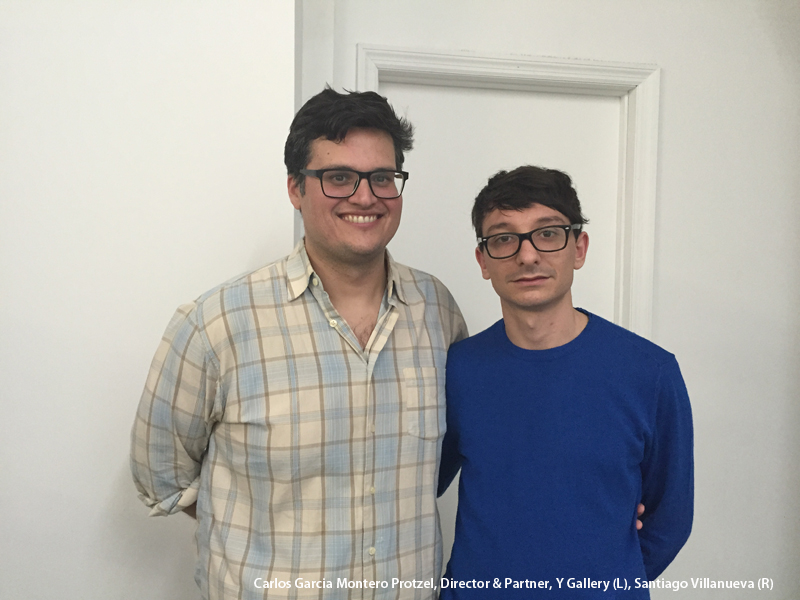
Santiago Villanueva, Y Gallery

I first met Artist Santiago Villanueva in 2010 in Buenos Aires. We were inside of the University of Buenos Aires social sciences campus, called “Marcelo T. de Alvear,” spending the day hijacking social and political student protest posters that would later be utilized in another artist’s exhibition in Scotland. That university campus is known as the most activist campus in the city.

SantiagoVillanueva7

At that time I was very wide-eyed and excited, witnessing first-hand this incredibly palpable activist energy in Buenos Aires. I was noticing the strong sociopolitical commentary both in the city’s daily life, as well as in art and expression in Argentina in general. It was coming from students and citizens of all walks of life, as well as from the top contemporary artists in the country.

YGalleryVillanueva2 copy

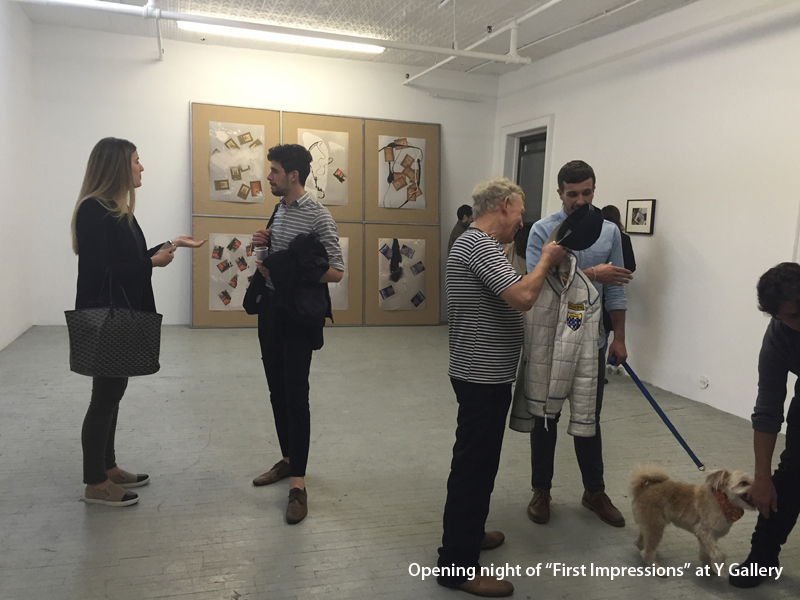
I’m thrilled to share that Villanueva, one of the influential contemporary artists I had the privilege of spending time with there, is currently exhibiting at NYC’s Y Gallery on the lower east side with a show titled “First Impressions.” The exhibition comprises a series of recent works that reflect his continuing revision of Argentinian history and art history.

YGalleryVillanueva4

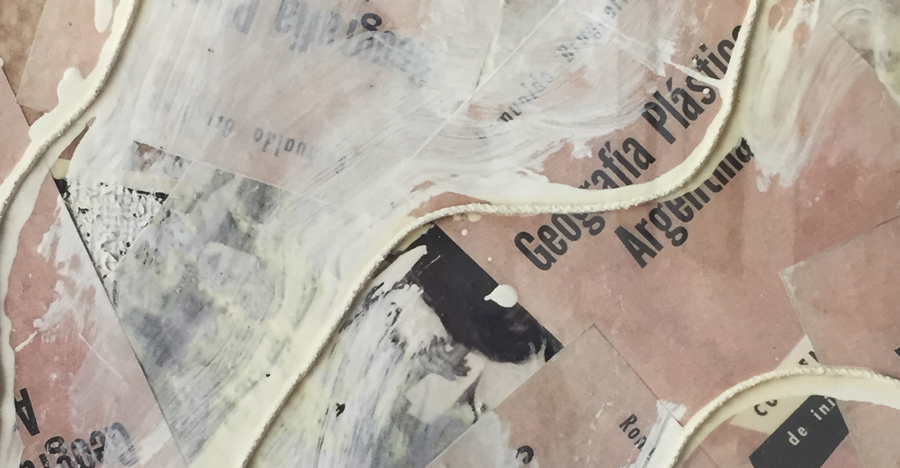
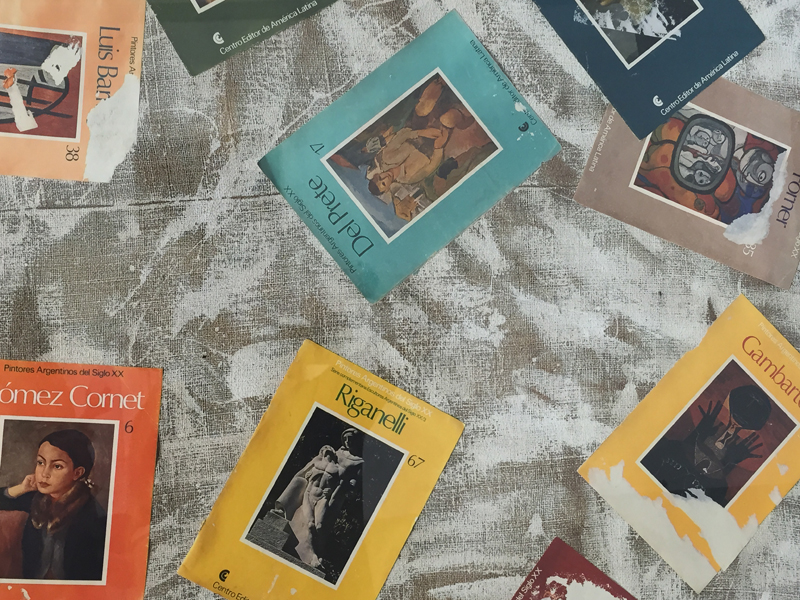
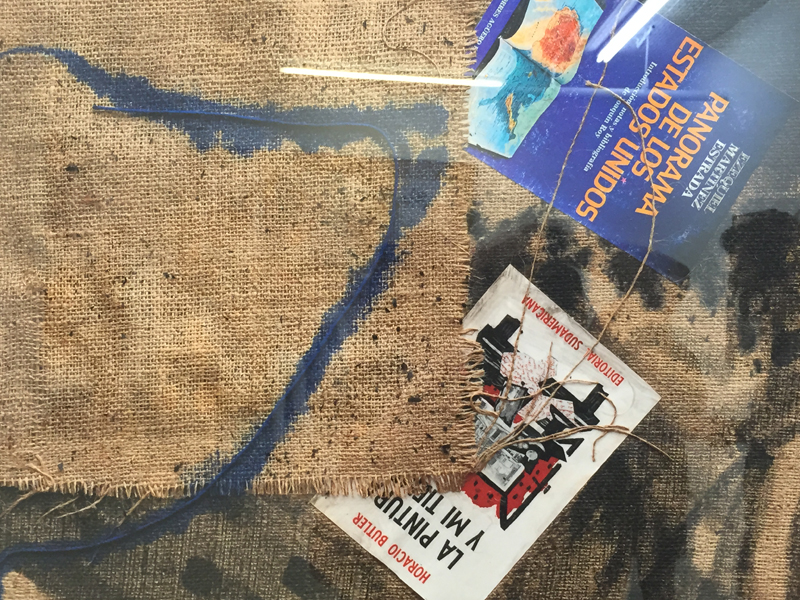
“First Impressions” combines a mid-19th century Argentinian visual tradition called the “disorderly table,” or, “mesa revuelta” (imagine it as a messy still life), with the results of Villanueva’s past two years of research about Argentinian art history. For the project, Villanueva worked with a variety of media including papers, threads, letters, documents and images selected from both the mass media and the works of specific artists. The result is a personal map or atlas of Argentinian art history that both changes the usual visual expectations of a still life, and provides a unique, non-linear methodology for the understanding of art history that breaks from traditional pedagogic approaches.

Villanueva8 Villanueva6

This exhibition marks another success in Villanueva’s exciting career. In recent years he has received a consistent stream of honors from prestigious organizations, including scholarships at the Center for Artistic Research (Centro de Investigaciones Artísticas – CIA) and the Cisneros Fontanals Art Foundation (Fundación Cisneros Fontanals – CIFO), as well as appearances in museums and institutions including the General Argentine Consulate in New York, the Museum of Modern Art of Buenos Aires (MAMBA), and the Museum of Latin American Contemporary Art (MACLA).

Villanueva9

Stop by Y Gallery (319 Grand St.) to see “First Impressions,” open through November 15th, 2015.