Pictured Above: Natasha Roberts Kay Photographed by Jeanne Paradiso for THE KNOW
As both New York’s Art Week and Fashion Week come to a close, a recent project came to mind that tastefully married the two worlds: A Room Just So, an exhibit of twenty international artists curated by Natasha Roberts Kay at Bergdorf Goodman.
Audrey Schilt, Behind the Scenes at Ralph Lauren (Claudia Being Fitted), Acrylic paint on canvas, 42 x 48 in. Courtesy of the curator.
Roberts Kay—a fashionista herself—wears many hats including curator, sought-after art advisor, new mom, and powerhouse publicist for the Public Art Fund. She can always be found pushing forward courageously with her vision, including regularly curating art exhibitions in New York City’s tallest skyscraper. While some in the art world shy away from embracing the connection between fine art and luxury retail, Roberts Kay orchestrates consonance between the two.
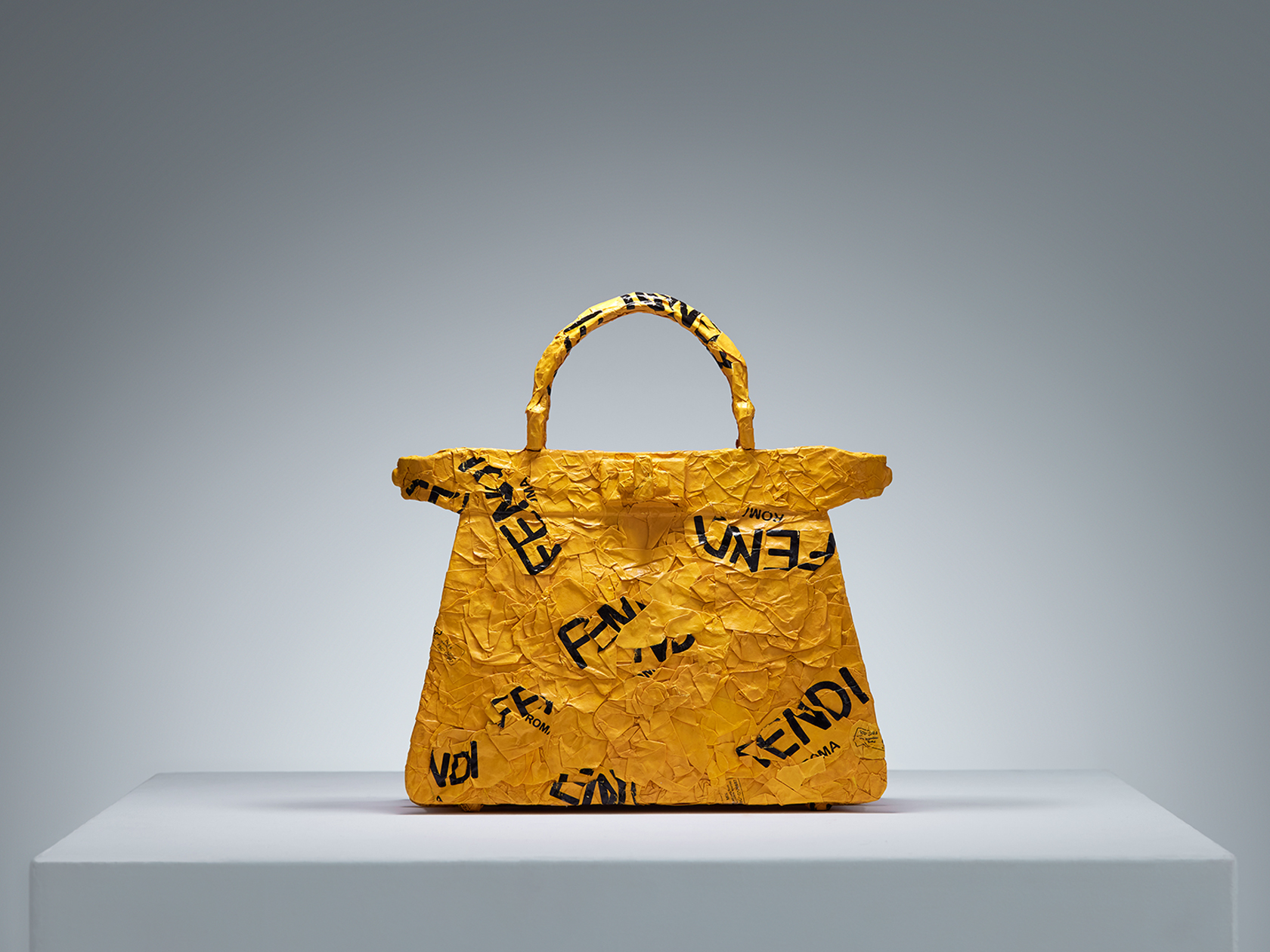
CHiNGLiSH WANG, CHiNGLiSH Brands (Fendi Peekaboo), Paper shopping bags and metal wire, 11 x 4.4 x 11.5 in. Courtesy of the curator.
This was clear to me as soon as I stepped onto the seventh floor of Bergdorf Goodman to see Roberts Kay’s curated summer art exhibition, A Room Just So. Naturally, an environment like Bergdorf’s that successfully blurs the lines between retail and art is an inviting setting for the right exhibit. For A Room Just So, appropriately located on Bergdorf’s interior design floor, Roberts Kay “reimagined domestic spaces as living galleries, where paintings, sculpture, furniture, and design objects seamlessly intertwined with the art of home décor”.
Erin Kono, PersimmonI + II, Egg tempera on shaped board, 9.5 in. tondo each. Courtesy of the curator.
The exhibit, which included sixty sculptures, paintings, photography, textiles, and design objects by Alex Anderson, Vicky Barranguet, Edgard Barbosa, C.J. Chueca, Jane Dashley, Jen Dwyer, Kamiesha Garbadawala, Leia Genis, Manuela Gonzalez, Katie Hector, Erin Kono, Kouros Maghsoudi, Thérèse Mulgrew, Hannah Polskin, Gerardo Pulido, Audrey Schilt, Jeremy Silva, CHiNGLiSH WANG, Darryl Westly, and Avery Wheless, added new depth of creative storytelling to the department store’s seventh floor. The works, which ranged from abstraction, to surrealism, to figuration, to functionality, spoke to how art, design, and interior space have the capacity to shape our state of mind. Roberts Kay’s inclusion of thorough information about each artist on view with an impressive detailed audio guide elevated the show to the standards of a top commercial art gallery, while its setting at Bergdorf’s infused it with warmth by simulating living at home with the artworks. A Room Just So positioned the twenty artist’s works in a salable environment with exposure to new clientele, without diminishing their value as original works of art fit for a traditional gallery or museum.
Roberts Kay shared: “With the exhibition, my intention was to assemble a group of traditional artists who are stylish and fashion-forward. For example, Audrey Schilt started her career as Halston’s illustrator at Bergdorf’s—she even sketched Jackie Kennedy in a fitting for her iconic Pillbox hat—and now Schilt paints works inspired by her time in fashion, including her Behind the Scenes at Ralph Lauren series. Artists Leia Genis and Manuela Gonzalez works featured draped and woven textiles that were painted and dyed. CHiNGLiSH WANG sculpted iconic handbags using several major brands’ own shopping bags as material. Many of the works in A Room Just So directly demonstrated a relationship between fine art and design.”
Gerardo Pulido, Set of #25, Gouache, watercolor, and marker on paper, 12 x 9 in. Courtesy of the curator.
Anecdotally when I entered Bergdorf’s to see A Room Just So on a quiet Friday morning this summer, I overheard a shopper speaking on the phone in the jewelry section to my left, “Hi, I’m at Bergdorf’s,” she said, “…it’s really the last of the great department stores.” Hearing this, I thought to myself, wow, that really is true, isn’t it. Bergdorf Goodman is iconic; it has its own deeply-rooted historical weight as a bastion of elegance in New York City culture that allows it to seamlessly incorporate a foray into fine art that—with the right people like Roberts Kay on board—can be taken seriously.
Alex Anderson, Rose Vessel, Earthenware, glaze, gold luster, 10 x 12 x 12 in. Courtesy of the curator.
While A Room Just So has come to a close, currently on view in Bergdorf’s seventh floor gallery space is a new exhibit expertly organized by Tribeca-based art and design firm, Todd Merrill Studio, in partnership with de Gournay handpainted wallpaper. This new show features additional artists I love who cross over between the art and design spaces, including Andrea Marquis and Jamie Harris. Bergdorf Goodman’s seventh floor home decor space is open to view seven days a week.
Above image: Installation view of Laura Owens, Matthew Marks Gallery, New York, February 13 – April 19, 2025. Photo by Bailey Coleman.
By Bailey Coleman
“Have you seen Laura Owens yet?”
Opening the door to the gallery I am welcomed by a nearly manic energy. Gallery goers are thrilled with themselves that they have finally made it to Chelsea to see the show everyone is talking about. Laura Owen’s eponymous exhibition at Matthew Marks has been widely lauded as a tour-de force of art making and I was just as excited as those around me to see what all the fuss was about. There is a swarm of people hovering around the gallery attendant’s desk with anticipation as the artist casts her first spell. An older woman with a fresh, blonde, blowout squeals with excitement, as a roll of tape magically moves across the desk. Suddenly, a drawer opens when her friend removes a pen from its holder. Having been witness to these moments of fantasy, we are baptized and free to pass through to the magical world of Laura Owens in her first solo show in New York City since her 2017 mid-career survey at The Whitney.
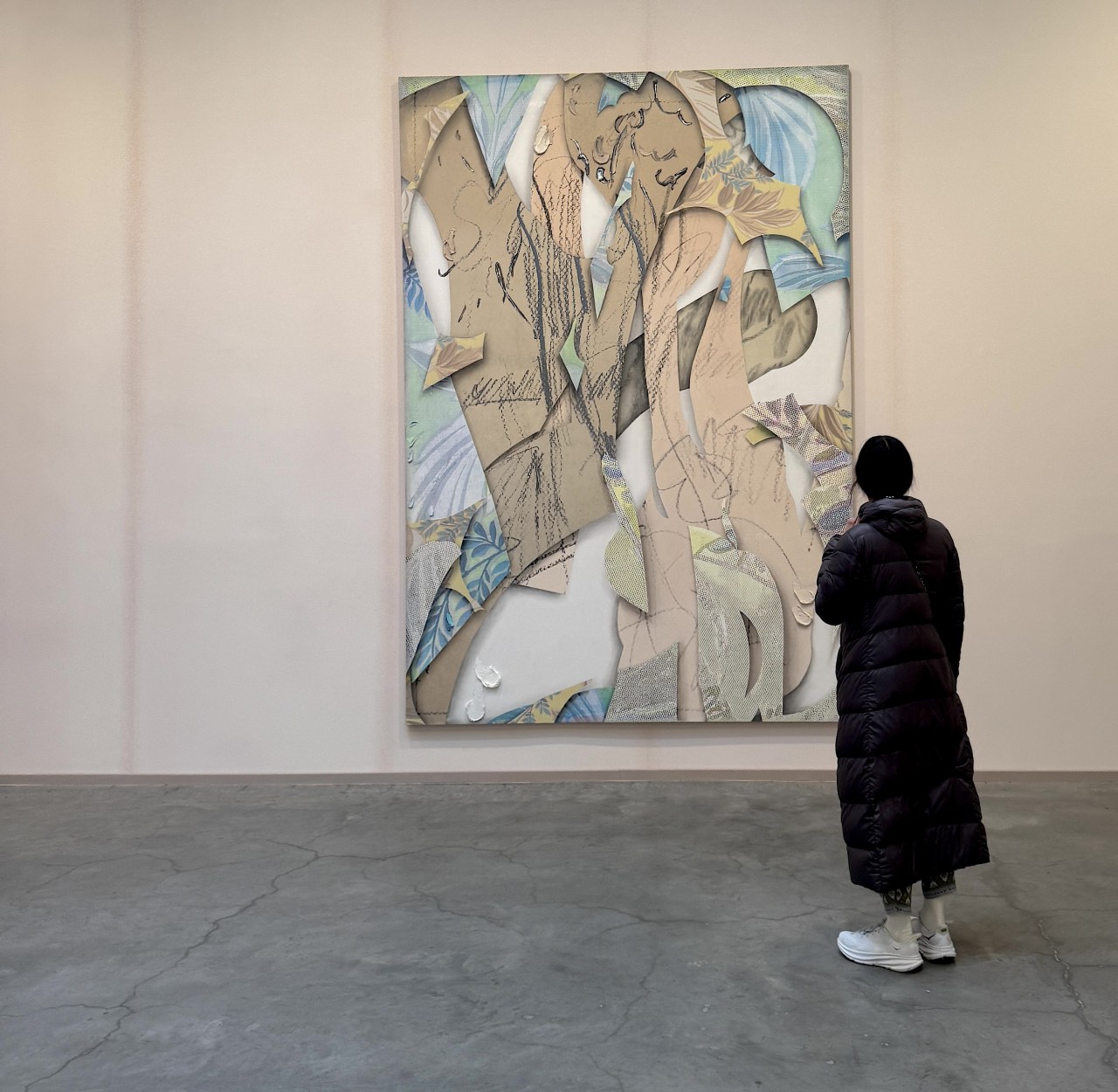
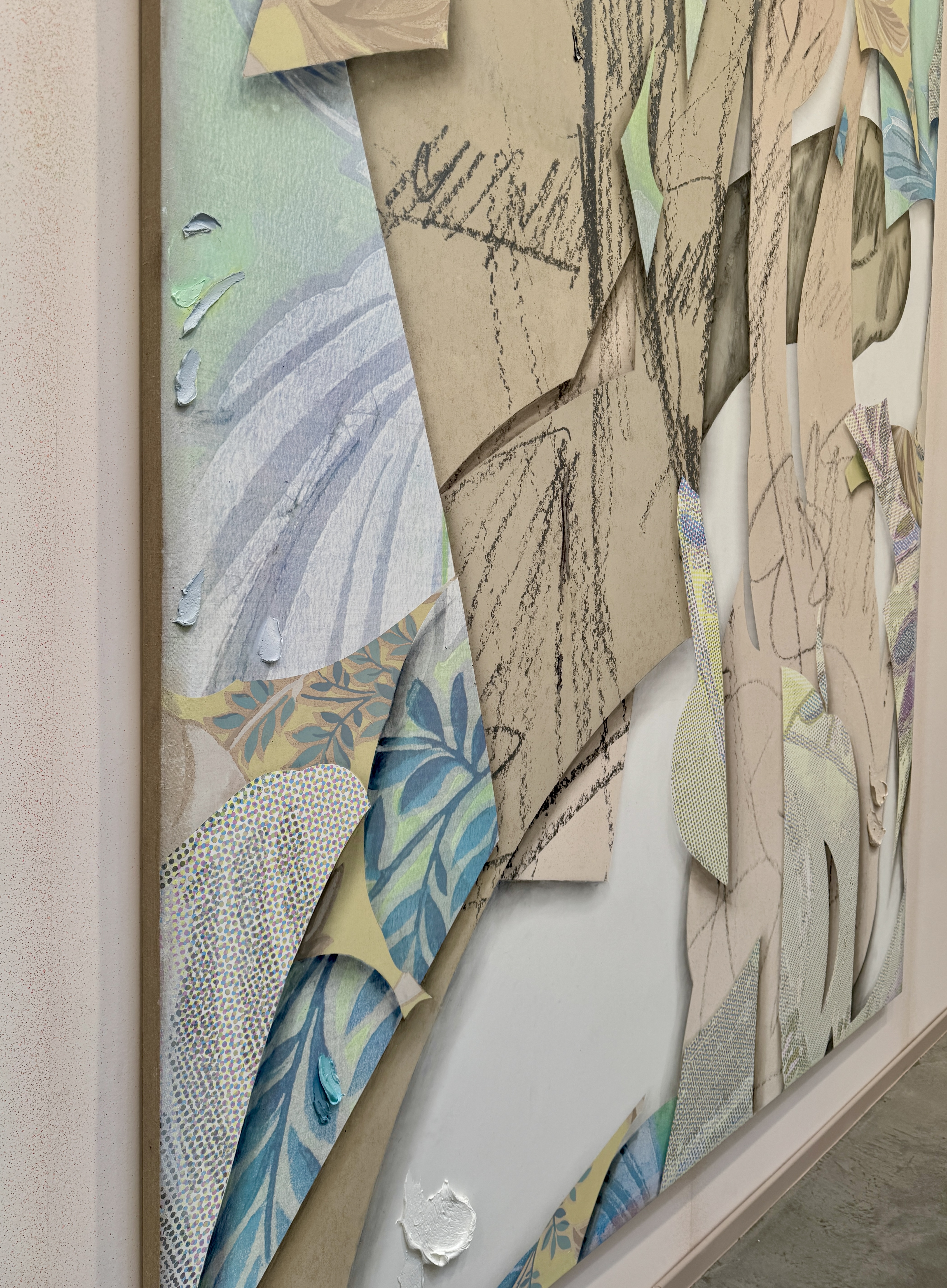
Laura Owens, Untitled (Detail), 2025, Oil, pastel, charcoal, graphite, and silkscreened Flashe on linen, 130 x 90 inches. Photo by Bailey Coleman.
In the first gallery, ten-foot tall vertical pastel paintings hang in effigy of Laura Owens. Though not intended to burn in sacrifice, these impressive works on canvas are singular retrospectives of Laura Owens’s unique style. Collage, digital media, hand-made silk screen prints and heavy daubs of oil paint compete and complement one another in an effort to excavate the nature of contemporary abstraction. Articulated in light teal cubist forms, the painting on the gallery’s farthest wall is a combustive battleground of style and technique. The result is a soft pixelation of abstracted shapes that superimpose each other and create the illusion of material layering. Her work has been likened to artists such as Picasso and de Kooning by The New York Times and others. These artists were interested in the integrity of the picture plane and celebrating the medium specific flatness inherent to its two-dimensionality. Owens, of course, adheres to these Greenbergian ideals, however, her degloving of the picture plane goes one step further. By outlining formal elements of her composition in shadow, Owens emphasizes that these shapes, designs, and motifs are, indeed, painted, suggesting that qualities that contribute to the illusion of three-dimensional painting can extend to elements usually thought of as contributing to flatness.
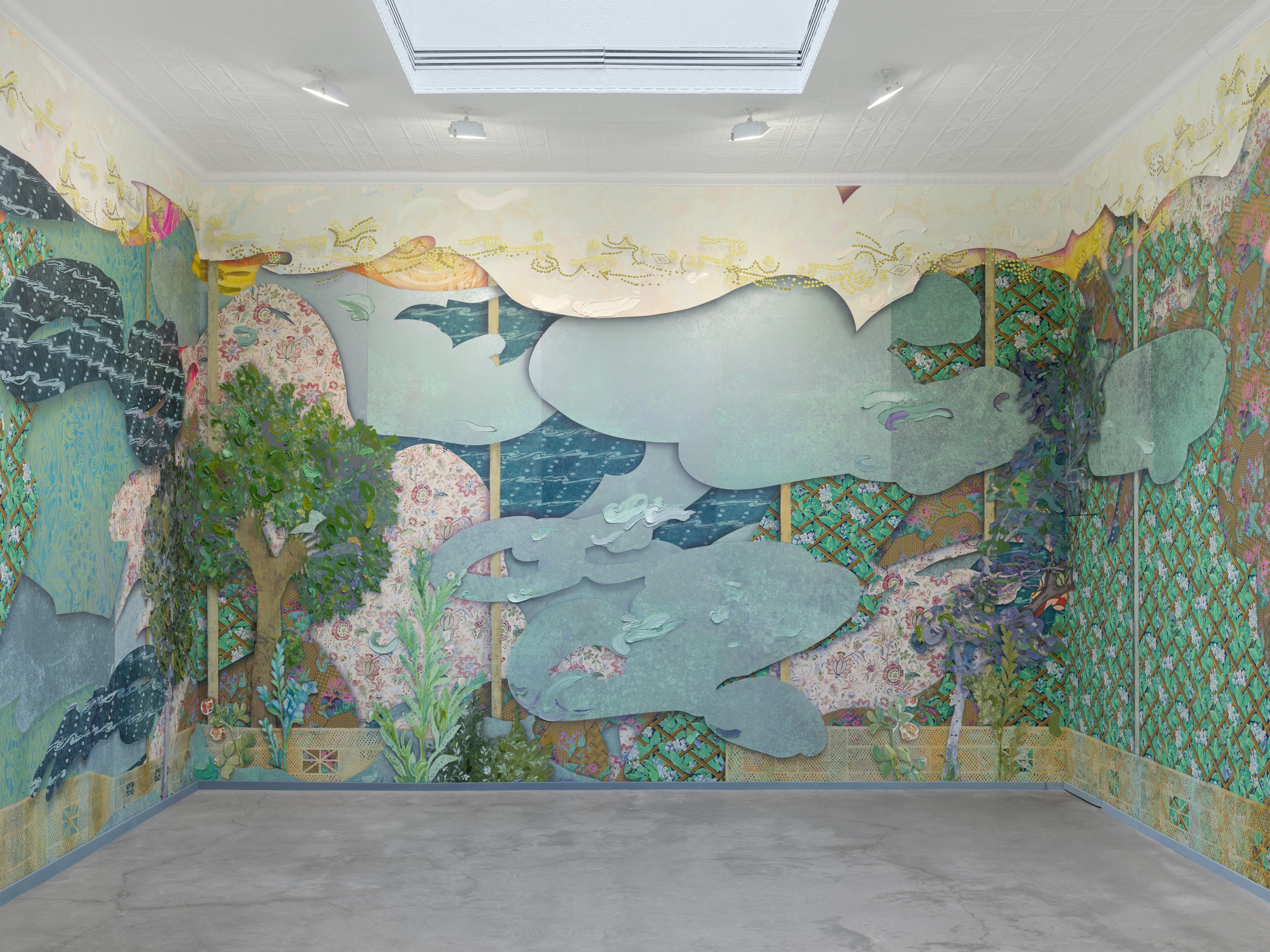
Once ushered through the large vault-like doors at the rear of the first gallery, I entered into what appeared to be a secret garden with hide-and-seek mechanical pop-outs that reveal small paintings. This exhibition is a surprise departure from Owens’s previous solo shows in many ways. Owens’s 2017 Whitney mid-career retrospective featured her impressive paintings on typical white walls. Now, at Matthew Marks, Laura Owens invites the viewer into an immersive environment that the artist herself has dictated. Floor to ceiling aluminum panels boast one hundred and fifty layers of her silkscreen prints, oil painting, and clay-coated paper that showcases a complex botanical motif with a lattice gate and overflowing greenery. The intricacy of the design layers and subtle shifts in depth perspective become an enveloping environment of the artist’s imagination. Suddenly, a gallery attendant opens a final hidden door to reveal a video installation in a dark, tiny, 3 x 4′ closet-like room. Craning my head upwards in the claustrophobic cinema, I watch as two black crows wax philosophical on the fall of the Roman empire and the prevalence of misogyny throughout ancient history – acting as a subtext of sorts. It felt like type of fever-dream talk show I’ve always craved, but never realized was missing from my life until I saw it.
After a moment of surreal and comedic bird-watching, I exited the principal gallery space and went next door to the annex to catch the exhibition’s final act. There, large boxes with handles, pulls, and knobs hold books and other curios. Fingering through the objects, the printed matter tells a narrative of existential exploration and metaphysical interest beyond the scientific. To my nostalgic delight, I am reminded of show-and-tell in elementary school, sharing memories tied to objects. Overall, the exhibition affirms Laura Owens as an alchemist of painting. She melds painterly skill, an eagerness to adapt unique technologies, art history, and humor, to create something entirely new and wholly her own.
“Laura Owens” is on view at Matthew Marks Gallery through April 19th, 2025.
Bailey Coleman
Bailey Coleman is a contributing writer to Artifactoid and is the founder of her own art publication: Bin Day Art. She is an art advisor and writer based in New York working with clients to curate private collections that speak to both individual desire and market interest. She received her MA in the History of Art & Curating from the University of London and her BA in Art History from Barnard College of Columbia University.
This article was originally published in Cultbytes.
Above: Installation view. “James Lee Byars: Perfect is the Question” curated by Vicente Todolí at Reina Sofia Museum Palacio de Velázquez, Madrid, Spain, May 10 – Sep. 1, 2024. Photo: Alexandra Goldman.
James Lee Byars occupies an interesting place at the intersection of minimalism and spirituality. Recalling the spiritual abstract painters Agnes Pelton and Hilma Af Klint who preceded him, there is this idea of the spiritual abstraction of the earlier half of the 20th century seeping into the conceptual minimalist sculpture of the latter half, which coalesces harmoniously in Byars’s work. Within it, he’s secured his unique position in art history, in a way that feels sincere.
Visiting “Perfect is the Question,” the American conceptual installation and performance artist Byars solo exhibition at the Reina Sofia Palacio de Velázquez in Madrid, I became interested in Byars’s unique ideas. I was excited that this was the “old stuff”—the good stuff. Even though his work is large and takes up space, it is quiet and pensive, rather than an overt visual spectacle. Presenting work from the 1950s-1990s, “Perfect Is the Question” at The Reina Sofia was curated by Vicente Todolí, and was the second iteration of a traveling exhibition that began at Pirelli HangarBicocca in Milan.
James Lee Byars. “A Dozen Facts,” 1967, in “James Lee Byars: Perfect is the Question” curated by Vicente Todolí at Reina Sofia Museum Palacio de Velázquez, Madrid, Spain, May 10 – Sep. 1, 2024. Photo: Alexandra Goldman.
The exhibition emphasizes Byars endorsement of the color gold, asserting it is not decorative, but rather, is spiritual, closer to god, like halos in fifteenth-century religious oil paintings. He also worked frequently with the colors white and red, also spiritual and powerful in their own ways – elemental colors. He works with the idea of the perfection of the circle, Da Vinci’s Vitruvian Man and “perfect proportions”, the “perfection” of death, and the physiological effects of minimalist sculpture on the viewer (think Tony Smith’s Die, 1962 as a six-foot gold pillar) He works with the ideas of myths, beliefs, transcendence, religious relics, architecture, and coveted objects. For example, he created a fantastical reliquary-like sculpture based on the once-held belief that narwhal tusks were unicorn horns. He combines the aesthetics of 1960s minimalism with Eastern philosophy, medieval Christianity, and the Renaissance interest in mathematical perfection in aesthetics.
Installation view. “James Lee Byars: Perfect is the Question” curated by Vicente Todolí at Reina Sofia Museum Palacio de Velázquez, Madrid, Spain, May 10 – Sep. 1, 2024. Photo: Alexandra Goldman.
Installation view. “James Lee Byars: Perfect is the Question” curated by Vicente Todolí at Reina Sofia Museum Palacio de Velázquez, Madrid, Spain, May 10 – Sep. 1, 2024. Photo: Alexandra Goldman.
Upon my return to New York, I looked at the “50 Years of Dia” webpage. I could not believe I did not see Byars’s name listed. He seems to fit in perfectly with this group of artists, and his spiritual twist to minimalism deserves recognition at this major establishment for installation art. It is not that Dia Art Foundation is the be-all and end-all of institutions, but for conceptual installation and large-scale minimalist sculpture (especially from the second half of the 20th century), it is hard to beat. Nor did I hear Byars’s name in my 2019 graduate-level Art History course on minimalism at Hunter College.
Michael Werner Gallery’s co-owner Gordon VeneKlasen, who represents the Byars estate, has been working on getting Byars into Dia for years. He thinks that Byars is excluded from the history of U.S. minimalism because of his interest in the immaterial: “Byars had a very different way of dealing with things than the minimalists because of his interest in the dematerial. He spent a ton of time in Japan and wanted to make immaterial work. He wanted to make the work disappear. The Minimalists would make an object and then would write a theory about it. He, conversely, would take an idea and make it concrete. No wonder he connected so closely with Beuys and Broodthaers. He was also really in with Rudi Fuchs and Harald Szeemann—the European curators.”
Byars had a retrospective at MoMA PS1 in 2014, 17 years after his death. Furthermore, he has had a significant exhibition history in the U.S. I might be the last one to the James Lee Byars party, or as the death-obsessed artist might have said—the last guest at his funeral. VeneKlasen emphasized: “He was a hero to so many artists. Dia artist Anne Truitt started every lecture of hers by saying: ‘We need to talk about James Lee Byars.’”
Installation view. “James Lee Byars: Perfect is the Question” curated by Vicente Todolí at Reina Sofia Museum Palacio de Velázquez, Madrid, Spain, May 10 – Sep. 1, 2024. Photo: Alexandra Goldman.
Installation view. “James Lee Byars: Perfect is the Question” curated by Vicente Todolí at Reina Sofia Museum Palacio de Velázquez, Madrid, Spain, May 10 – Sep. 1, 2024. Photo: Alexandra Goldman.
A versatile artist, Byars worked with a lot of natural and found materials; not only the narwhal horn, but dried roses, silk, wood, marble, paper, and sandstone. He was doing performances that involved choreography, geometry, and spirituality. He was experimenting with photography in the ‘60s and ‘70s, photo-documenting his performances as well as incorporating books and written ephemera into his practice. In 1969, his performance “The World Question Center” was broadcast on Belgian national television and comprised of intellectuals asking him significant questions—among them were Marcel Broodthaers and John Cage, writer Simon Vinkenoog, doctor Robert Jungk, and Knesset member Uri Avnery. The piece inspired The Reality Club, a New York-based group of intellectuals who met between 1981-1996. And, the title of the Madrid retrospective. Byars’s inquisitive practice touched the lives of many artists and intellectuals across the world.
In one of Byars most famous performances, “The Death of James Lee Byars,” the artist symbolically staged his leaving the physical world. It ook place shortly after he had been diagnosed with terminal cancer in 1994. The performance was set in a gilded gold room with crystals configured in a five-point shape representing his body, himself physically absent. It incorporated his ideas of spirituality and Da Vinci’s “five points” theory to represent any human body, as well as Eastern ideas learned from his years spent in Kyoto, Japan in the late 1950s. A couple of years later, in 1997, he died in Cairo where he was making art with artisans.
Installation view. “James Lee Byars: Perfect is the Question” curated by Vicente Todolí at Reina Sofia Museum Palacio de Velázquez, Madrid, Spain, May 10 – Sep. 1, 2024. Photo: Alexandra Goldman.
Installation view. “James Lee Byars: Perfect is the Question” curated by Vicente Todolí at Reina Sofia Museum Palacio de Velázquez, Madrid, Spain, May 10 – Sep. 1, 2024. Photo: Alexandra Goldman.
Byars has been lauded and recognized worldwide for half a century. He was included in Documenta 5, 6, 7, 8, and 9 in Kassel, Germany, and the Venice Biennials of 1980, 1986, and 1999. Apart from “James Lee Byars: Back in Detroit” presenting the artist’s performances at Wayne State University, Byars work is mostly being reexamined in Europe. In Europe, the traveling show “Perfect is the Question” and a dual retrospective held during this year’s Venice Biennial at the Palazzo Loredan, the seat of the Istituto Veneto di Scienze, Lettere ed Arti, alongside works by Seung-taek Lee are incredibly dense in further contextualizing the multi-faceted artist. The exhibition in Venice was a follow-up exhibition to one organized in London by Michael Werner Gallery and Lee’s Seoul gallery, Gallery Hyundai.
Byars left the U.S. in the late 1960s upon an invitation from Anny De Decker to join her gallery Wide White Space Gallery in Antwerp, and he never moved back. Veneklasen, who is based in New York, explains: “He just didn’t really fit in here. His first [seminal] performance was in 1969 in Belgium. He made his career in Europe. He disconnected. He was the American artist who was never an American.” He is quick to add: “But he was and istruly an American artist; he was born in Detroit.”
Byars is more present in European institutions than in the U.S., even though he is American. Is it because he spent a long time living in Japan, or because he died in Cairo? Whatever the reason it is time to bring him back to New York.
This article was originallly published in Cultbytes.
Hanae Utamura. “Into the Light,” 2023. Acrylic on Paper. 57.5 x 42 inches. Courtesy of the artist.
In a life-changing instant—the sudden death of her husband—Japanese artist Hanae Utamura went from creating artwork that spoke to geopolitical collective memory in Japan, to exploring the realm of the personal through the body and the metaphysical. Her prior series of projects looked outward to the world and spoke to collective pain, suffering, death, loss, and trauma. Her newer work looks inward to our spiritual being, birth, grief, and the biological earthly entities that create us. Despite this challenge, Utamura is light-hearted and thoughtful. We met while welcoming El Salvadoran artist Beatriz Cortez’s time-based visual art project, Ilopango: The Volcano that Left: a Calder-stabile-like metal sculpture to Troy. In the shape of a volcano—a symbol in both Salvadoran culture and in Mesoamerican codices—it brings ideas of the Mayan underworld to the fore. In Troy, we participated in a ceremony to bless the Native American burial site with tobacco while Ilopango passed by us on the river.
Unbeknownst to Utamura’s recent loss, I was drawn to her bubbly and friendly nature and intrigued by her knowledge of indigenous practices. Perhaps it was our proximity to other realms that connected us—my mother lost her mother at a young age and has explored modes of communication with spirits, exposing me to conversation and practice surrounding energetic transitions. In recent years, spiritual art by women tracing back to modernist and proto-modernist abstraction is more widely known, facts that Jennifer Higgies writes about in her new surveyThe Other Side: A History of Women in Art and the Spirit World. As we offered tobacco to the land, Utamura invited me to visit her studio on the Rensselaer PoIytechnic Institute’s (RPI) nearby campus, where she is enrolled in a practice PhD program, and I accepted.
At her studio, Utamura told an unexpected and moving story about the recent transition in her artwork style. Her husband, Robert Phillips, was an American new music composer. They were an artistic couple who met in 2014 at Akademie Schloss Solitude, an international artist residency in Stuttgart, Germany. Within a very short period after the world entered the pandemic, Utamura experienced bringing life into the world, giving birth to their son, Kai, in 2021. Shortly thereafter, in 2023, she saw life leave the world with Robert’s death due to sudden illness. It was a devastating and unexpected tragedy for the young couple and their family.
On the 49th day after Robert’s passing, which in Buddhist tradition marks the day when one’s spirit and energy are fully released, Utamura performed a ritual to honor him. She had saved the placenta from Kai’s birth (which is dried in the shape of a bowl), placed Robert’s hair inside the placenta, and buried both together beneath a tree. When Utamura and Robert spent their last moments with each other, they exchanged locks of hair. The placenta provides oxygen and nutrients to the child through the umbilical cord, which also brings waste products away. It is shaped like a brain, or as Utamura describes it, a “half-cut earth,” and symbolizes growth and birth. “Placenta is treated as medical waste after birth in the Western medical world, but many cultures have a sacred, spiritual relationship to the placenta,” she commented. The placenta is often referred to as the “tree of life” for the branch-like patterns made by its blood vessels. The site continues Robert and Utamura’s life together, as the placenta’s nutrients—parts of their DNA—enrich the grass and tree roots, and other, in her words, “non-human species.” And, Utamura’s ritual symbolized Kai protecting Robert’s spirit, and carrying him into spiritual transcendence, with the eternal protection of his son.
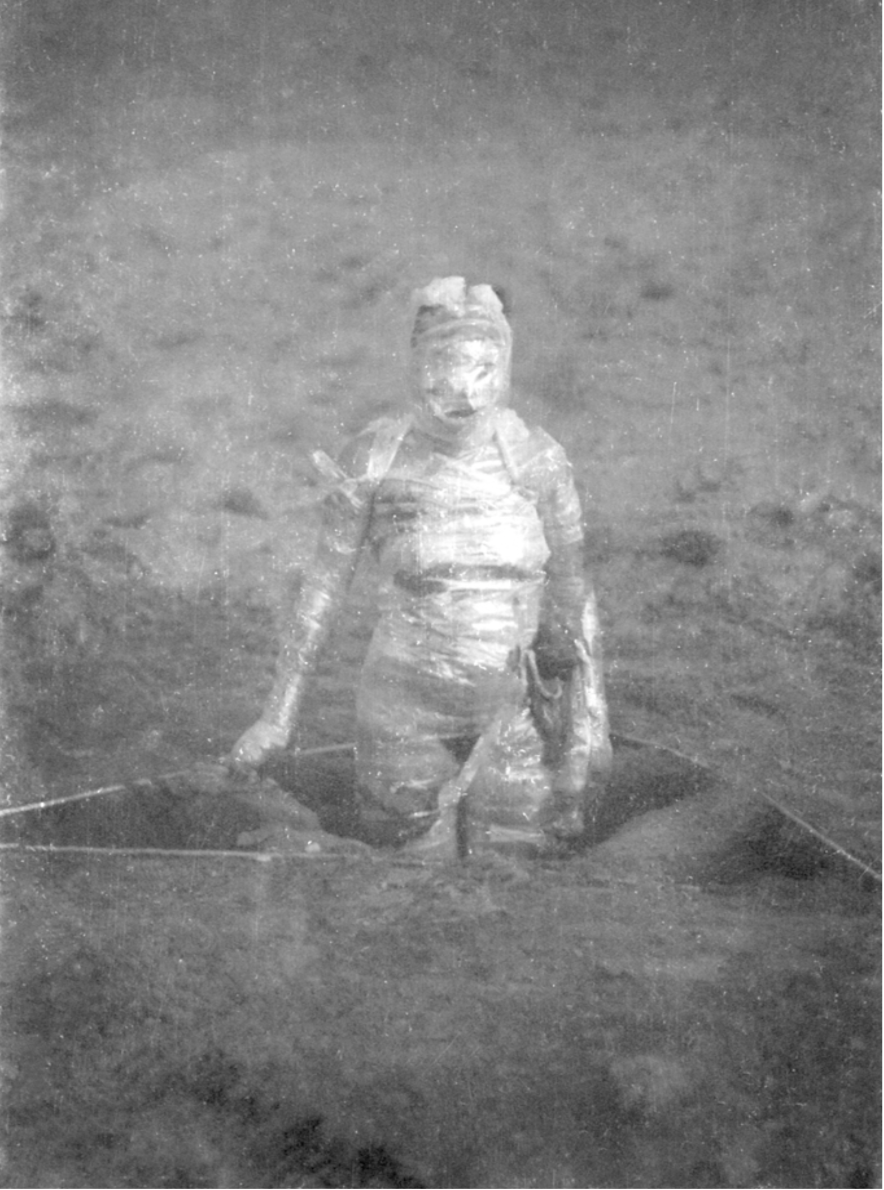
Maria Evelia Marmolejo. “Anónimo 4,” 1982. Performance. Photo by Nelson Villegas. Image courtesy of Maria Evelia Marmolejo.
Pioneering feminist artists from the early eighties also worked with the idea of the placenta as considered “medical waste” in Western medicine, while it is spiritual, such as Colombian artist Maria Evelia Marmolejo (who was included in the 2017-2018 exhibition Radical Women: Latin American Art 1960-1985 Hammer Museum and Brooklyn Museum). For Marmolejo’s 1982 performance, Anónimo 4, she dug a 1.5-meter triangular pit into the ground and filled it with sewer water and the placentas of all the babies born that day in hospitals near the performance site, in Cali, Colombia and Guayaquil, Ecuador. She wrapped her body in the placentas, and submerged herself in the hole, “embarking on a psychological and sociological self-exploration of the fear of being born in a society in which there is no guarantee of survival,” she explains in an interview. Artists like Marmolejo and Utamura observe the importance of the placenta by incorporating them into their performance rituals in meaningful, powerful, spiritual, and symbolic ways, whereas at the hospitals, they tend to be discarded.
Understandably, Utamura could not entirely let go of her partner. Because of these sudden extreme encounters with life and death, which now flow, in her words, “like the confluence of the river with raising Kai,” her perspective was instantaneously transformed, altering her artistic practice. Before Robert’s death, she created more geo-political artworks, often performances and films. One work Uncanny Valley – Study for Future Strata (see image below) raises questions around the dominant historical narrative of nuclear history by juxtaposing images of the elements that surrounded the atomic mushroom clouds of the bombing in Nagasaki, with the mining site in Congo where uranium was sourced for nuclear production – positioned above, and the military storage site near Niagara Falls where nuclear waste from the Manhattan Project was secretly disposed – positioned below. But, after she experienced the life-altering sequence of birth and death events, she felt compelled to turn inward to the body and spirit. Abstract painting helped her overcome “the unspeakable”—I immediately drew a parallel to the shift to abstraction in Western art after World War II. She believes in abstract painting as a powerful medium for channeling the energetic transitions relating to birth and death.
Hanae Utamura. “Uncanny Valley – Study for Future Strata,” 2022- Mixed Media. 21 x 16 inches. Courtesy of the artist.
“This has also very much been a collaborative process with Robert,” Utamura added, “Aur means ‘light’ in Hebrew. I feel that his symbolic composition, Aur, for string quartet and electronics, is the light that he transcended into. It transforms death into a departure. When painting, I hear his music inside my ear—his essence is expressed even more through his music in his physical absence. The music truly starts to live in eternity within me.” Having followed my mother’s journey to stay in touch with my grandmother after her death Utamura’s will to stay connected as a source of comfort resonated with my own experiences.
The first several paintings Utamura created exploring her feelings of grief were watery representations of a body, dissolving. After creating several of these more figurative paintings, she was invited to a séance by Tamar Gordon, a professor of Anthropology in the Communication and Media department at RPI, and a member of her doctoral committee. The séance would help her further shift her focus from grief to communication.
Hanae Utamura. “The Limb,” 2023. Acrylic on Paper. 24 x 18 inches. Courtesy of the artist.
At the séance, the physical medium Gary Mannion, headed a circle under controlled conditions, alternating between complete darkness and red light. Physical mediums, as opposed to mental mediums, produce materializations of spirits while mental mediums interpret and channel them. Physical mediums produce ectoplasms which are viscous manifestations of spirits that exude from their body taking on any form, including apparitions. Encircled by the participants and sitting in a cabinet, tied down to a chair, Mannion produced an ectoplasmic hand and invited members to touch and hold it. Utamura described the experience as having felt like “touching a wet hand.”
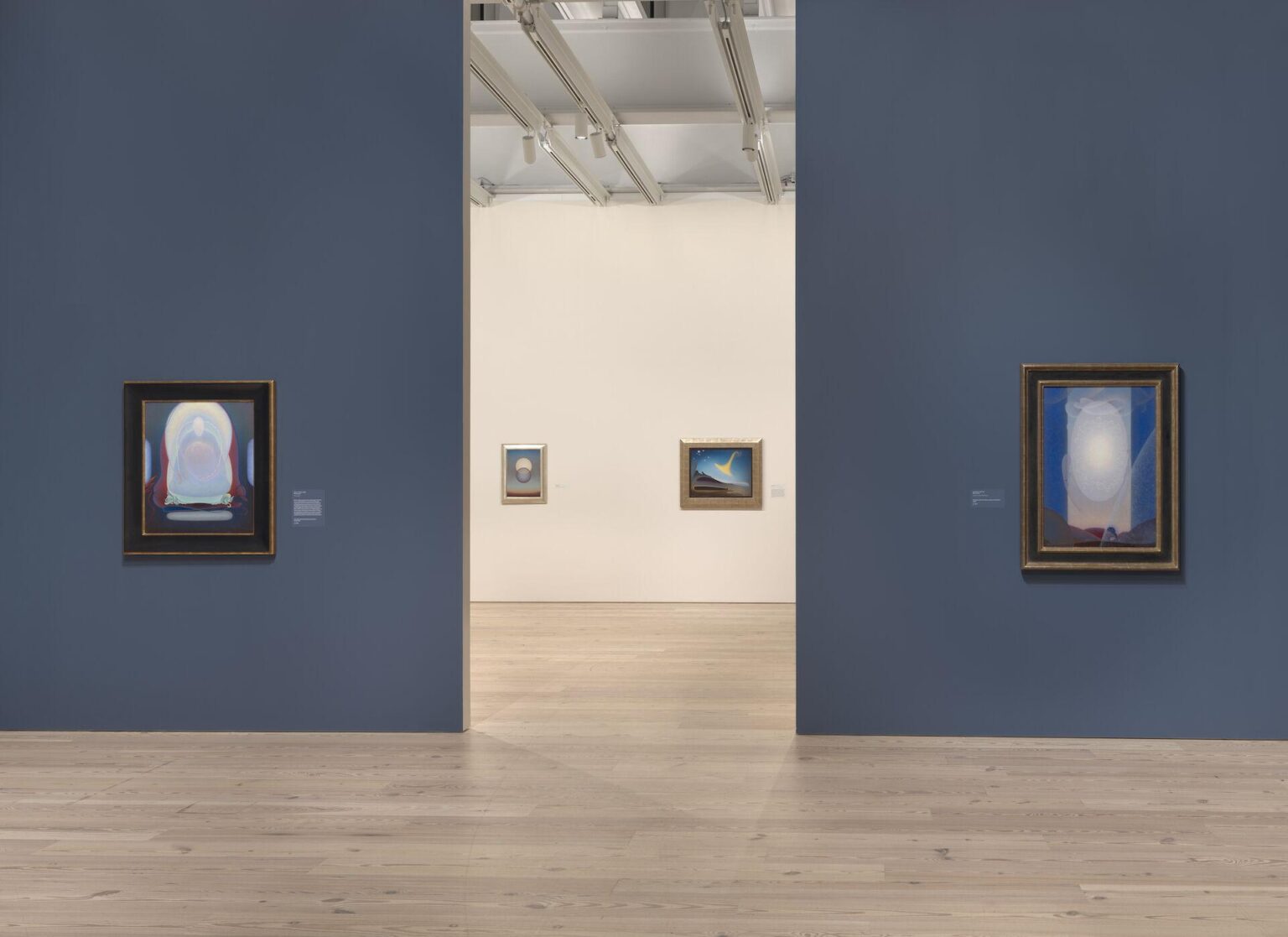
Installation view of “Agnes Pelton: Desert Transcendentalist” (Whitney Museum of American Art, New York, March 13–November 1, 2020). From left to right: Mother of Silence, 1933; Departure, 1952; Awakening (Memory of Father), 1943; Light Center, 1947-48. Photograph by Ron Amstutz. Courtesy of The Whitney Museum of American Art.
Séances were an American phenomenon popularized by the Spiritualist movement in the 1850s. They spread to Britain, other parts of Europe, Brazil, and Australia, and consisted of circles of sitters who gathered to channel the realm of spirits. Today, they are less common, but exist and Mannion is a leading figure in the field.
Utamura’s new work is also influenced by Shannon Taggart, a photographer and artist who authored a popular book depicting sitters in various states of transfiguration. Taggart recently had an exhibition of her work at the Opalka Gallery in Albany, NY. The two-day public opening included a dialogue between Taggart and Dr. Anne D. Braude, the director of Women’s Studies in Religion at Harvard Divinity School, and the author of the book,Radical Spirits: Spiritualism and Women’s Rights in Nineteenth-century America, which explores the close engagement of Spiritualism with the women’s rights movement. There is also a growing recognition in recent years of female artists like Hilma af Klint and Agnes Pelton, who employed art as a language to explore spirituality. Utamura considers her work as in alignment with these artists and thinkers.
Hanae Utamura. “Presence of Absence #3,” 2023. Acrylic on Paper. 24 x 18 inches. Courtesy of the artist.
After the séance with Mannion, Utamura created another series of paintings in which she began to depict the imaginary body that evolves to a more abstract state in its process, like energies and colors (rather than a dissolving figure), with rich, cosmic dark blues or brighter florals. Often she incorporates a bit of iridescent pigment “inspiring to channel, as it reflects light” she explains. The composition of Utamura’s new more abstract paintings on paper are vaginal and womb- or placenta-like. Some of these images incorporate a hand and a tree branch, perhaps referencing the tree under which she performed the ritual for Robert, or the sensation of touching a wet hand in the séance.
Serendipitously, a few months before Robert’s passing, she also found a book lying in a classroom at RPI titled The Perfect Medium: Photography and the Occult published by Yale University Press. It is the catalog from an exhibition in 2005 at the Metropolitan Museum of Art that showcased the history of photography on mediumship channeling with the spiritual realm, with imagery dating back to the nineteenth century. There is a page in the book that shows photography which captured ectoplasmic emissions, and the composition of these images have similarities to the composition of Utamura’s new paintings. She has a feeling that her spiritual involvement with the other realm was and is still being presented to her from many different angles.
Both of these newer series explore what comes before, what happens during, and what comes after, an extreme moment—global or personal. “We are living through dark times with a lot of death,” Utamura remarked sensitively in her studio, putting aside her personal loss and experience, knowing that this is going on all around us. “We’ve learned to accumulate, but we are not taught much about how to face loss. I think it is time for us to face this; exploring these spaces would also bring us more understanding of life in its complexity, and knowledge of how to nourish life. It will prepare us with strong grounds for the future to come. The more darkness that falls upon us, we also need light that illuminates our world.”
Turkish-French artist Sarp Kerem Yavuz loves photographing handsome men. His various bodies of work include sculptural photo-portraits of nude male models adorned with projected imagery of ornate Turkish Bathhouse tiles, sensuous, homoerotic photos of young American men convening in sports locker rooms (another homosocial space), and mixed media including neons, works on LED screens, and a functioning backgammon board created entirely out of Legos.
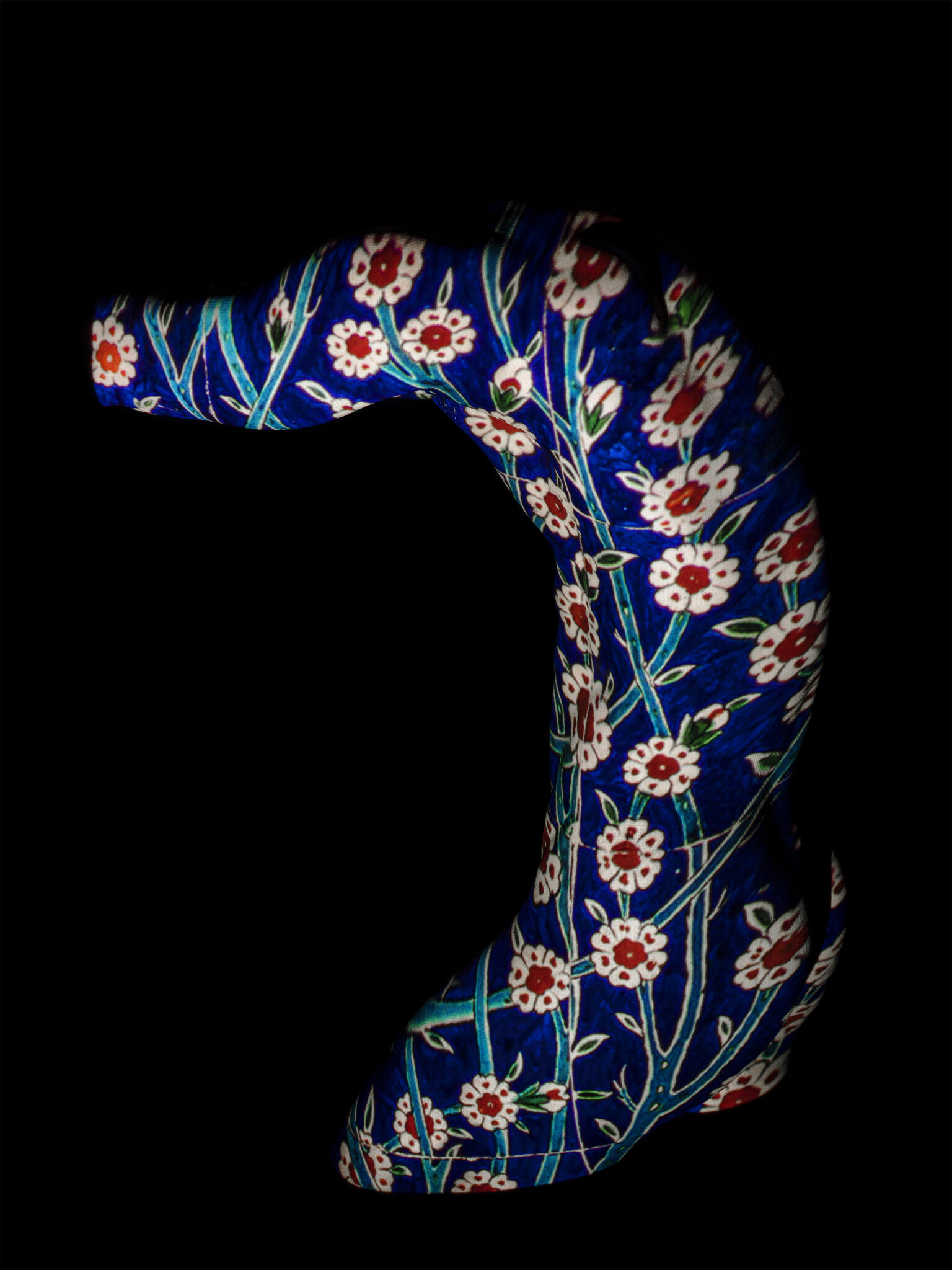
Sarp Kerem Yavuz, “Bahçivan,” 2022. Glicée print, 40 x 30 in. Courtesy of of the artist.
Thematically, Kerem Yavuz’s artwork is a reflection of himself: both Turkish and gay. These two elements haven’t historically been able to mix without conflict in his life, and he has always been interested in exploring those challenges. “For the last decade, I’ve been interested in deconstructing masculinity within an Islamic context. I often do this by queering (arguably already queer) orientalist imagery. My largest body of work to date, Maşallah, comprised of scanned Iznik tiles and later, scanned porcelain dinnerware, projected on male nudes to talk about the superimposition of conservative politics onto my generation. I would also periodically visit various Turkish baths to create cinematic scenes that were meant to imply the existence of broader, imagined, queer narratives unfolding in these traditional homo-social spaces. I guess I could say that I was always more interested in the story than the particular medium, although I am partial to photography.” Now that he lives and works in New York City, Kerem Yavuz is able to openly express these two important facets of his identity without suffering censorship from the Turkish government and death threats, among other significant challenges he has faced that many people may not have the courage to stand up to in the name of creative expression.
Sarp Kerem Yavuz. “Boğaz,” 2023. Polaroid. 4.2 x 3.4 in. Courtesy of the artist.
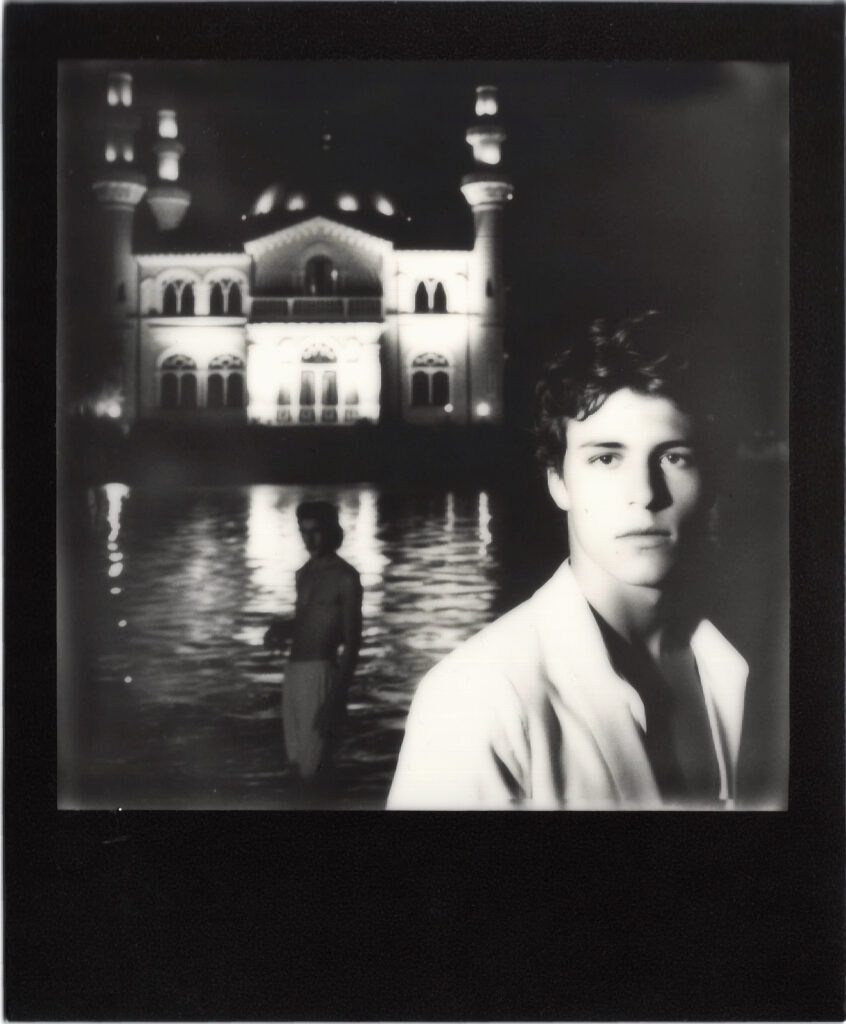
This year, he expanded upon his traditional art and photography practice by utilizing the AI software, Midjourney, to create AI-generated imagery for his latest series: Polaroids from the Ottoman Empire, currently on view at Palo gallery in NoHo. He discovered Midjourney “while looking into new digital art trends…its aesthetic capabilities felt more in line with my style than Dall-E.” The cinematic images on view in the exhibition Polaroids from the Ottoman Empire include images of two fit, ostensibly Turkish, shirtless men romantically gazing at the moonlight over a Mosque along the Bosphorus, a bejeweled drag queen making her grand entrance in an invented 1920s-style speakeasy nightclub in Istanbul, and bust-style portraits of handsome, turban-clad men gazing seductively at the viewer from inside a Hammam setting, among other fantasy, homoerotic, faux-vintage Turkish narratives.
The lighting in each of Kerem Yavuz’s AI-generated images is filmic and romantic, with mainly dark or jewel-tone color palettes. There are also a few black-and-white shots included in the series, which feel a bit out of place when thinking of traditional Polaroids. Some of Kerem Yavuz’s AI images are reminiscent of the style of a Jacques-Louis David painting, among other art-historical references and sources of stylistic inspiration. The Polaroid borders Kerem Yavuz chooses to print each image within – because no one likes to see a Polaroid without that iconic built-in bottom-heavy frame – are black, white, or gold. Before framing, Kerem Yavuz finally mounts each printed Polaroid on a mat, which represents a common color of velvet in traditional Ottoman interior decorating.
Importantly, Kerem Yavuz also shoots with real Polaroid film in a different series of his work, Shadows of the Empire, photographing staged scenes of his friends in Istanbul that comment on parallels between LGBTQ+ and women’s rights being taken away in both Turkey and the United States in recent years. “Shadows of the Empire” is currently on view at Zero Bond, where he is this month’s artist in residence via Apostrophe gallery. It is not easy to tell the difference between Kerem Yavuz’s real Polaroids and his AI-generated Polaroids. It’s clear Kerem Yavuz is using AI to mimic and expand upon his own photographic language, rather than copying another artist’s style: a major current plagiaristic danger of AI in the digital art space.
Sarp Kerem Yavuz. “Away,” 2022. Gold Frame Polaroid, 4.2 x 3.4 in. Courtesy of the artist.
For Kerem Yavuz, as both a traditional photographer and AI artist, the inevitable element of financial investment also comes into consideration. Kerem Yavuz elaborates, “I think most people who insist on traditional photography tend to forget how extraordinarily expensive high-end digital photo shoots are. Buying a decent medium format digital camera, which is what I have been using for the past decade, runs you between $10,000-$20,000. You can rent, but then you also need to get really good equipment insurance so that tends to be around $1000 for a week of shooting, just for a camera with a regular lens attached with a spare battery and some flash drives, (not including any lights, stands, sandbags to keep the stands where they are, portable batteries, backdrops, studio space if you need it etc.). Then, there is the additional cost of paying models, assistants, and the time cost of processing and editing the images, plus transportation if you are shooting on location. I have done all of these for years, and I have greatly enjoyed the process, but it is a costly endeavor, which often means you need commercial work to be able to afford to make artistic work. It is also incredibly time consuming. AI photography, at least in the way I have been engaging in it, feels a little more like street photography, where the production element is removed in favor of chance and spontaneity. It’s trickier to get what you want, since there is inevitably a lesser degree of control, but it does offer a greater degree of access to people without the means or the network to dive into photography as it is structured today.”
Whether shot in the flesh or rendered digitally, iconic gay male nude portrait photography can call to mind the explicitly sexual, stark, sensuous, and formidable black and whites by Robert Mapplethorpe, or perhaps the striking, colorful photography of nude or semi-nude male dancers and religious figures in fantastical staged scenes by David LaChapelle. Unlike Mapplethorpe’s homoerotic photography, Kerem Yavuz’s is understated in its eroticism. Unlike LaChapelle’s staged fantasy photography, Kerem Yavuz’s imaginary gay scenes incorporate an Ottoman visual language and color palette. Kerem Yavuz has his own visual language, and experiments with the reverse process using Midjourney to see how it categorizes his original images. “What is fascinating about Midjourney and other internet-based algorithms is that their ‘imagination’ is ultimately shaped by whatever dominates the web. Midjourney has a fun tool that allows you to upload your own images and have it describe them to you. With my photographs, it often says ‘in the style of Hasan Hajjaj’ which is flattering, as I love his work, but I was never inspired by his practice and our aesthetics are quite different. It just goes to show that online media and discourse around Middle Eastern imagery has a long way to go.”
Sarp Kerem Yavuz. “Sahilde,” 2023. Polaroid. 4.2 x 3.4 in. Courtesy of the artist.
The subtly erotic and Middle-Eastern qualities of Kerem Yavuz’s photography stem from his relationship with his father, or the idea of “the father-son relationship.” When Kerem Yavuz came out at age thirteen, his father did not accept his homosexuality and was consequently absent for most of his life. Today, the two are estranged. When asked if he knows other artists working with the idea of the father-son relationship, Kerem Yavuz replied that the father-son relationship is a very vulnerable topic, in almost a banal way. He commented, “Mapplethorpe’s hypersexualilty functioned almost as a protective armor – people don’t accept regular male vulnerability, which is what my work speaks to.”
Another through line in Kerem Yavuz’s artistic career is he is frequently ahead of the curve as an innovator, which, he commented, “can be lonely at times when no one yet understands [his] ideas.” AI is a contentious topic worldwide in industries spanning art, tech, medicine, politics, law, advertising, and many more. In photography specifically, it is already a topic that has entered the forefront of the conversation. Recently, German Photographer Boris Eldagsen won a photography award with his AI-generated photograph (created on Dall-E 2 software), The Electrician, at the Sony World Photography Awards, and declined to accept the award because of his concern for how AI will affect (and compete with) the photography world overall. That perspective is understandable, as the judges of the award were unable to discern his AI-generated photograph from real photographs in the competition.
Kerem Yavuz’s AI Polaroids and “real” Polaroids also look similar to one another. There is something about the people or settings in the AI-generated images that is a “little too perfect,” which can give them away upon close examination, but it’s not always obvious which are which. The catch is that none of the people or places in the AI-generated imagery are real, and they all appear to exist in an unknown, historical place and time in a Turkish, Ottoman past. They’re like memories from a homoerotic dream version of Istanbul during the Ottoman Empire, that never existed, nor would have been able to exist, because of the Ottoman Empire’s extreme homophobia. Kerem Yavuz commented on his inspiration for the series,“I loved the notion that in a parallel universe, I would have been traipsing around a present-day Ottoman Empire, photographing my queer friends in various places in Istanbul.”
Sarp Kerem Yavuz. “Banyo,” 2023. Polaroid. 4.2 x 3.4 in. Courtesy of the artist
Even though Kerem Yavuz’s AI-generated images look – in one way or another – “real”, with Kerem Yavuz’s title of the series, he “confesses” another hint into the photographs’ fictional origins: while the Ottoman Empire ended in World War I, Polaroids were not invented until World War II. Therefore through just his title, Kerem Yavuz lets viewers know his Polalroids from the Ottoman Empire are technical impossibilities.
For Kerem Yavuz, Polaroids from the Ottoman Empire is also about the “believability” of images in the current AI era. However, questioning the believability of photography, while now heightened due to AI, isn’t new. Falsified imagery in photography has been explored since Yves Klein’s 1960 Leap Into the Void, in which Klein created an early, analogue visual illusion to “document” a man jumping out of a window even though it never really happened. Edward Weston’s 1920s and ‘30s vegetable still lives, Peppers, look at first glance like black and white photo portraits of muscular male torsos, tricking the eye at first glance. With the eventual invention of Photoshop and an infinite array of postproduction effects and image-generating software, the notion of photography as solely a medium that documents reality is nearly a century gone. Kerem Yavuz’s decision to print his images on Polaroids is another layer of his trickery: “Polaroids bring a plausibility to the narrative because we are culturally conditioned to think of them as documents. No one thinks a Polaroid is faked, even though the technology to expose images onto a Polaroid digitally has existed for a decade,” he emphasized.
To create the AI Polaroids, Kerem Yavuz teaches Midjourney software how to make an image look gay, glamorous, exotic, romantic, antique, Ottoman, or express other features simultaneously, using his words. He even gets specific in the sense of telling the software, “make this image look like it was shot with a Nikon 110 millimeter lens,” or “give me an image of two men in front of a mosque in Istanbul in the style of Jodorowsky,” and the software generates that effect or visual. Through repeated processes of trial and error, Kerem Yavuz communicates different combinations of these key words to the software until he gets his desired imagery in return – a tedious practice that requires a lot of patience and nuanced communication between man and machine. Each time, the AI software transforms Kerem Yavuz’s permutations of adjectives into generated imagery based on other imagery it has been introduced to previously online. Kerem Yavuz explains, “In photography, we often shoot the same shot hundreds of times with small tweaks and iterations. This also applies to AI-generated imagery, where sometimes Midjourney will give me almost what I’m looking for, but not quite, so I will spend hours telling it to iterate on one specific thing. Sometimes, in both cases, the image just doesn’t work. Or you end up needing to edit in post.” As result of the collaboration between Kerem Yavuz and Midjourney (which actually lives on Discord – a platform he describes comically as “the unholy love child of Reddit and WhatsApp”), the scenarios in the imagery look, to some degree, believable.
A serious problem with this, that Kerem Yavuz recognizes and addresses, is Midjourney software’s inherent biases. He remarked that he has noticed, through his use of this software to create his imagery, that if he asks it for an image of “two handsome men,” it will most often provide images of two white men. If he asks for “two gay men,” it will similarly give him images of men covered in rainbow clothing, or holding Pride flags. It barely understands when he asks it for images of “two men kissing” and shows him images of two men pecking on the cheek rather than engaged in any type of romantic kissing. There is very obvious heterosexual, white, cisgender bias in this process that Kerem Yavuz continues to notice, critique, and do extra work to find ways around to get his desired image results, repeatedly putting the technology to the test.
Like artists and photographers working throughout history, Kerem Yavuz is working with the technology of his time. It’s not long ago that everyone was talking nonstop about NFTs – now, the new buzzword is AI. There’s inevitably a coalescence of the two as well. Many question if either of these two technologies have potential to exist on par with more traditional art forms. But, more than just buzzwords, there is real artistry in the conceptual aspect, detailed communication technique, choice of software, printing and exhibiting decisions, visual composition, color palette, light source simulation, and more that Kerem Yavuz employs to create his AI-generated imagery for his Polaroids from the Ottoman Empire.
Conversations today about AI – across industries and contexts – often involve sensationalist notions of “Is it good?” “Is it bad?” “Is it scary?” “Are we doomed?” What I think Kerem Yavuz is proving with Polaroids from the Ottoman Empire is that there is a way to authentically make original art using AI software as a tool. When executed thoughtfully and with the level of care and critique he uses, art creation becomes one of the technology’s positives. He concludes, “In its current form, I feel like AI is making poets of us all, and I find that delightful.”
Sarp Kerem Yavuz’s solo exhibition Polaroids from the Ottoman Empire is on view at Palo Gallery until July 1st, 2023 and Shadows of the Empire is on view at Zero Bond.
Michael Sailstorfer: Clearing on view at Proyectos Monclovathrough April 1, 2023. Courtesy of the author.
By Alexandra Goldman
It would behoove most for-profit galleries to feature a sellable show to run concurrently with their local major art fair. At this year’s nineteenth edition of Zona Maco in Mexico City, the prominent Polanco gallery Proyectos Monclova made the bold decision to instead display a highly unsellable installation by Michael Sailstorfer in its main ground floor exhibition space.
Last year in the same gallery space during Zona Maco, Proyectos Monclova presented a solo exhibition of about fifty intimately sized, colorful, square wall-hanging works by Gabriel De La Mora titled, Psicotropical. Far from what one might imagine as traditional geometric abstract paintings or op-art, De La Mora’s works on view were mosaics created out of exquisite organic materials, such as naturally iridescent butterfly wings and obsidian. They look like abstract paintings from a distance, but up close, reveal themselves to be technically intricate, perplexing conceptual art objects that, fortunately for the gallery, would look breathtaking in most living rooms.
This year, Monclova’s ground floor gallery instead featured a minimalist kinetic sculpture exhibition by Sailstorfer (b. Germany, 1979) titled, Clearing. Vastly different from Psicotropical, Clearing comprises only one single installation titled, Forst (a German word that, according to the gallery’s Instagram, means, “an area of trees created for the commercial production of wood” and does not directly translate to English nor Spanish). In 2012, Sailsltorfer won Germany’s prestigious Vattenfall Contemporary award for Forst, based on the idea that the project “pays tribute to the artistic position that re-questions and extends the classical concept of sculpture,” according to Berlinische Gallery.
Michael Sailsltorfer: Clearing at Proyectos Monclova in Mexico City. Courtesy of the author.
Without necessarily being aware of the Vattenfall Contemporary award’s ability to perfectly pinpoint the success of this project, this “re-questioning” and “extending the classical concept of sculpture” is exactly what being in the presence of Forst calls on viewers to ponder. Inside Proyectos Monclova’s white-cube gallery space (with twenty-foot ceilings), visitors find themselves immediately confronted with three larger than life, upside-down trees, slowly and methodically twirling in different directions propelled by giant metal mechanical arms, like dystopian jewelry box ballerinas in an unfolding horror film of climate crisis.
Thematically, the project speaks to the environment. Each time Saillstorfer installs Forst (to date it has been installed in multiple global locations), he instructs to install it with trees that are local to the site of the installation, and that were already fallen or cut down (he does not cut down trees to create the project). At Proyectos Monclova, all three trees in Forst are from the Mexico City area.
Proyectos Monclova’s Director and Senior Partner Polina Stroganova noted that in this version of the installation, two evergreen trees and one deciduous tree are included, because for the artist, three evergreens would look “too Christmas-y.” Forst has also previously been installed with five trees instead of three, and there is no specific instruction regarding the angles or distances at which the trees need to be positioned in relation to one another in any iteration of the installation.
The trees are not all intended to spin in the same direction, as this would look too mechanical. In Proyectos Monclova’s presentation of Forst, the evergreens on the left side of the room orbit counterclockwise, while the deciduous tree between them on the right mirrors with a clockwise rotation.
Michael Sailsltorfer: Clearing at Proyectos Monclova in Mexico City. Courtesy of the author.
Forst also speaks to the passage of time. As the trees swirl around, they’re positioned so that they press and drag against the gallery floor in a way that progressively “draws” perfect circular markings around them like protractors. Saillstorfer intends for some of the branches to brush lightly against the gallery walls as well, leaving evolving streaks. Is this mark-making beautiful, or destructive? How intentional is it, versus left to chance? It is a combination of both, and an integral part of the work. The tension between the organic forms of the trees on view, and the way they decay over time inside the gallery, in opposition with the perfect, geometric circles their perpetual movements each create on the surrounding interior architecture, paired with the powerful mechanical metal beams of their spinning support apparati, create a perfect recipe for Sailstorfer’s man/machine-versus-nature metaphor. Sometimes the combination produces beauty, and sometimes it produces destruction.
Representing the best of minimalist sculpture, Forst gives viewers the awe-inspiring physiological sensation by way of proximity to the art, similar to being around a Richard Serra. The scent of the trees, the sound of them brushing against the floor and walls, and the sound of the mechanical mechanisms, all also become a part of Forst’s multi-sensory experience. Visitors are welcome to wander through Sailstorfer’s man-made indoor “forest” and experience themselves as part of the surreal full-room composition. Sailstorfer’s angled metal beams supporting and spinning the trees are a practical choice, but also a clear aesthetic homage to minimalist sculpture’s quintessential incorporation of industrial materials.
Unlike pure minimalist sculpture, Sailsltorfer’s Forst is also kinetic sculpture. If you think of Alexander Calder as the godfather of kinetic sculpture, you might think of kinetic sculpture initially as man-made elements (such as metal, sculpted elements) put in motion by natural forces such as wind or gravity. Forst is the exact inversion of that, as it comprises natural elements (the trees) put into motion by man-made forces (the mechanical arms).
Perhaps the only things that Gabriel De La Mora and Michael Sailstorfer have in common are that they are both well-established talented artists, with very keen eyes for tactfully incorporating nature into their art, even though this manifests in wildly different ways in their practices. One of Sailstorfer’s previous projects included painting a square of earth in a forest with black paint, video-recording it from above as the black paint square eroded over time due to natural elements, and broadcasting the erosion video feed inside a gallery.
By exhibiting Clearing during Zona Maco this year, Proyectos Monclova makes clear that it is a forward-thinking gallery that chose to present itself with an unforgettable institutional installlation, prioritizing its identity, integrity, and experience over sales numbers during a key annual moment in which international eyes are on them. And perhaps, if it hasn’t happened already, a major institution will swing by and acquire the piece. Michael Sailstorfer: Clearing will remain on view at Proyectos Monclova in Mexico City until April 1, 2023.
Still. Life., a strong solo exhibition of sizeable still life paintings by Australian artist Zoe Young, opened October 15th as the third successful exhibition collaboration between Gruin Gallery, founded by formerly New York-based gallerist Emerald Gruin, and domicile (n.), an innovative East Hollywood multi-modal artist project space created by Cyrus Etemad and curator Margot Ross. Still. Life., Young’s first breakout solo exhibition in the U.S., will remain on view at domicile (n.) in LA’s Merrick Building until November 22nd , 2021.
Zoe Young and Emerald Gruin met one another while studying together at the National Arts School in Sydney over a decade ago, and have since maintained a friendship and mutual appreciation for one another’s work. Still. Life. represents a consummation of their meaningful relationship over many years.
The title of the exhibition, Still. Life., is immediately sobering. Young created all the still life paintings in this exhibition during pandemic quarantine lockdown in Australia, isolated and alone in her studio. By breaking up the two words, it poses questions and presents thoughts about these words individually. What does it mean to be still? What does it mean to be alive? What does it mean to be separated, when you’re used to being together? And, most importantly, when and how does life still go on? These reflections are all embodied in each of Young’s still life paintings.
Australia had one of the world’s strictest pandemic travel regulations, only opening its borders for the first time after twenty months this week on November 1, 2021. Young’s artistic practice frequently included portraits and other figurative imagery of people prior to the pandemic, however in lockdown, she turned to the still life, focusing on the decadence and pleasure of objects in the absence of people.
Young is a multi-year finalist of Australia’s Archibald Prize, which is considered Australia’s most prestigious award for portraiture. When there are not people around to paint, what could better express the stories of people than their things? Young’s paintings in Still. Life. are in this way imagined portraits of people, showing evidence of their tastes and existence through books, cassette tapes, food, drink, and décor without revealing their physicality.
Zoe Young, Squid ink pasta for breakfast before breakfast at Tiffany’s, 2021, Acrylic on Belgian linen, 59 x 59 x 1 5/8 ” (150 x 150 x 4 cm). Courtesy of Gruin Gallery and domicile (n.).
Each painting details one of Young’s imagined fantasy dinner parties in Tinseltown, which she yearned for while in solitude. The artist had never been to LA, but always dreamed of going to experience its patina, glamour, and allure. The lengthy quarantine she weathered only heightened her desire to bring these fantasies to life through her art: both of traveling, and intermingling with people in the most basic of ways. There is a unique joy that comes from clinking glasses and sharing food off of the same plates as others, evident in Young’s paintings.
Formally, the works show off the artist’s hand with generously applied paint and visible brush strokes. Young’s soft, Francophile color palette is optimistic, with what feels like dappled sunlight pouring into each scene and highlighting the architecture of her objects. Young’s style of painting is reminiscent of Matisse, Alice Neel, and Wayne Thiebaud. Some moments in the paintings reveal Young’s affinity for French culture by way of certain wines, cheeses, Louis Vuitton, perfume, and even a tiny French flag on a toothpick, while others such as fish heads and lemons recall 17th century Dutch vanitas still lives. One of my favorite moments in the exhibition is how, in the work “Chablis, Surf shacks + Olives”, 2021, Young paints the reflection of a striped tablecloth refracting within a white wine glass, demonstrating her attention to detail and technical prowess.
The paintings also evoke a cross-continental playfulness and sense of humor. Young’s scenes often pretend to feature L.A. beaches, but as many Australians may recognize, actually depict Sydney’s Bondi Beach. Nods to surf culture from both California and Australia make appearances throughout the exhibition, and in an Oscar Wildian fashion, Young paints herself into her work fusing her own name onto one of her painted book covers.
Zoe Young, Bribery and corruption over brunch, 2021, Acrylic on Belgian linen, 68 1/8 x 88 1/4 x 1 3/8 ” (173 x 224 x 3.5 cm). Courtesy of Gruin Gallery and domicile (n.).
Finally, many of the fruits in young’s still life paintings are fabulously mythological and sexual, such as pomegranates, strawberries, pears, grapefruits, and avocadoes; a possible commentary on the desire for human touch, absent for many in isolation during the pandemic. Several of these fruits also grow in gardens in both Australia and California, linking the two geographic regions. Emerald Gruin holds gardening dear to her heart as gardening was her mother’s lifelong passion and exceptional talent. Therefore the heavy presence of flowers, fruits and vegetables throughout this exhibition is additionally an important connection between artist and gallerist.
Young was deeply saddened believing for a long time that due to the continued lockdown in Australia, she would not be able to make it to her own first ever U.S. exhibition in LA. However, because of the recent opening up of Australia’s travel restrictions on November 1st, Young will finally travel to Los Angeles. In her honor, Gruin Gallery and domicile (n.) extended the exhibition and will be hosting a real Hollywood dinner party for Young in the gallery space, surrounded by her paintings, with plans to have the real dinner mirror the aesthetics in the paintings. It seems for this powerful, manifesting artist, that fantasies do come true.
Zoe Young, Still. Life. is on view at Gruin Gallery x domicile (n.) in the Merrick Building, 4859 Fountain Avenue, Los Angeles, CA, from October 15 – November 22, 2021.
Above detail image courtesy of Alteronce Gumby and False Flag Gallery, New York, NY, 2021.
By Alexandra Goldman
I give and receive crystals as gifts. I believe in their energetic power for channeling different qualities into and out of our lives. Whether it’s love, openness, abundance, strength, clarity, protection, release…they’re magical.
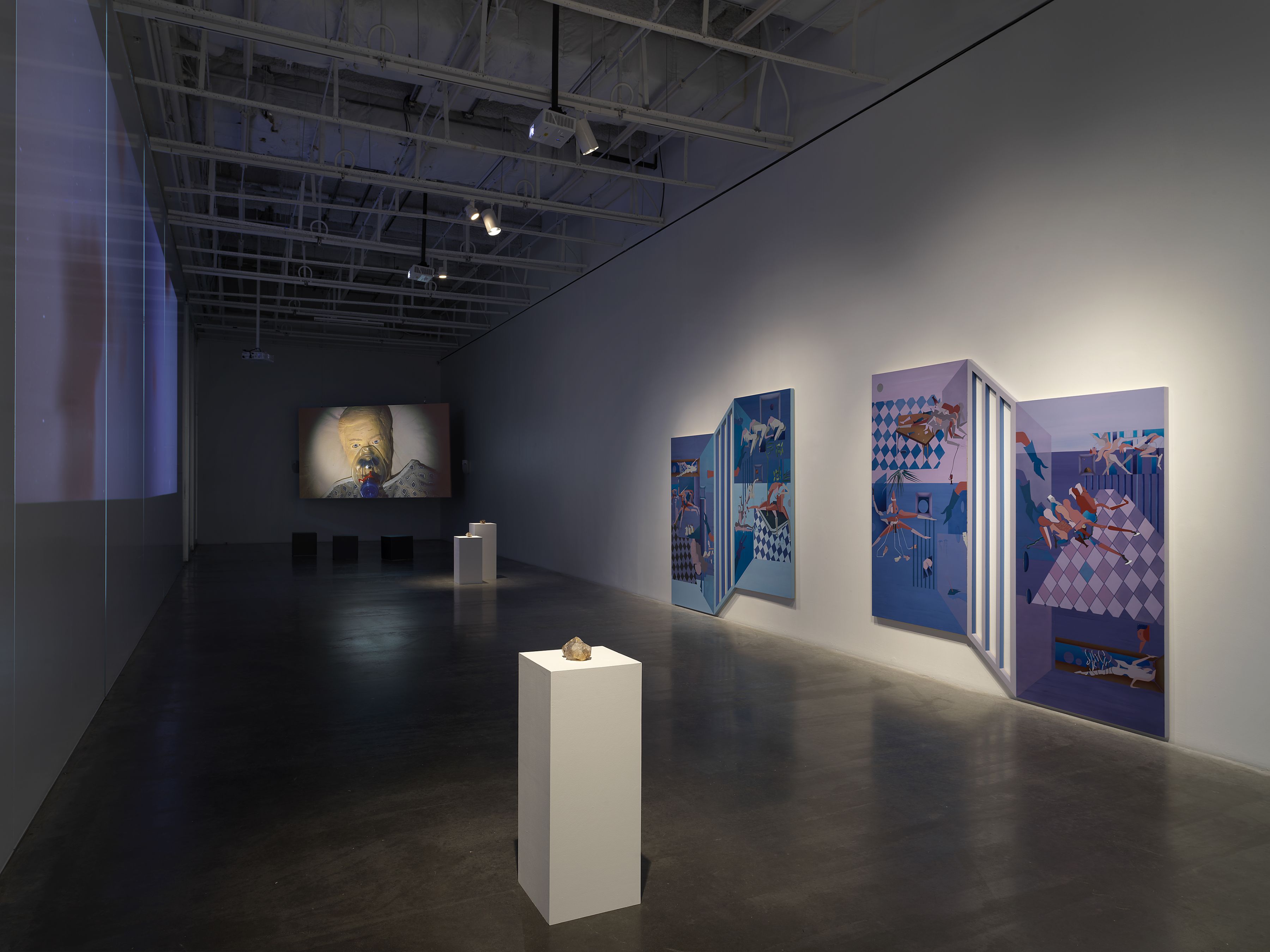
What I hadn’t expected to see, was a profusion of crystals in contemporary art and its exhibitions culminating in one New York moment. By this I mean Art with a capital A, at major museums, art fairs, and galleries. My recent viewing experiences have led me to believe the moment for crystals in Art has arrived.
Medieval artists evoked divinity through religious art, magnificent cathedrals and stained glass windows. Romantic artists explored the sublime in nature. Later 19th and earlier 20th century painters like Hilma Af Klint and Agnes Pelton channeled spirituality through abstract forms.
It’s no wonder that following the apocalyptic despair of 2020, multiple artists today are either consciously or subconsciously eager to incorporate a material into their work that traditionally possesses properties for spiritual connectivity and otherworldly transcendence. While that overarching idea feels clear to me, each artist’s decision to include crystals in their work also has nuanced meaning specific to that work, so I encourage paying attention to what makes each unique in its context as well.
Within this past month, I came across four unrelated NYC-based art exhibitions that each incorporate crystals, which compelled me to take notice and write this brief article. The following is a photo essay of these beautiful – and wonderfully diverse – examples of artwork currently (or recently) on view featuring crystals in New York City. You can still catch many of them on view this week, for a serving of culture with a side of soul healing.
Above image: Anastasia Sosunova, Agents, 2020 (still). Video, color, sound; 14:57 min. Courtesy the artist. Video commissioned for “Roots to Routes,” 2020, curated by Juste Kostikovaite, Maija Rudovska and Merilin Talumaa, with the support of the Baltic Culture Fund.
The Screens Series, “a platform for the presentation of new video works by emerging contemporary artists,” is a hidden gem tucked in the basement of The New Museum. Its current iteration, “Screens Series: Anastasia Sosunova” curated by Gary Carrion-Murayari, comprises three videos by Sosunova (b. 1993, Ignalia, Lithuania). Her 14:26 minute video titled, “Agents”, 2020, looks critically at the idea of tradition, questions reality, and considers the role of the artist as filmmaker, philosopher, craftsperson, and creator of tradition.
The New Museum notes, “Sousnova’s recent works have explored popular folk traditions, post-Soviet national identity, and the tension between public and private space in the Covid-era, among many other topics. [Her videos] mix historical research and creative fiction to examine tenuously constructed feelings of community and belonging.” With “Agents”, Sosunova channels universal ideas through a hyper-local scenario.
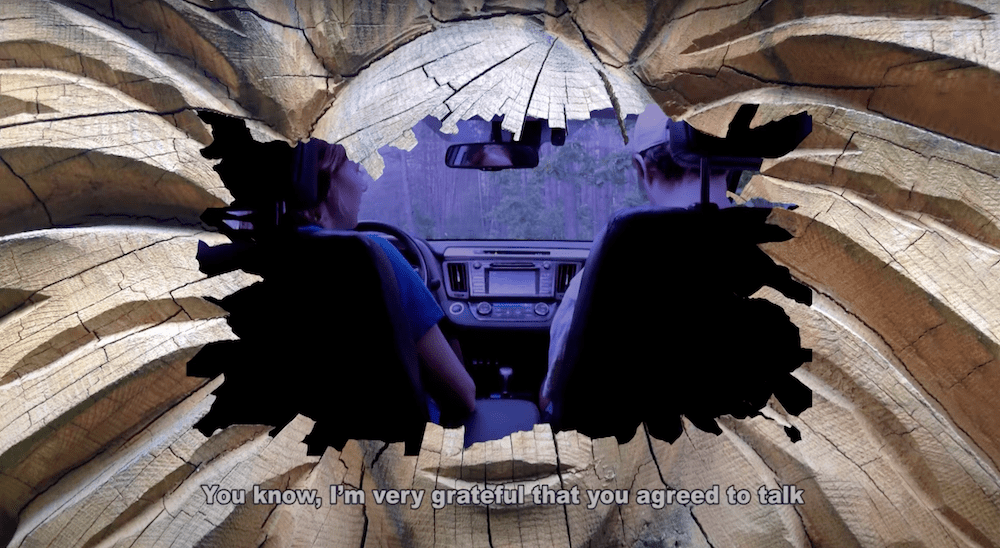
“Agents” opens with a scene of a woman and man driving a car slowly into the woods. They park amidst the trees, as if in a horror movie. The two engage in whispering a conversation in what I’d imagine is Lithuanian, with English subtitles. The conversation is noted at the start of the film to have been scripted for artistic purposes. Viewers find out later in the film that the forest was one of the only places people were allowed to go outside during Covid-19 quarantine in Lithuania. Music is playing.
Anastasia Sosunova, Agents, 2020 (still). Video, color, sound; 14:57 min. Courtesy the artist. Video commissioned for “Roots to Routes,” 2020, curated by Juste Kostikovaite, Maija Rudovska and Merilin Talumaa, with the support of the Baltic Culture Fund.
“We should turn it off, otherwise, we’ll scare them,” the woman says. While watching, I imagined the woman, who is in the driver’s seat, to be Sosunova. The man in the passenger’s seat seems to be a Lithuanian folk sculptor (or an actor playing one) – in other words, it could be argued that, in this filmed conversation, he, the craftsperson, is the “artist”, while the artist, Sosunova, is the “interviewer”. The woman continues, “You know, I’m very grateful that you agreed to talk in these circumstances. I thought at some point the things we create live their own lives, one can even say they come to life, and I begin to think of folk art conspiratorially.”
Anastasia Sosunova, Agents, 2020 (still). Video, color, sound; 14:57 min. Courtesy the artist. Video commissioned for “Roots to Routes,” 2020, curated by Juste Kostikovaite, Maija Rudovska and Merilin Talumaa, with the support of the Baltic Culture Fund.
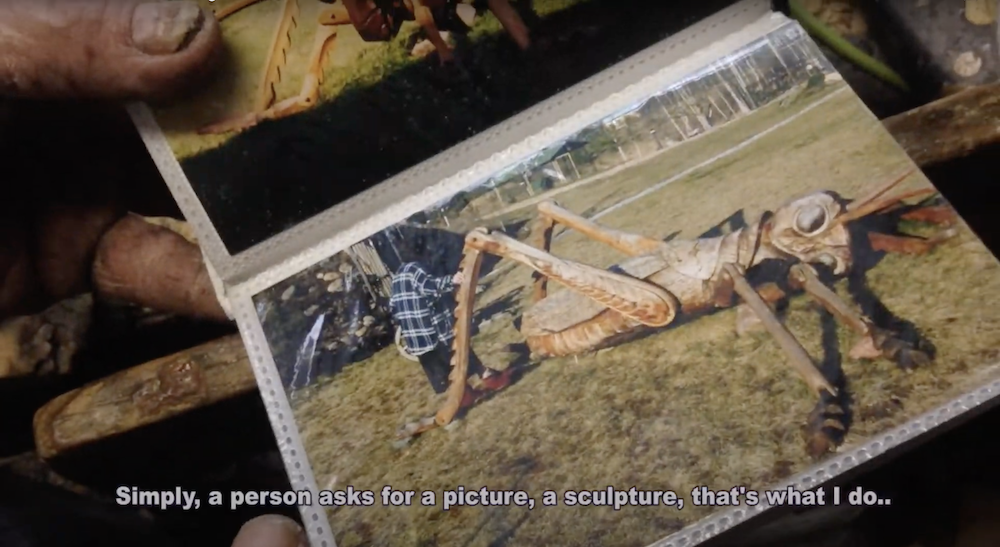
Sosunova immediately places the viewer in a cinematic vantage point mediated by fantasy, inducing a required suspension of disbelief. The protagonists are shot through what looks like a blasted hole in the middle of a strange animated wooden totem face framing their Socratic conversation. Both protagonists remain fairly anonymous throughout the duration of the film, as they are only shot with one camera angle from behind, revealing the backs of their heads and a slight profile at most, creating a disorienting effect. Viewers of the film get to know these characters mostly through their voices, dialogue, the deliberateness with which they speak, and their mutual respect for the conversation at hand. Viewers also get to know the sculptor through alternating camera shots of his weathered hands and dirty fingernails, that have surely been carving wood for decades, flipping through old photo albums of crafts and sculptures he either has created or references for inspiration.
Anastasia Sosunova, Agents, 2020 (still). Video, color, sound; 14:57 min. Courtesy the artist. Video commissioned for “Roots to Routes,” 2020, curated by Juste Kostikovaite, Maija Rudovska and Merilin Talumaa, with the support of the Baltic Culture Fund.
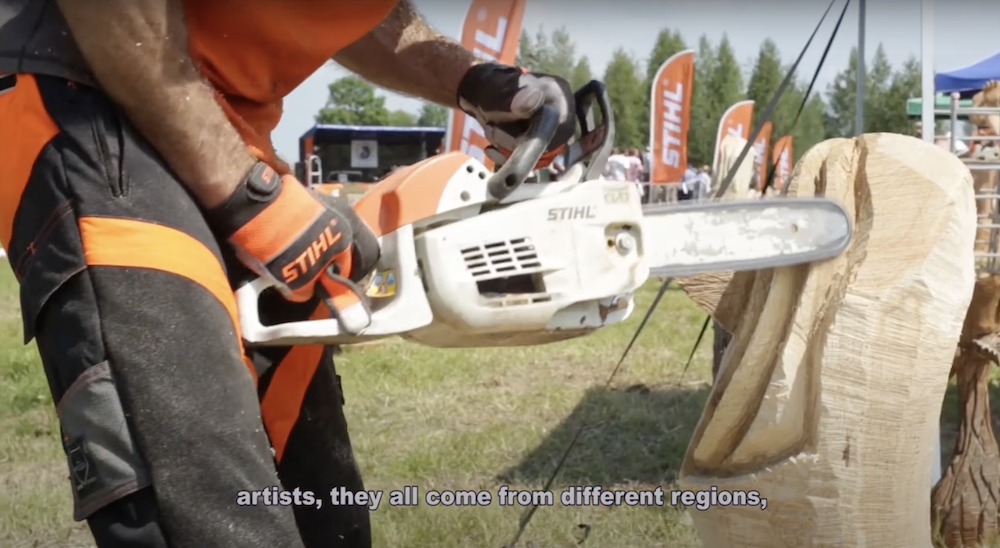
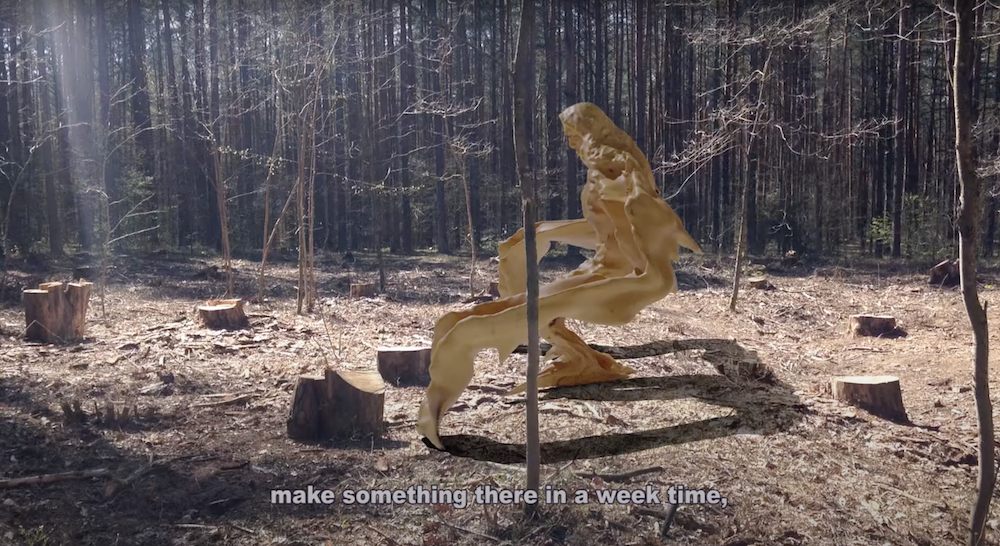
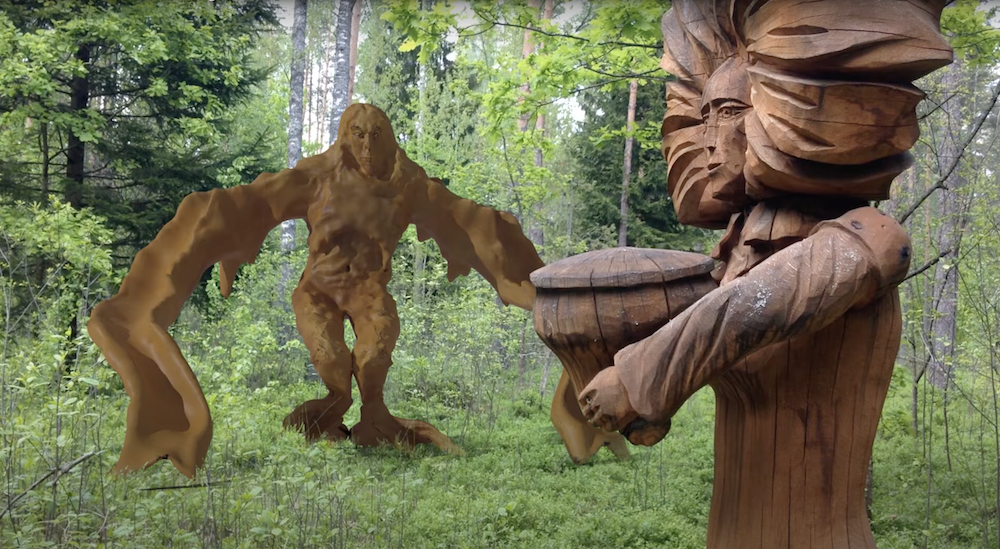
In the car, the pair seems intent on encountering what Sosunova describes as a “Golem” or “Cyclopse-like” living version of Lithuanian wooden folk sculpture: the embodiment of tradition taking on a life of its own after it is created. According to the sculptor, the original inanimate wooden folk sculptures are left in the forest every year following a week-long festival for which people come from all different regions to carve traditional wooden folk sculptures in the shapes of different woodland creatures, religious figures, or folkloric characters, and have them judged. After the festival they are abandoned in the forest, and because of this tradition, the forest is now filled with mythical man-made creatures.
But, is tradition good or bad? The interviewer (assumed to be Sosunova) proposes, “I am interested, you know, in learning how much we can give up primary meanings that are in these images, and how much the symbols themselves control us if we use them thoughtlessly…for instance, Ancient Greek legends about Cyclops were born after the Greeks found old elephant skulls who used to inhabit that peninsula, and thought those were one-eyed giants that actually lived there. This is how I also thought about the Lithuanian tradition of devil depiction, it is so mystified, but in fact it is for the most part an iconography of anti-Semitism. What should we do with those images?” The film examines where both religious and secular symbols come from, who is creating what, why, when, and for whom.
Anastasia Sosunova, Agents, 2020 (still). Video, color, sound; 14:57 min. Courtesy the artist. Video commissioned for “Roots to Routes,” 2020, curated by Juste Kostikovaite, Maija Rudovska and Merilin Talumaa, with the support of the Baltic Culture Fund.
Later in the script, the sculptor shares a more vulnerable side of himself, adding another layer of openness and universality to the video. He comments, “Well, a few hundred years ago, when creating those folk sculptures, no one thought about traditions, a person did something from the heart. If a person creates a thing from the heart today, then after a few years there will be a tradition of some sort. The most important thing to do is make it from the heart. In the past, I was more critical, when I was younger, but now I think – let people make what they need. Sure, I don’t like it when people fool around, when it starts being all about fooling around it’s irritating. But otherwise, let the people do their thing, not my business, whatever people like should exist.” There is a relatable realness and resignation in this statement that rings very true after (and arguably unfortunately still during) the global pandemic, like a prophecy of the post(?)-pandemic art world: “Sure, I don’t like it when people fool around, [but]…whatever people like should exist,” with haunting simplicity.
The cloudy atmosphere and muted color palette of the setting of the video evoke an overall greyness, which reminds me of the abundance of grey architecture in Eastern Europe and the lingering evidence of communism and former Soviet control. However, with “Agents”, Sosunova emphasizes there is magic emerging within this greyish environment. What is unknown is if it is light or dark magic. To what extent are Sosunova’s CGI golems of tradition benign or treacherous? And what is the artist’s responsibility in the face of them?
The overall feeling of not being able to know what time of day it is in the video is also compelling. The setting seems to transition at different points from morning to afternoon, to twilight, in no particular order. There’s an oneiric sense of space and time throughout the film, enhanced by the abrupt stopping and starting of hypnotic video game music featuring tracks by Sro and Blear Moon.
Visitors to The New Museum will note Sosunova’s CV to date comprises mostly exhibitions in Lithuania, Estonia, and Latvia. It’s incredible to see great emerging art like Sosunova’s from other global regions, here New York. The experience of this video is at once very familiar and an immersion into Lithuanian subconscious.
“Agents”, 2020 by Anastasia Sosunova is on view at The New Museum from 30 June – 22 August, 2021. WM
Anastasia Sosunova, Agents, 2020 (still). Video, color, sound; 14:57 min. Courtesy the artist. Video commissioned for “Roots to Routes,” 2020, curated by Juste Kostikovaite, Maija Rudovska and Merilin Talumaa, with the support of the Baltic Culture Fund.
Above: Emma Balder, Harmony, 2020. Recycled fabrics, rope, bungee, paper, acrylic, and thread on canvas, 40 x 81 x 3″. Courtesy of the artist.Photo by Jay Marroquin.
By Alexandra Goldman
This month I was excited to be connected for a virtual studio visit with Houston-based artist Emma Balder by my friend, colleague, and mentor, Dr. Jose Falconi, Lecturer of Latin American art at Brandeis University.
Balder was born in Boston in 1990. She grew up curiously watching her mother sew costumes for her and her siblings, and as a young teen experimented with cutting up and sewing her own clothing. She later earned her BFA from SCAD with a background in painting, and has since shifted toward heavily incorporating sewing and fiber art into her practice using recycled materials.
Emma Balder’s studio, Houston, TX. Courtesy of the artist.
She began integrating textile waste into her practice during her formative year-long residency at the Vermont Studio Center, where she was given bags of the recycled scrap cloth material as a gift by a fellow resident who had an excess of it and couldn’t take it traveling overseas. Since then, Balder has continued to collect textile waste from seamstresses and fashion designers. “There is so much waste, and it bothered me, but I saw beauty in it,” Balder noted. Additional examples interesting artists who work with recycled textiles include Tamara Kostianovsky and Linda Friedman-Schmidt. The interpretations of the medium by these three artists is vastly different, showing off its vast potential.
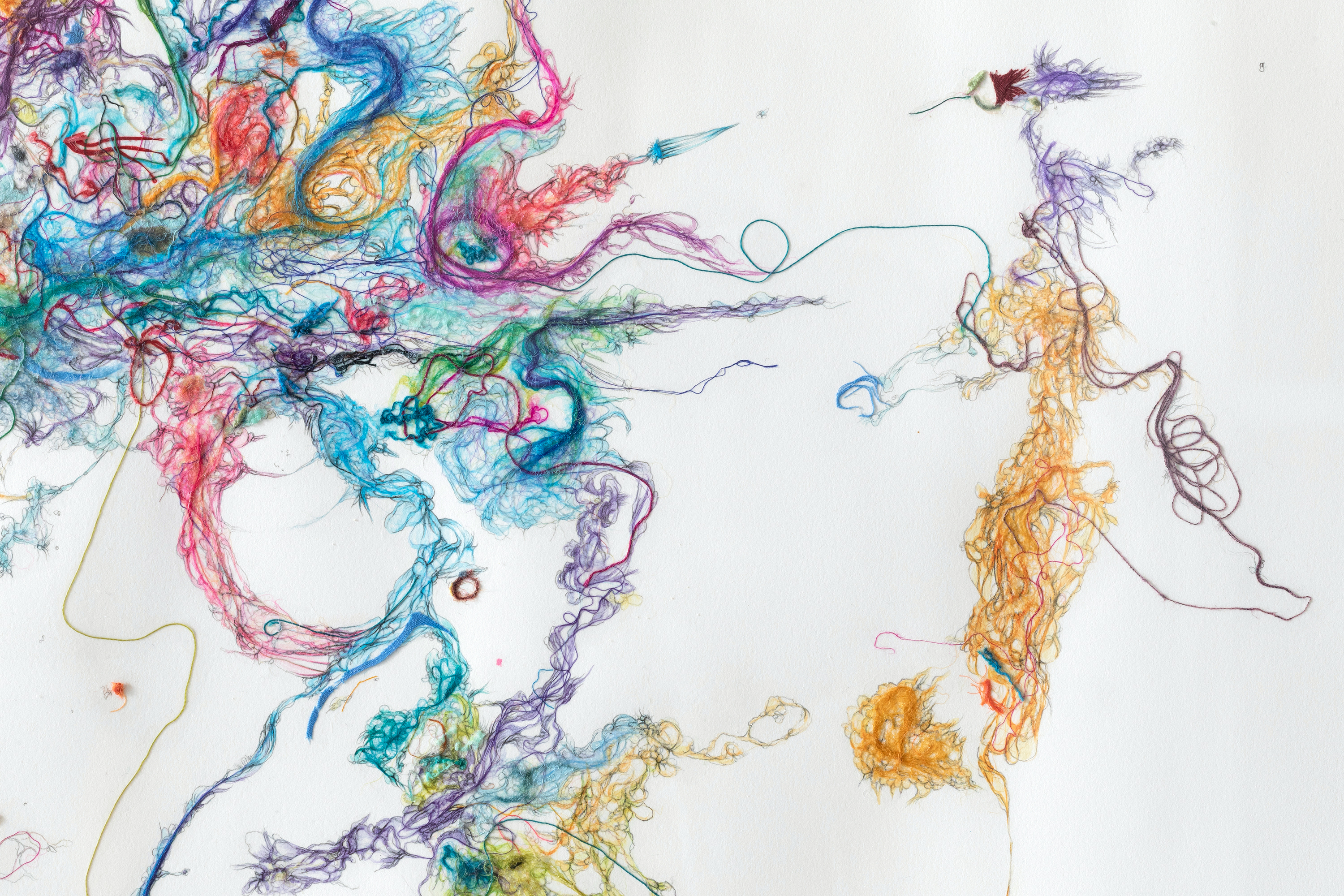
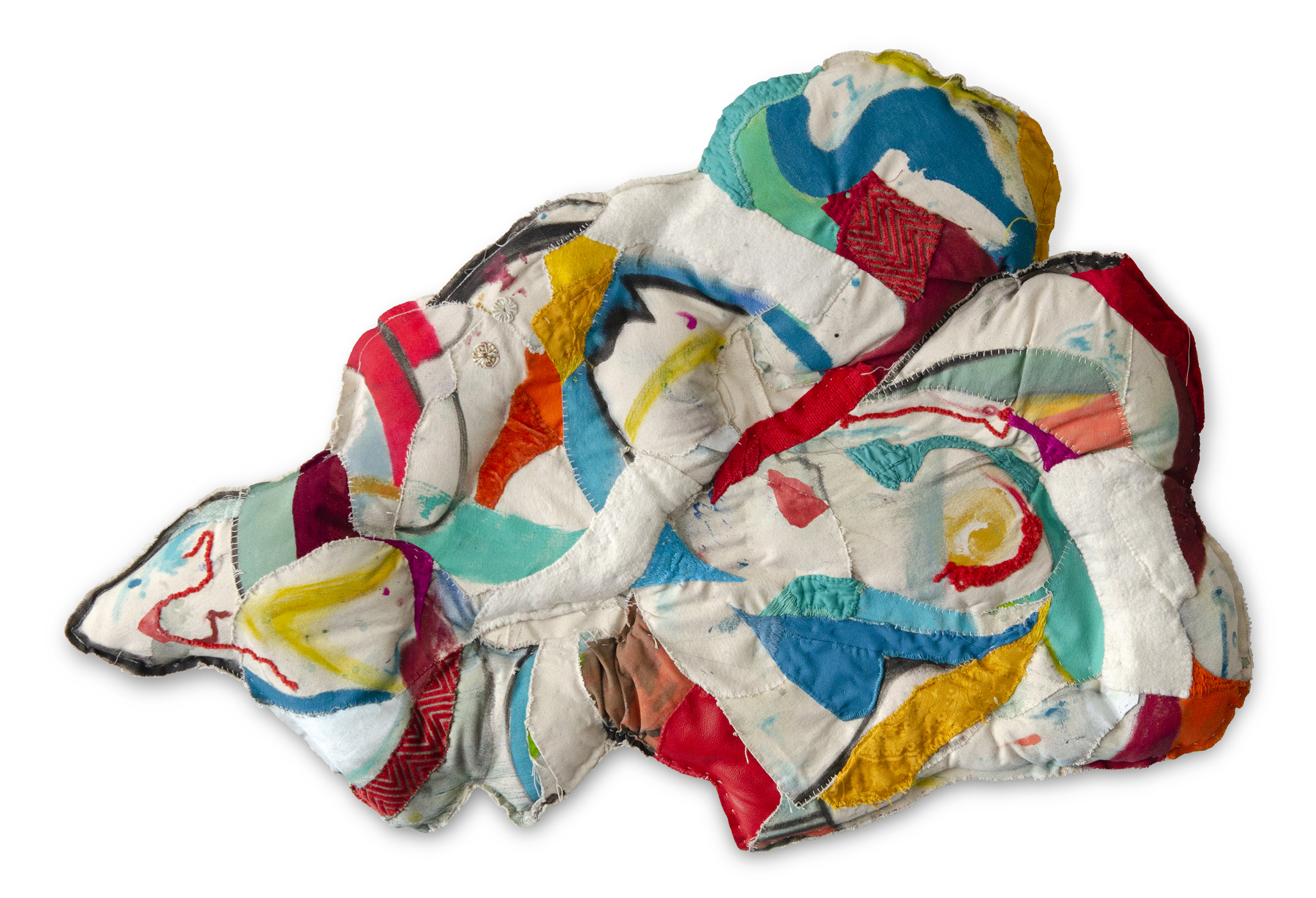
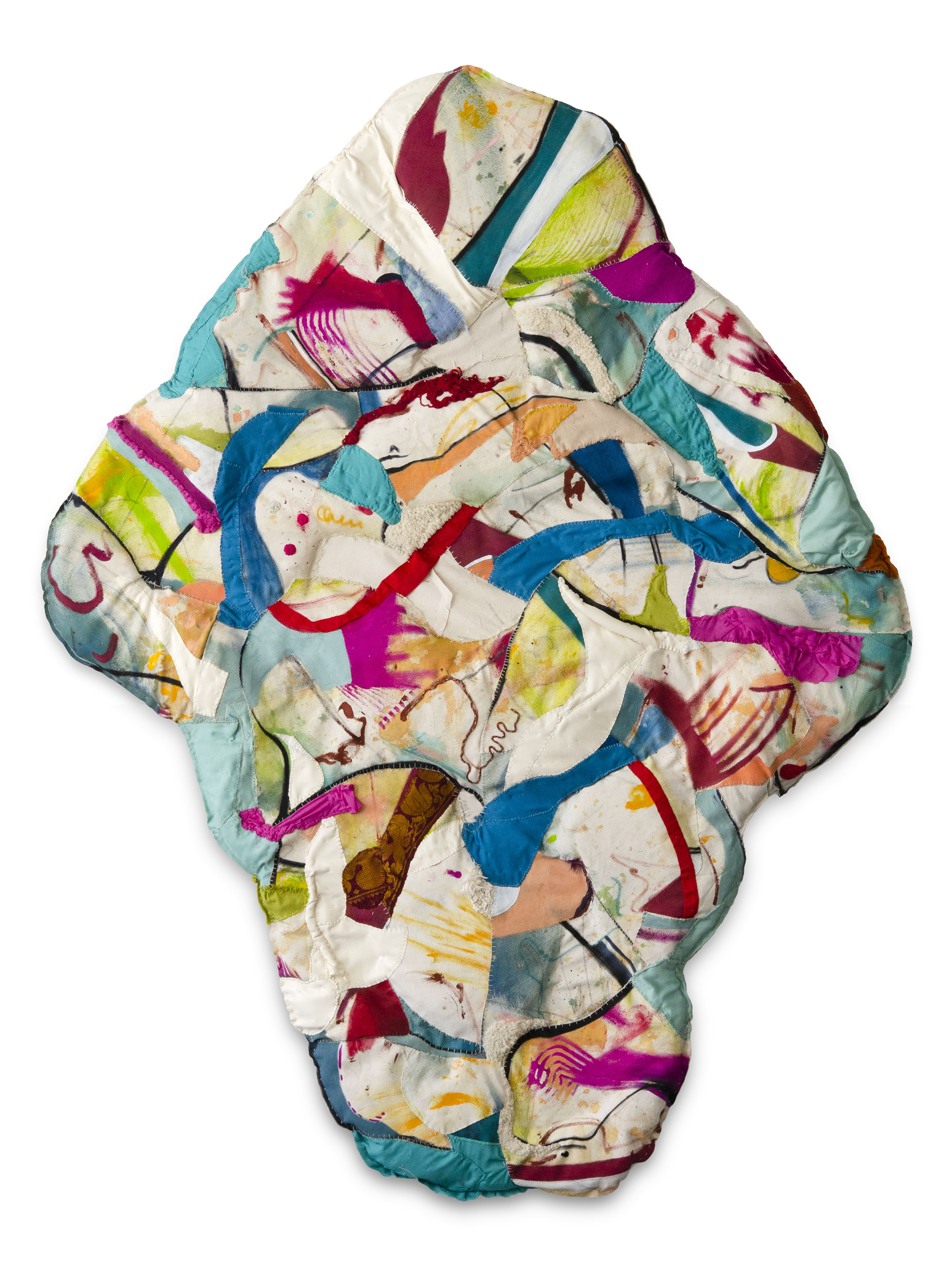
Her colorful organically shaped works fall into two main categories: “Pinglets”, which are (often stuffed) three-dimensional wall pieces that Balder creates by completing a painting, cutting it up, and re-stitching it together in new compositions mixed with other recycled textiles, and “Fiber Paintings”, in which Balder “paints” on paper and panel with colorful thread, using the thread itself as the paint. A fervent environmentalist, working with recycled fiber materials is of utmost importance to Balder.
On her website, Balder notes, “The Pinglet project documents a process of regeneration. This project began with the physical deconstruction of one painting, the Ping. The disjuncture of parts were then rearranged and reconstructed with needle and thread to form small baby paintings, called Pinglets.” Pings are usually abstract landscapes of around 12 x 8 ft. Balder knows to cut up the Ping at the moment she is satisfied with it, believing the moment that you become complacent, it is time to catalyze change and reignite the creativity that comes from vulnerability.
Following our studio visit I’ve come to understand why Balder has named one of her main artwork styles a made up word such as a “Pinglet”: Balder is principally interested in creating artwork as a manifestation of her own world on her own terms: a place to escape to and live in; both a new world and a new home. In a Derridean sense, this logically begins with creating and defining her own language to refer to her new world without relying on preexisting terms. In her work she creates a beautiful synergy by deconstructing and reconstructing both the physical materials she is utilizing to create the works, and the language she uses to describe them.
Pinglets are filled with vibrant bursts of shape and color caught in a balancing act throughout the composition channeling an unlikely yet successful combination of Vasily Kandinsky and Howardena Pindell. The Pinglets look like stuffed animals in the shapes of clouds, human organs, puddles, or the symbols for hills in Aztec Codices. Balder’s work also visually recalls the legacy of Marta Minujín and her stuffed, bright hanging wall pieces that look like Fruit Stripe gum got into a pillow fight. The difference is that Balder’s gum is chewed.
Both Balder’s Pinglet and Fiber Painting abstractions appear to be dancing or blowing in the wind. They are free, and Balder found both freedom and home in the creation of her own combinations and interpretations of media that don’t stick to traditional definitions of painting or sculpture.
Interestingly, when asked about her main artistic inspiration or influence, Balder, without hesitation, mentioned that she is often thinking about and inspired by Catalan architect Antonio Gaudi. As a Barcelonaphile who has experienced Gaudi’s architecture in person, this resonated with me on multiple levels: bright playful colors, organic forms, structure, and the fact that architecture can be a site where art, home, and nature coalesce. Balder’s works are each like small architectures.
Through our conversation, I learned that Balder intends to generate the abstract feeling of home throughout her oeuvre. I asked her if she wouldn’t mind revealing the source of the importance of home in her work. She mentioned she moved around a few times as a child, and what she always missed most and returned to in her mind was her favorite place: the natural environment that surrounded her first house, where she would play amidst a cluster of trees, have secret meetings with friends or siblings, and carve into or decorate the tree trunks. She felt at home in nature, in these trees, more than the house itself. If you look at Balder’s Pinglets, they are formally reminiscent of horizontal slices of tree trunks.
Balder’s commitment to the environment has also attracted the attention of large brands. She was selected in 2019 by PepsiCo as one of the three environmentally-focused artists chosen to have their artwork featured on the series of 100% recycled plastic LIFEWTR water bottles. Sweeping visuals of Balder’s Fiber Paintings can still be found on the bottles today. The series marked a moment of transition for LIFEWTR to go from using regular plastic bottles to recycled ones. While it is still not good for the environment to have single-use plastics in circulation, the massive shift of a company like Pepsi to transition their bottles from new to recycled materials is a step in the right direction. Last week I serendipitously came across Balder’s LIFEWTR bottle at JFK Airport en route to Miami, and was thrilled to have the chance to take in the visual of it with in-depth insight into Balder’s practice, rather that looking at it as an image on a product without context.
LIFEWTR Series 9.3 “The Art of Recycling”, Emma Balder, Image courtesy of the artist.
Looking ahead as Balder continues to develop her practice, she desires to focus even more intently on creating space, and inviting viewers in. “I don’t know how much longer the wall is going to serve me. I have been playing around with sculpture, and I would really like to create an immersive space where the viewer can feel like they are part of that world, and feel that sense of coming home,” she revealed. I look forward to seeing the worlds Balder has in store.














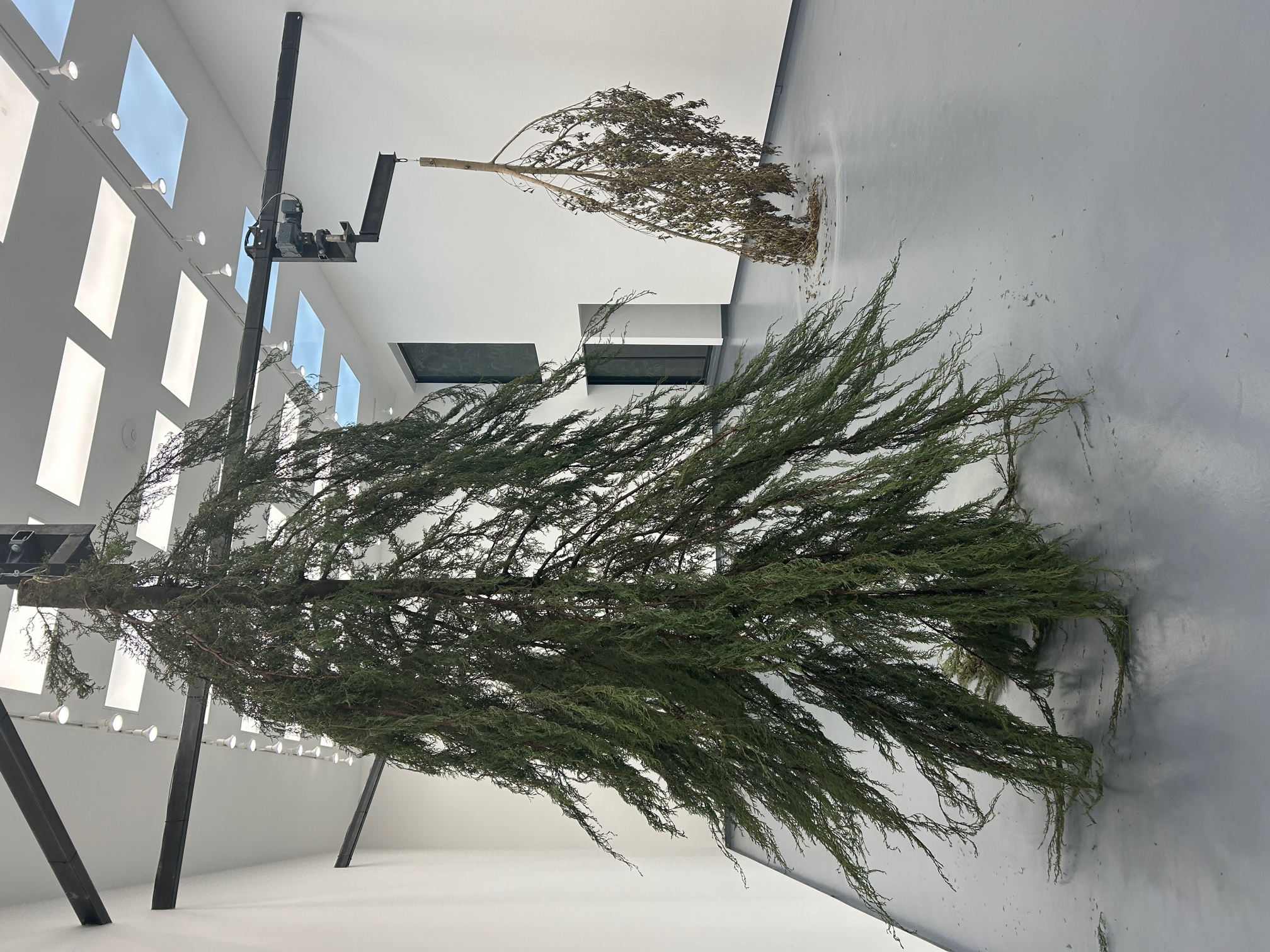 Michael Sailsltorfer: Clearing at Proyectos Monclova in Mexico City. Courtesy of the author.
 Michael Sailsltorfer: Clearing at Proyectos Monclova in Mexico City. Courtesy of the author.









 artifactoid