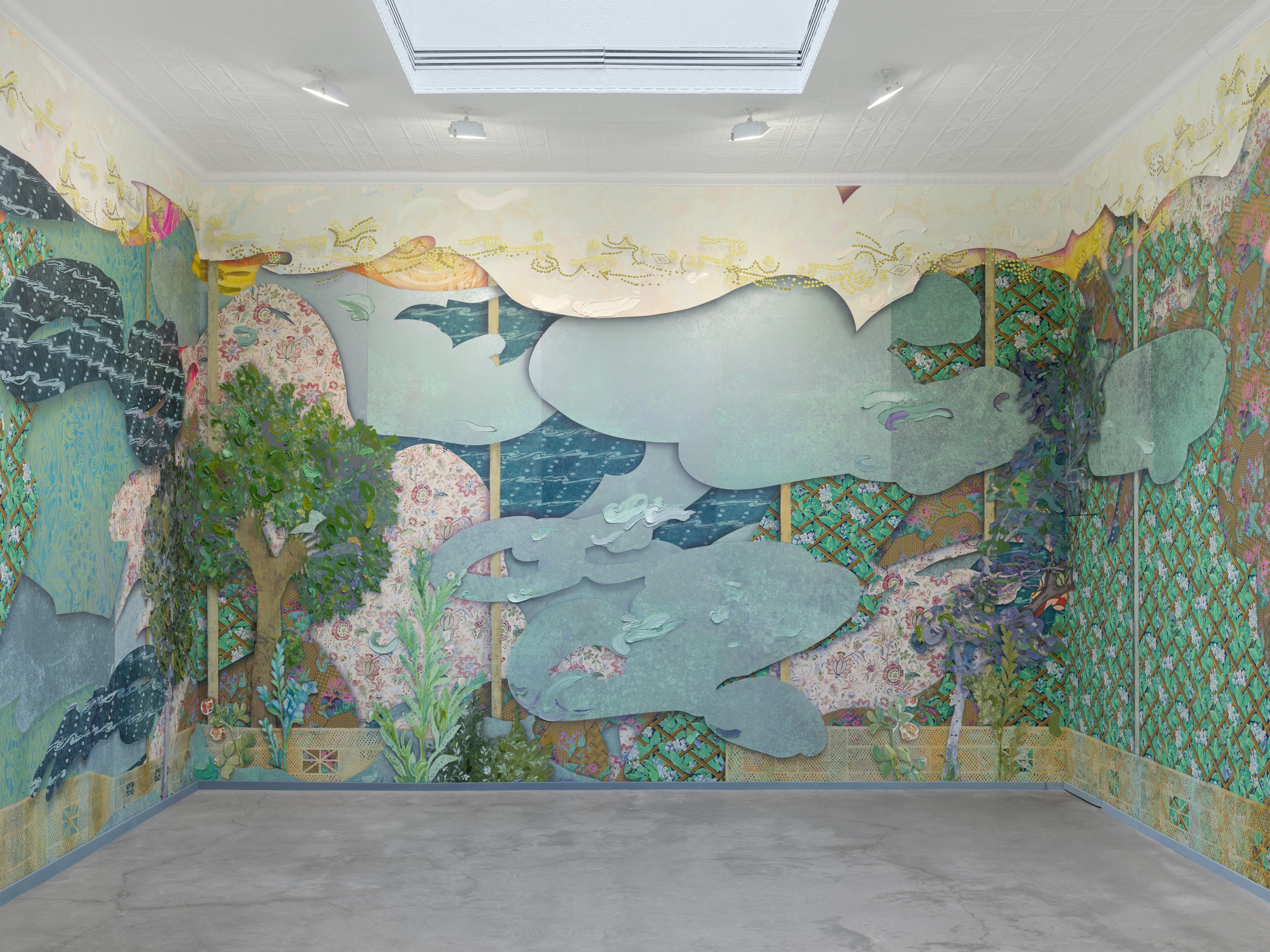
Above image: Installation view of Laura Owens, Matthew Marks Gallery, New York, February 13 – April 19, 2025. Photo by Bailey Coleman.
By Bailey Coleman
“Have you seen Laura Owens yet?”
Opening the door to the gallery I am welcomed by a nearly manic energy. Gallery goers are thrilled with themselves that they have finally made it to Chelsea to see the show everyone is talking about. Laura Owen’s eponymous exhibition at Matthew Marks has been widely lauded as a tour-de force of art making and I was just as excited as those around me to see what all the fuss was about. There is a swarm of people hovering around the gallery attendant’s desk with anticipation as the artist casts her first spell. An older woman with a fresh, blonde, blowout squeals with excitement, as a roll of tape magically moves across the desk. Suddenly, a drawer opens when her friend removes a pen from its holder. Having been witness to these moments of fantasy, we are baptized and free to pass through to the magical world of Laura Owens in her first solo show in New York City since her 2017 mid-career survey at The Whitney.
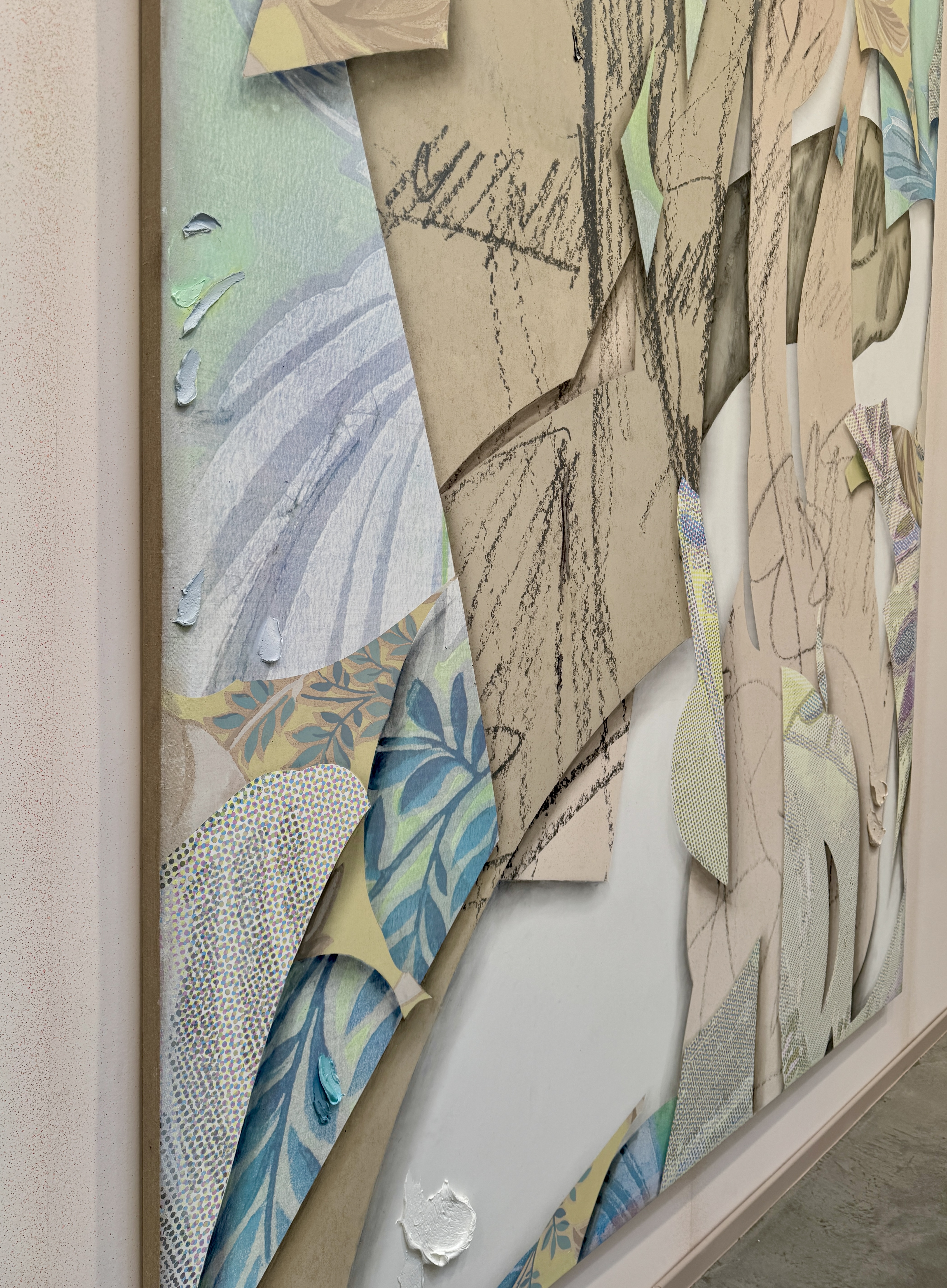
Laura Owens, Untitled (Detail), 2025, Oil, pastel, charcoal, graphite, and silkscreened Flashe on linen, 130 x 90 inches. Photo by Bailey Coleman.
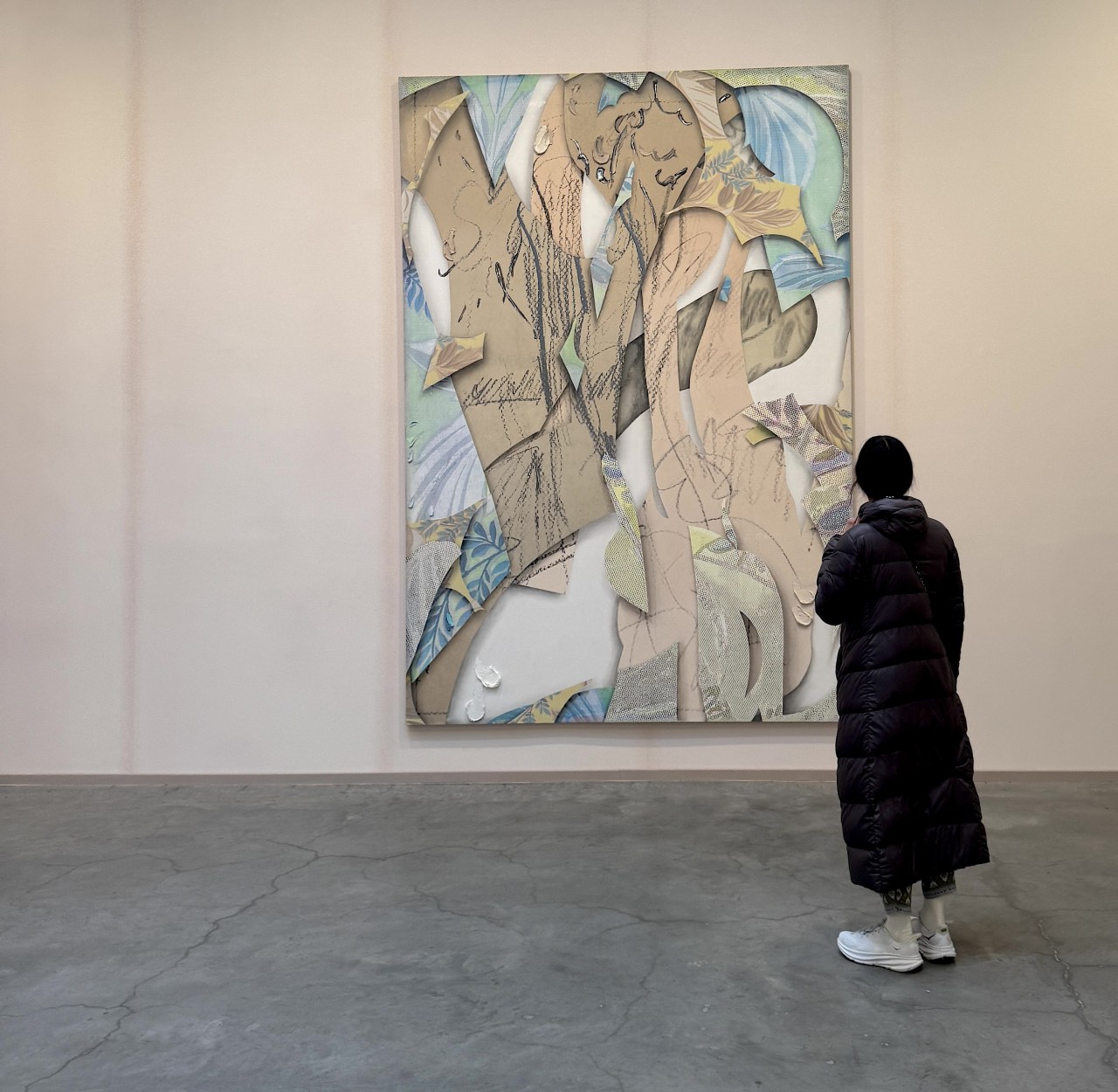
In the first gallery, ten-foot tall vertical pastel paintings hang in effigy of Laura Owens. Though not intended to burn in sacrifice, these impressive works on canvas are singular retrospectives of Laura Owens’s unique style. Collage, digital media, hand-made silk screen prints and heavy daubs of oil paint compete and complement one another in an effort to excavate the nature of contemporary abstraction. Articulated in light teal cubist forms, the painting on the gallery’s farthest wall is a combustive battleground of style and technique. The result is a soft pixelation of abstracted shapes that superimpose each other and create the illusion of material layering. Her work has been likened to artists such as Picasso and de Kooning by The New York Times and others. These artists were interested in the integrity of the picture plane and celebrating the medium specific flatness inherent to its two-dimensionality. Owens, of course, adheres to these Greenbergian ideals, however, her degloving of the picture plane goes one step further. By outlining formal elements of her composition in shadow, Owens emphasizes that these shapes, designs, and motifs are, indeed, painted, suggesting that qualities that contribute to the illusion of three-dimensional painting can extend to elements usually thought of as contributing to flatness.
Once ushered through the large vault-like doors at the rear of the first gallery, I entered into what appeared to be a secret garden with hide-and-seek mechanical pop-outs that reveal small paintings. This exhibition is a surprise departure from Owens’s previous solo shows in many ways. Owens’s 2017 Whitney mid-career retrospective featured her impressive paintings on typical white walls. Now, at Matthew Marks, Laura Owens invites the viewer into an immersive environment that the artist herself has dictated. Floor to ceiling aluminum panels boast one hundred and fifty layers of her silkscreen prints, oil painting, and clay-coated paper that showcases a complex botanical motif with a lattice gate and overflowing greenery. The intricacy of the design layers and subtle shifts in depth perspective become an enveloping environment of the artist’s imagination. Suddenly, a gallery attendant opens a final hidden door to reveal a video installation in a dark, tiny, 3 x 4′ closet-like room. Craning my head upwards in the claustrophobic cinema, I watch as two black crows wax philosophical on the fall of the Roman empire and the prevalence of misogyny throughout ancient history – acting as a subtext of sorts. It felt like type of fever-dream talk show I’ve always craved, but never realized was missing from my life until I saw it.
After a moment of surreal and comedic bird-watching, I exited the principal gallery space and went next door to the annex to catch the exhibition’s final act. There, large boxes with handles, pulls, and knobs hold books and other curios. Fingering through the objects, the printed matter tells a narrative of existential exploration and metaphysical interest beyond the scientific. To my nostalgic delight, I am reminded of show-and-tell in elementary school, sharing memories tied to objects. Overall, the exhibition affirms Laura Owens as an alchemist of painting. She melds painterly skill, an eagerness to adapt unique technologies, art history, and humor, to create something entirely new and wholly her own.
“Laura Owens” is on view at Matthew Marks Gallery through April 19th, 2025.
Bailey Coleman
Bailey Coleman is a contributing writer to Artifactoid and is the founder of her own art publication: Bin Day Art. She is an art advisor and writer based in New York working with clients to curate private collections that speak to both individual desire and market interest. She received her MA in the History of Art & Curating from the University of London and her BA in Art History from Barnard College of Columbia University.
This article was originallly published in Cultbytes.
Hanae Utamura. “Into the Light,” 2023. Acrylic on Paper. 57.5 x 42 inches. Courtesy of the artist.
In a life-changing instant—the sudden death of her husband—Japanese artist Hanae Utamura went from creating artwork that spoke to geopolitical collective memory in Japan, to exploring the realm of the personal through the body and the metaphysical. Her prior series of projects looked outward to the world and spoke to collective pain, suffering, death, loss, and trauma. Her newer work looks inward to our spiritual being, birth, grief, and the biological earthly entities that create us. Despite this challenge, Utamura is light-hearted and thoughtful. We met while welcoming El Salvadoran artist Beatriz Cortez’s time-based visual art project, Ilopango: The Volcano that Left: a Calder-stabile-like metal sculpture to Troy. In the shape of a volcano—a symbol in both Salvadoran culture and in Mesoamerican codices—it brings ideas of the Mayan underworld to the fore. In Troy, we participated in a ceremony to bless the Native American burial site with tobacco while Ilopango passed by us on the river.
Unbeknownst to Utamura’s recent loss, I was drawn to her bubbly and friendly nature and intrigued by her knowledge of indigenous practices. Perhaps it was our proximity to other realms that connected us—my mother lost her mother at a young age and has explored modes of communication with spirits, exposing me to conversation and practice surrounding energetic transitions. In recent years, spiritual art by women tracing back to modernist and proto-modernist abstraction is more widely known, facts that Jennifer Higgies writes about in her new surveyThe Other Side: A History of Women in Art and the Spirit World. As we offered tobacco to the land, Utamura invited me to visit her studio on the Rensselaer PoIytechnic Institute’s (RPI) nearby campus, where she is enrolled in a practice PhD program, and I accepted.
At her studio, Utamura told an unexpected and moving story about the recent transition in her artwork style. Her husband, Robert Phillips, was an American new music composer. They were an artistic couple who met in 2014 at Akademie Schloss Solitude, an international artist residency in Stuttgart, Germany. Within a very short period after the world entered the pandemic, Utamura experienced bringing life into the world, giving birth to their son, Kai, in 2021. Shortly thereafter, in 2023, she saw life leave the world with Robert’s death due to sudden illness. It was a devastating and unexpected tragedy for the young couple and their family.
On the 49th day after Robert’s passing, which in Buddhist tradition marks the day when one’s spirit and energy are fully released, Utamura performed a ritual to honor him. She had saved the placenta from Kai’s birth (which is dried in the shape of a bowl), placed Robert’s hair inside the placenta, and buried both together beneath a tree. When Utamura and Robert spent their last moments with each other, they exchanged locks of hair. The placenta provides oxygen and nutrients to the child through the umbilical cord, which also brings waste products away. It is shaped like a brain, or as Utamura describes it, a “half-cut earth,” and symbolizes growth and birth. “Placenta is treated as medical waste after birth in the Western medical world, but many cultures have a sacred, spiritual relationship to the placenta,” she commented. The placenta is often referred to as the “tree of life” for the branch-like patterns made by its blood vessels. The site continues Robert and Utamura’s life together, as the placenta’s nutrients—parts of their DNA—enrich the grass and tree roots, and other, in her words, “non-human species.” And, Utamura’s ritual symbolized Kai protecting Robert’s spirit, and carrying him into spiritual transcendence, with the eternal protection of his son.
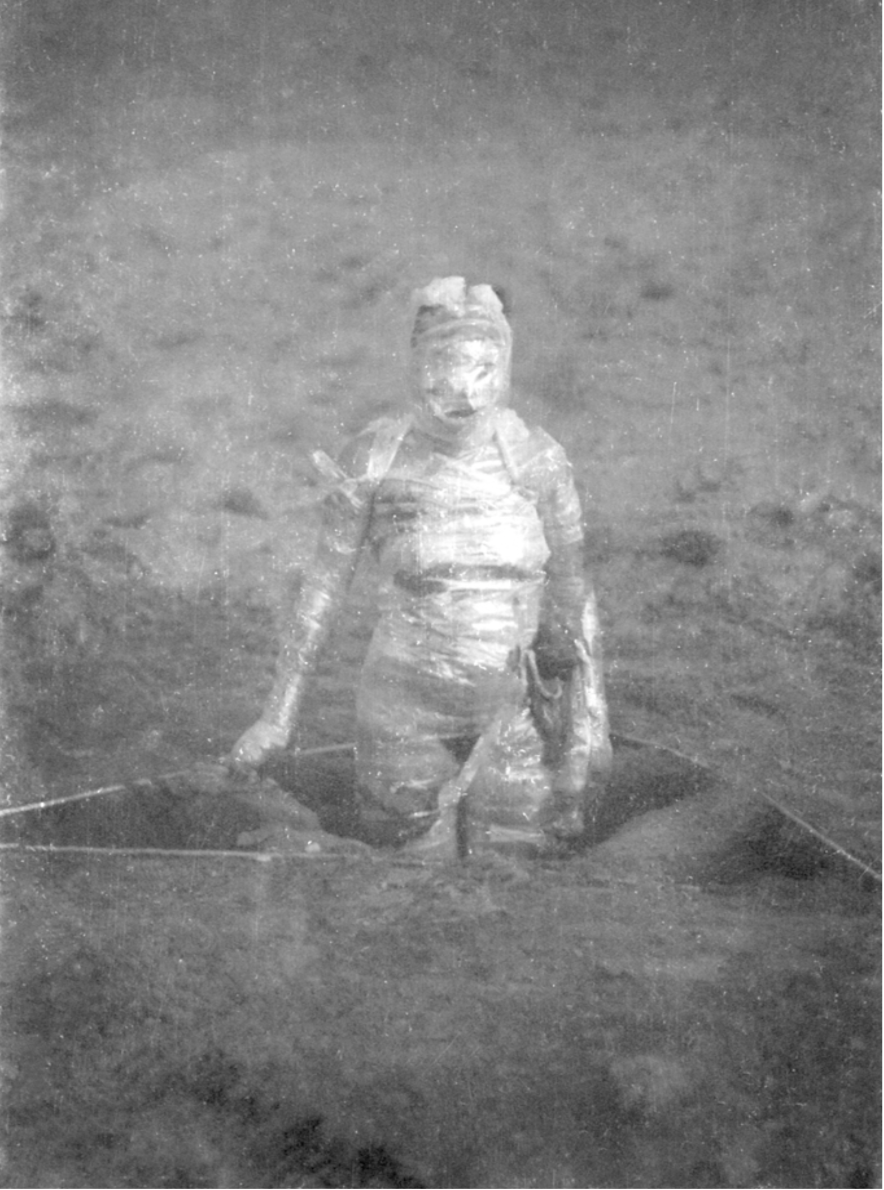
Maria Evelia Marmolejo. “Anónimo 4,” 1982. Performance. Photo by Nelson Villegas. Image courtesy of Maria Evelia Marmolejo.
Pioneering feminist artists from the early eighties also worked with the idea of the placenta as considered “medical waste” in Western medicine, while it is spiritual, such as Colombian artist Maria Evelia Marmolejo (who was included in the 2017-2018 exhibition Radical Women: Latin American Art 1960-1985 Hammer Museum and Brooklyn Museum). For Marmolejo’s 1982 performance, Anónimo 4, she dug a 1.5-meter triangular pit into the ground and filled it with sewer water and the placentas of all the babies born that day in hospitals near the performance site, in Cali, Colombia and Guayaquil, Ecuador. She wrapped her body in the placentas, and submerged herself in the hole, “embarking on a psychological and sociological self-exploration of the fear of being born in a society in which there is no guarantee of survival,” she explains in an interview. Artists like Marmolejo and Utamura observe the importance of the placenta by incorporating them into their performance rituals in meaningful, powerful, spiritual, and symbolic ways, whereas at the hospitals, they tend to be discarded.
Understandably, Utamura could not entirely let go of her partner. Because of these sudden extreme encounters with life and death, which now flow, in her words, “like the confluence of the river with raising Kai,” her perspective was instantaneously transformed, altering her artistic practice. Before Robert’s death, she created more geo-political artworks, often performances and films. One work Uncanny Valley – Study for Future Strata (see image below) raises questions around the dominant historical narrative of nuclear history by juxtaposing images of the elements that surrounded the atomic mushroom clouds of the bombing in Nagasaki, with the mining site in Congo where uranium was sourced for nuclear production – positioned above, and the military storage site near Niagara Falls where nuclear waste from the Manhattan Project was secretly disposed – positioned below. But, after she experienced the life-altering sequence of birth and death events, she felt compelled to turn inward to the body and spirit. Abstract painting helped her overcome “the unspeakable”—I immediately drew a parallel to the shift to abstraction in Western art after World War II. She believes in abstract painting as a powerful medium for channeling the energetic transitions relating to birth and death.
Hanae Utamura. “Uncanny Valley – Study for Future Strata,” 2022- Mixed Media. 21 x 16 inches. Courtesy of the artist.
“This has also very much been a collaborative process with Robert,” Utamura added, “Aur means ‘light’ in Hebrew. I feel that his symbolic composition, Aur, for string quartet and electronics, is the light that he transcended into. It transforms death into a departure. When painting, I hear his music inside my ear—his essence is expressed even more through his music in his physical absence. The music truly starts to live in eternity within me.” Having followed my mother’s journey to stay in touch with my grandmother after her death Utamura’s will to stay connected as a source of comfort resonated with my own experiences.
The first several paintings Utamura created exploring her feelings of grief were watery representations of a body, dissolving. After creating several of these more figurative paintings, she was invited to a séance by Tamar Gordon, a professor of Anthropology in the Communication and Media department at RPI, and a member of her doctoral committee. The séance would help her further shift her focus from grief to communication.
Hanae Utamura. “The Limb,” 2023. Acrylic on Paper. 24 x 18 inches. Courtesy of the artist.
At the séance, the physical medium Gary Mannion, headed a circle under controlled conditions, alternating between complete darkness and red light. Physical mediums, as opposed to mental mediums, produce materializations of spirits while mental mediums interpret and channel them. Physical mediums produce ectoplasms which are viscous manifestations of spirits that exude from their body taking on any form, including apparitions. Encircled by the participants and sitting in a cabinet, tied down to a chair, Mannion produced an ectoplasmic hand and invited members to touch and hold it. Utamura described the experience as having felt like “touching a wet hand.”
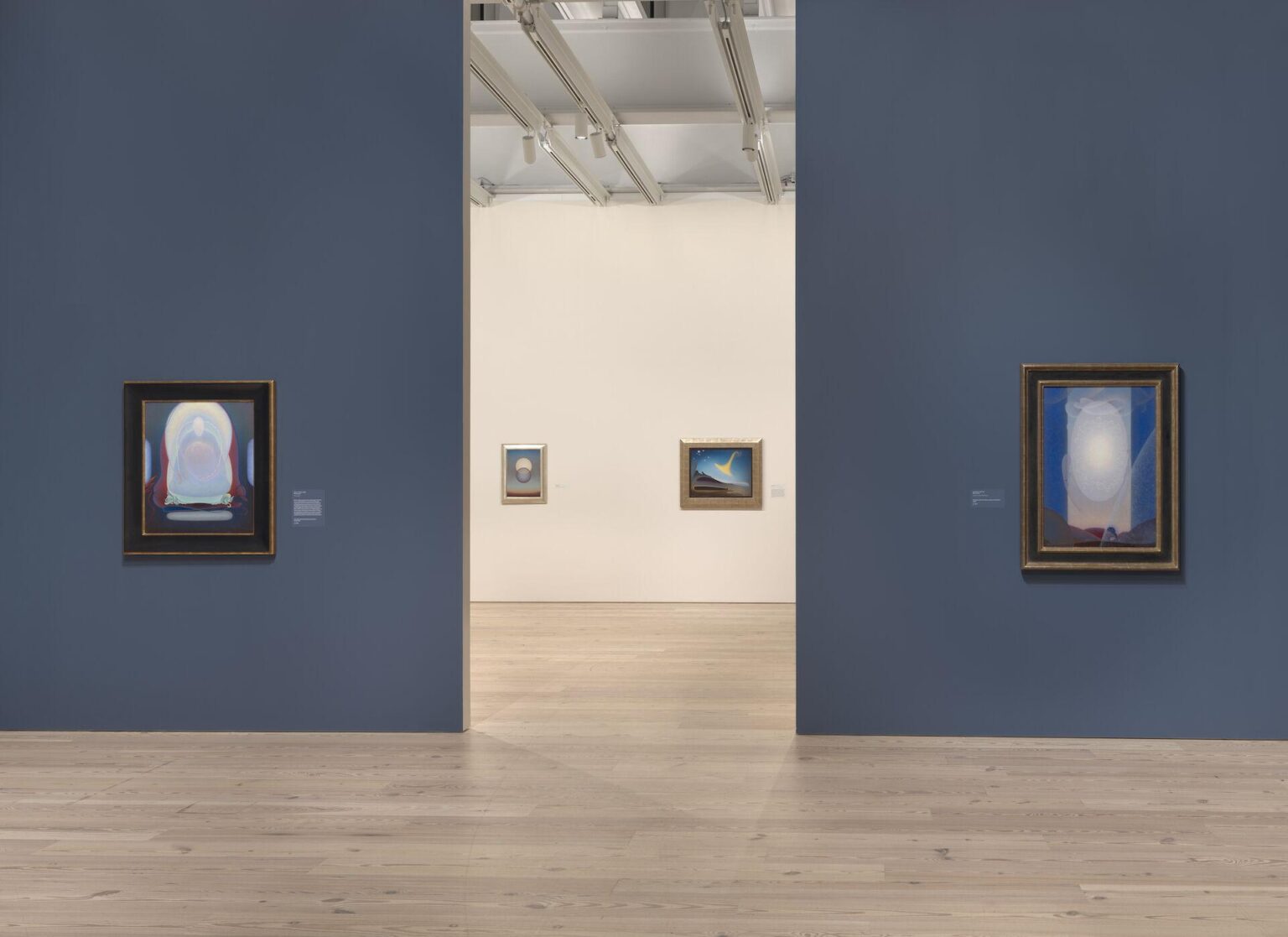
Installation view of “Agnes Pelton: Desert Transcendentalist” (Whitney Museum of American Art, New York, March 13–November 1, 2020). From left to right: Mother of Silence, 1933; Departure, 1952; Awakening (Memory of Father), 1943; Light Center, 1947-48. Photograph by Ron Amstutz. Courtesy of The Whitney Museum of American Art.
Séances were an American phenomenon popularized by the Spiritualist movement in the 1850s. They spread to Britain, other parts of Europe, Brazil, and Australia, and consisted of circles of sitters who gathered to channel the realm of spirits. Today, they are less common, but exist and Mannion is a leading figure in the field.
Utamura’s new work is also influenced by Shannon Taggart, a photographer and artist who authored a popular book depicting sitters in various states of transfiguration. Taggart recently had an exhibition of her work at the Opalka Gallery in Albany, NY. The two-day public opening included a dialogue between Taggart and Dr. Anne D. Braude, the director of Women’s Studies in Religion at Harvard Divinity School, and the author of the book,Radical Spirits: Spiritualism and Women’s Rights in Nineteenth-century America, which explores the close engagement of Spiritualism with the women’s rights movement. There is also a growing recognition in recent years of female artists like Hilma af Klint and Agnes Pelton, who employed art as a language to explore spirituality. Utamura considers her work as in alignment with these artists and thinkers.
Hanae Utamura. “Presence of Absence #3,” 2023. Acrylic on Paper. 24 x 18 inches. Courtesy of the artist.
After the séance with Mannion, Utamura created another series of paintings in which she began to depict the imaginary body that evolves to a more abstract state in its process, like energies and colors (rather than a dissolving figure), with rich, cosmic dark blues or brighter florals. Often she incorporates a bit of iridescent pigment “inspiring to channel, as it reflects light” she explains. The composition of Utamura’s new more abstract paintings on paper are vaginal and womb- or placenta-like. Some of these images incorporate a hand and a tree branch, perhaps referencing the tree under which she performed the ritual for Robert, or the sensation of touching a wet hand in the séance.
Serendipitously, a few months before Robert’s passing, she also found a book lying in a classroom at RPI titled The Perfect Medium: Photography and the Occult published by Yale University Press. It is the catalog from an exhibition in 2005 at the Metropolitan Museum of Art that showcased the history of photography on mediumship channeling with the spiritual realm, with imagery dating back to the nineteenth century. There is a page in the book that shows photography which captured ectoplasmic emissions, and the composition of these images have similarities to the composition of Utamura’s new paintings. She has a feeling that her spiritual involvement with the other realm was and is still being presented to her from many different angles.
Both of these newer series explore what comes before, what happens during, and what comes after, an extreme moment—global or personal. “We are living through dark times with a lot of death,” Utamura remarked sensitively in her studio, putting aside her personal loss and experience, knowing that this is going on all around us. “We’ve learned to accumulate, but we are not taught much about how to face loss. I think it is time for us to face this; exploring these spaces would also bring us more understanding of life in its complexity, and knowledge of how to nourish life. It will prepare us with strong grounds for the future to come. The more darkness that falls upon us, we also need light that illuminates our world.”
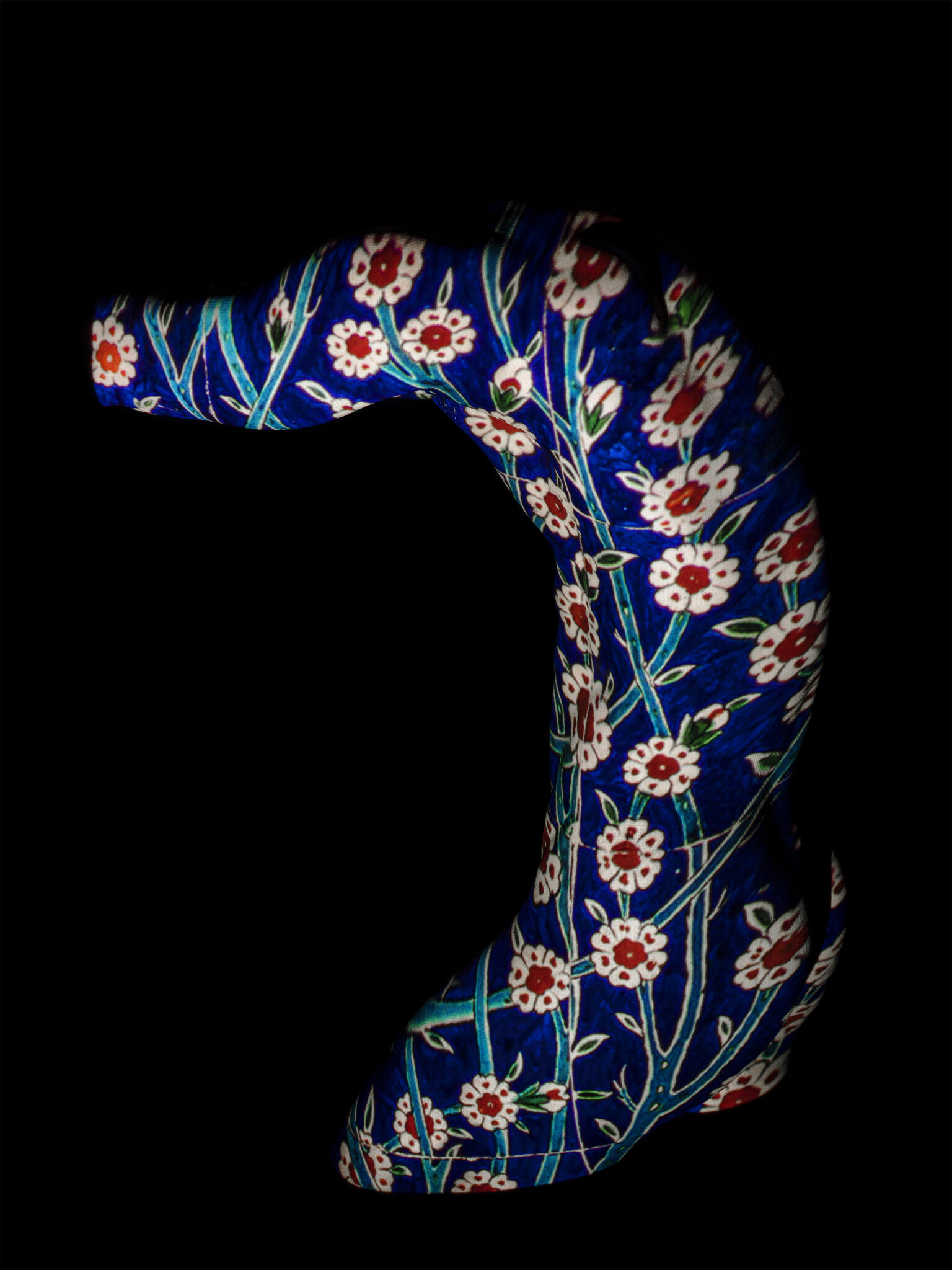
Turkish-French artist Sarp Kerem Yavuz loves photographing handsome men. His various bodies of work include sculptural photo-portraits of nude male models adorned with projected imagery of ornate Turkish Bathhouse tiles, sensuous, homoerotic photos of young American men convening in sports locker rooms (another homosocial space), and mixed media including neons, works on LED screens, and a functioning backgammon board created entirely out of Legos.
Sarp Kerem Yavuz, “Bahçivan,” 2022. Glicée print, 40 x 30 in. Courtesy of of the artist.
Thematically, Kerem Yavuz’s artwork is a reflection of himself: both Turkish and gay. These two elements haven’t historically been able to mix without conflict in his life, and he has always been interested in exploring those challenges. “For the last decade, I’ve been interested in deconstructing masculinity within an Islamic context. I often do this by queering (arguably already queer) orientalist imagery. My largest body of work to date, Maşallah, comprised of scanned Iznik tiles and later, scanned porcelain dinnerware, projected on male nudes to talk about the superimposition of conservative politics onto my generation. I would also periodically visit various Turkish baths to create cinematic scenes that were meant to imply the existence of broader, imagined, queer narratives unfolding in these traditional homo-social spaces. I guess I could say that I was always more interested in the story than the particular medium, although I am partial to photography.” Now that he lives and works in New York City, Kerem Yavuz is able to openly express these two important facets of his identity without suffering censorship from the Turkish government and death threats, among other significant challenges he has faced that many people may not have the courage to stand up to in the name of creative expression.
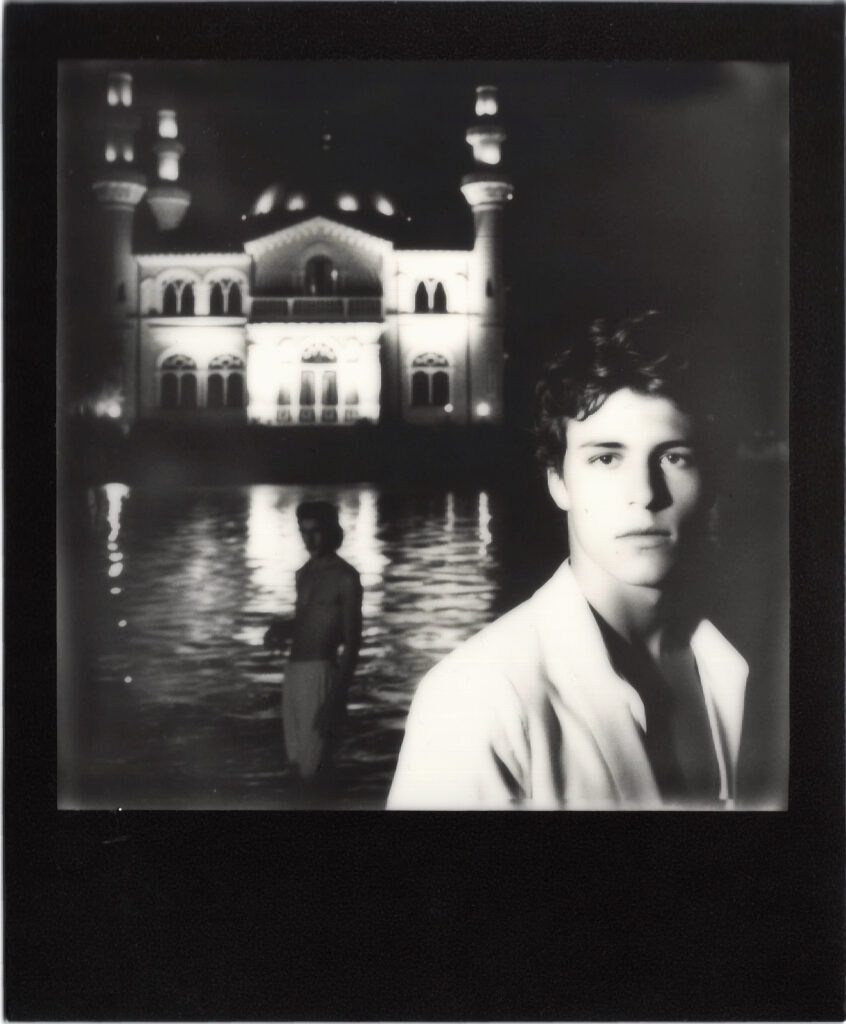
Sarp Kerem Yavuz. “Boğaz,” 2023. Polaroid. 4.2 x 3.4 in. Courtesy of the artist.
This year, he expanded upon his traditional art and photography practice by utilizing the AI software, Midjourney, to create AI-generated imagery for his latest series: Polaroids from the Ottoman Empire, currently on view at Palo gallery in NoHo. He discovered Midjourney “while looking into new digital art trends…its aesthetic capabilities felt more in line with my style than Dall-E.” The cinematic images on view in the exhibition Polaroids from the Ottoman Empire include images of two fit, ostensibly Turkish, shirtless men romantically gazing at the moonlight over a Mosque along the Bosphorus, a bejeweled drag queen making her grand entrance in an invented 1920s-style speakeasy nightclub in Istanbul, and bust-style portraits of handsome, turban-clad men gazing seductively at the viewer from inside a Hammam setting, among other fantasy, homoerotic, faux-vintage Turkish narratives.
The lighting in each of Kerem Yavuz’s AI-generated images is filmic and romantic, with mainly dark or jewel-tone color palettes. There are also a few black-and-white shots included in the series, which feel a bit out of place when thinking of traditional Polaroids. Some of Kerem Yavuz’s AI images are reminiscent of the style of a Jacques-Louis David painting, among other art-historical references and sources of stylistic inspiration. The Polaroid borders Kerem Yavuz chooses to print each image within – because no one likes to see a Polaroid without that iconic built-in bottom-heavy frame – are black, white, or gold. Before framing, Kerem Yavuz finally mounts each printed Polaroid on a mat, which represents a common color of velvet in traditional Ottoman interior decorating.
Importantly, Kerem Yavuz also shoots with real Polaroid film in a different series of his work, Shadows of the Empire, photographing staged scenes of his friends in Istanbul that comment on parallels between LGBTQ+ and women’s rights being taken away in both Turkey and the United States in recent years. “Shadows of the Empire” is currently on view at Zero Bond, where he is this month’s artist in residence via Apostrophe gallery. It is not easy to tell the difference between Kerem Yavuz’s real Polaroids and his AI-generated Polaroids. It’s clear Kerem Yavuz is using AI to mimic and expand upon his own photographic language, rather than copying another artist’s style: a major current plagiaristic danger of AI in the digital art space.
Sarp Kerem Yavuz. “Away,” 2022. Gold Frame Polaroid, 4.2 x 3.4 in. Courtesy of the artist.
For Kerem Yavuz, as both a traditional photographer and AI artist, the inevitable element of financial investment also comes into consideration. Kerem Yavuz elaborates, “I think most people who insist on traditional photography tend to forget how extraordinarily expensive high-end digital photo shoots are. Buying a decent medium format digital camera, which is what I have been using for the past decade, runs you between $10,000-$20,000. You can rent, but then you also need to get really good equipment insurance so that tends to be around $1000 for a week of shooting, just for a camera with a regular lens attached with a spare battery and some flash drives, (not including any lights, stands, sandbags to keep the stands where they are, portable batteries, backdrops, studio space if you need it etc.). Then, there is the additional cost of paying models, assistants, and the time cost of processing and editing the images, plus transportation if you are shooting on location. I have done all of these for years, and I have greatly enjoyed the process, but it is a costly endeavor, which often means you need commercial work to be able to afford to make artistic work. It is also incredibly time consuming. AI photography, at least in the way I have been engaging in it, feels a little more like street photography, where the production element is removed in favor of chance and spontaneity. It’s trickier to get what you want, since there is inevitably a lesser degree of control, but it does offer a greater degree of access to people without the means or the network to dive into photography as it is structured today.”
Whether shot in the flesh or rendered digitally, iconic gay male nude portrait photography can call to mind the explicitly sexual, stark, sensuous, and formidable black and whites by Robert Mapplethorpe, or perhaps the striking, colorful photography of nude or semi-nude male dancers and religious figures in fantastical staged scenes by David LaChapelle. Unlike Mapplethorpe’s homoerotic photography, Kerem Yavuz’s is understated in its eroticism. Unlike LaChapelle’s staged fantasy photography, Kerem Yavuz’s imaginary gay scenes incorporate an Ottoman visual language and color palette. Kerem Yavuz has his own visual language, and experiments with the reverse process using Midjourney to see how it categorizes his original images. “What is fascinating about Midjourney and other internet-based algorithms is that their ‘imagination’ is ultimately shaped by whatever dominates the web. Midjourney has a fun tool that allows you to upload your own images and have it describe them to you. With my photographs, it often says ‘in the style of Hasan Hajjaj’ which is flattering, as I love his work, but I was never inspired by his practice and our aesthetics are quite different. It just goes to show that online media and discourse around Middle Eastern imagery has a long way to go.”
Sarp Kerem Yavuz. “Sahilde,” 2023. Polaroid. 4.2 x 3.4 in. Courtesy of the artist.
The subtly erotic and Middle-Eastern qualities of Kerem Yavuz’s photography stem from his relationship with his father, or the idea of “the father-son relationship.” When Kerem Yavuz came out at age thirteen, his father did not accept his homosexuality and was consequently absent for most of his life. Today, the two are estranged. When asked if he knows other artists working with the idea of the father-son relationship, Kerem Yavuz replied that the father-son relationship is a very vulnerable topic, in almost a banal way. He commented, “Mapplethorpe’s hypersexualilty functioned almost as a protective armor – people don’t accept regular male vulnerability, which is what my work speaks to.”
Another through line in Kerem Yavuz’s artistic career is he is frequently ahead of the curve as an innovator, which, he commented, “can be lonely at times when no one yet understands [his] ideas.” AI is a contentious topic worldwide in industries spanning art, tech, medicine, politics, law, advertising, and many more. In photography specifically, it is already a topic that has entered the forefront of the conversation. Recently, German Photographer Boris Eldagsen won a photography award with his AI-generated photograph (created on Dall-E 2 software), The Electrician, at the Sony World Photography Awards, and declined to accept the award because of his concern for how AI will affect (and compete with) the photography world overall. That perspective is understandable, as the judges of the award were unable to discern his AI-generated photograph from real photographs in the competition.
Kerem Yavuz’s AI Polaroids and “real” Polaroids also look similar to one another. There is something about the people or settings in the AI-generated images that is a “little too perfect,” which can give them away upon close examination, but it’s not always obvious which are which. The catch is that none of the people or places in the AI-generated imagery are real, and they all appear to exist in an unknown, historical place and time in a Turkish, Ottoman past. They’re like memories from a homoerotic dream version of Istanbul during the Ottoman Empire, that never existed, nor would have been able to exist, because of the Ottoman Empire’s extreme homophobia. Kerem Yavuz commented on his inspiration for the series,“I loved the notion that in a parallel universe, I would have been traipsing around a present-day Ottoman Empire, photographing my queer friends in various places in Istanbul.”
Sarp Kerem Yavuz. “Banyo,” 2023. Polaroid. 4.2 x 3.4 in. Courtesy of the artist
Even though Kerem Yavuz’s AI-generated images look – in one way or another – “real”, with Kerem Yavuz’s title of the series, he “confesses” another hint into the photographs’ fictional origins: while the Ottoman Empire ended in World War I, Polaroids were not invented until World War II. Therefore through just his title, Kerem Yavuz lets viewers know his Polalroids from the Ottoman Empire are technical impossibilities.
For Kerem Yavuz, Polaroids from the Ottoman Empire is also about the “believability” of images in the current AI era. However, questioning the believability of photography, while now heightened due to AI, isn’t new. Falsified imagery in photography has been explored since Yves Klein’s 1960 Leap Into the Void, in which Klein created an early, analogue visual illusion to “document” a man jumping out of a window even though it never really happened. Edward Weston’s 1920s and ‘30s vegetable still lives, Peppers, look at first glance like black and white photo portraits of muscular male torsos, tricking the eye at first glance. With the eventual invention of Photoshop and an infinite array of postproduction effects and image-generating software, the notion of photography as solely a medium that documents reality is nearly a century gone. Kerem Yavuz’s decision to print his images on Polaroids is another layer of his trickery: “Polaroids bring a plausibility to the narrative because we are culturally conditioned to think of them as documents. No one thinks a Polaroid is faked, even though the technology to expose images onto a Polaroid digitally has existed for a decade,” he emphasized.
To create the AI Polaroids, Kerem Yavuz teaches Midjourney software how to make an image look gay, glamorous, exotic, romantic, antique, Ottoman, or express other features simultaneously, using his words. He even gets specific in the sense of telling the software, “make this image look like it was shot with a Nikon 110 millimeter lens,” or “give me an image of two men in front of a mosque in Istanbul in the style of Jodorowsky,” and the software generates that effect or visual. Through repeated processes of trial and error, Kerem Yavuz communicates different combinations of these key words to the software until he gets his desired imagery in return – a tedious practice that requires a lot of patience and nuanced communication between man and machine. Each time, the AI software transforms Kerem Yavuz’s permutations of adjectives into generated imagery based on other imagery it has been introduced to previously online. Kerem Yavuz explains, “In photography, we often shoot the same shot hundreds of times with small tweaks and iterations. This also applies to AI-generated imagery, where sometimes Midjourney will give me almost what I’m looking for, but not quite, so I will spend hours telling it to iterate on one specific thing. Sometimes, in both cases, the image just doesn’t work. Or you end up needing to edit in post.” As result of the collaboration between Kerem Yavuz and Midjourney (which actually lives on Discord – a platform he describes comically as “the unholy love child of Reddit and WhatsApp”), the scenarios in the imagery look, to some degree, believable.
A serious problem with this, that Kerem Yavuz recognizes and addresses, is Midjourney software’s inherent biases. He remarked that he has noticed, through his use of this software to create his imagery, that if he asks it for an image of “two handsome men,” it will most often provide images of two white men. If he asks for “two gay men,” it will similarly give him images of men covered in rainbow clothing, or holding Pride flags. It barely understands when he asks it for images of “two men kissing” and shows him images of two men pecking on the cheek rather than engaged in any type of romantic kissing. There is very obvious heterosexual, white, cisgender bias in this process that Kerem Yavuz continues to notice, critique, and do extra work to find ways around to get his desired image results, repeatedly putting the technology to the test.
Like artists and photographers working throughout history, Kerem Yavuz is working with the technology of his time. It’s not long ago that everyone was talking nonstop about NFTs – now, the new buzzword is AI. There’s inevitably a coalescence of the two as well. Many question if either of these two technologies have potential to exist on par with more traditional art forms. But, more than just buzzwords, there is real artistry in the conceptual aspect, detailed communication technique, choice of software, printing and exhibiting decisions, visual composition, color palette, light source simulation, and more that Kerem Yavuz employs to create his AI-generated imagery for his Polaroids from the Ottoman Empire.
Conversations today about AI – across industries and contexts – often involve sensationalist notions of “Is it good?” “Is it bad?” “Is it scary?” “Are we doomed?” What I think Kerem Yavuz is proving with Polaroids from the Ottoman Empire is that there is a way to authentically make original art using AI software as a tool. When executed thoughtfully and with the level of care and critique he uses, art creation becomes one of the technology’s positives. He concludes, “In its current form, I feel like AI is making poets of us all, and I find that delightful.”
Sarp Kerem Yavuz’s solo exhibition Polaroids from the Ottoman Empire is on view at Palo Gallery until July 1st, 2023 and Shadows of the Empire is on view at Zero Bond.
Above image: Olek installing Project B in 2010. Image courtesy of Olek on Vimeo.
By Alexandra Goldman
If you never saw it in person, you’ve probably seen an image of Project B at least once. The original guerrilla art installation was only up for a few hours before it was taken down by the city, but its viral visuals live forever online. For the ten-year anniversary of Project B this Christmas, I’ve decided to take a closer look at the project and the person who created it, the Polish artist Olek, née Agata Oleksiak, (b. 1978, Staszow, Poland). I’ve found it is a story about ritual, iconoclasm, and two different New York-based immigrant artists who wanted to see the United States doing well. It’s also strongly connected to Olek’s Polish roots.
Charging Bull has become a known site of protest on its own in New York and the subject of several acts of iconoclasm, especially since the 2011 Occupy Wall Street movement. It has had paint doused on it in 2017, and had dye poured on it, and its head bashed with a spiked banjo in 2019, for causes ranging from anti-financial corruption, to protecting the environment, to anti-Trump demonstrations. Because of this, there is a current conversation about relocating it. Olek’s wrapping of the bull with yarn has been the most peaceful form of altering the statue while still having a big impact. It is similar to how the artist Dustin Klein created a light projection of a portrait of Breonna Taylor to project onto the controversial statue of Robert E. Lee in Richmond in July 2020 as part of the BLM movement. Both yarn and light can be used as peaceful strategies for acts of iconoclasm on monuments.
Olek installing Project B in 2010. Image courtesy of Olek on Vimeo.
For background, in 1989, Italian immigrant sculptor Arturo Di Modica (b. Sicily, 1941) originally installed Charging Bull on Wall Street at Christmas time. He had a studio on Crosby street, and without city permission he and a group of friends delivered by truck the self-funded sculpture in front of the New York Stock Exchange. He intended the sculpture of the known market symbol as a “Christmas gift” to the city symbolizing “the strength and power of the American people”, two years after the October 19, 1987 stock market crash known as “Black Monday” (the worst crash since 1929). Within hours, Charging Bull was removed by the city and taken to a warehouse for storage, before it was later legally relocated to Bowling Green.
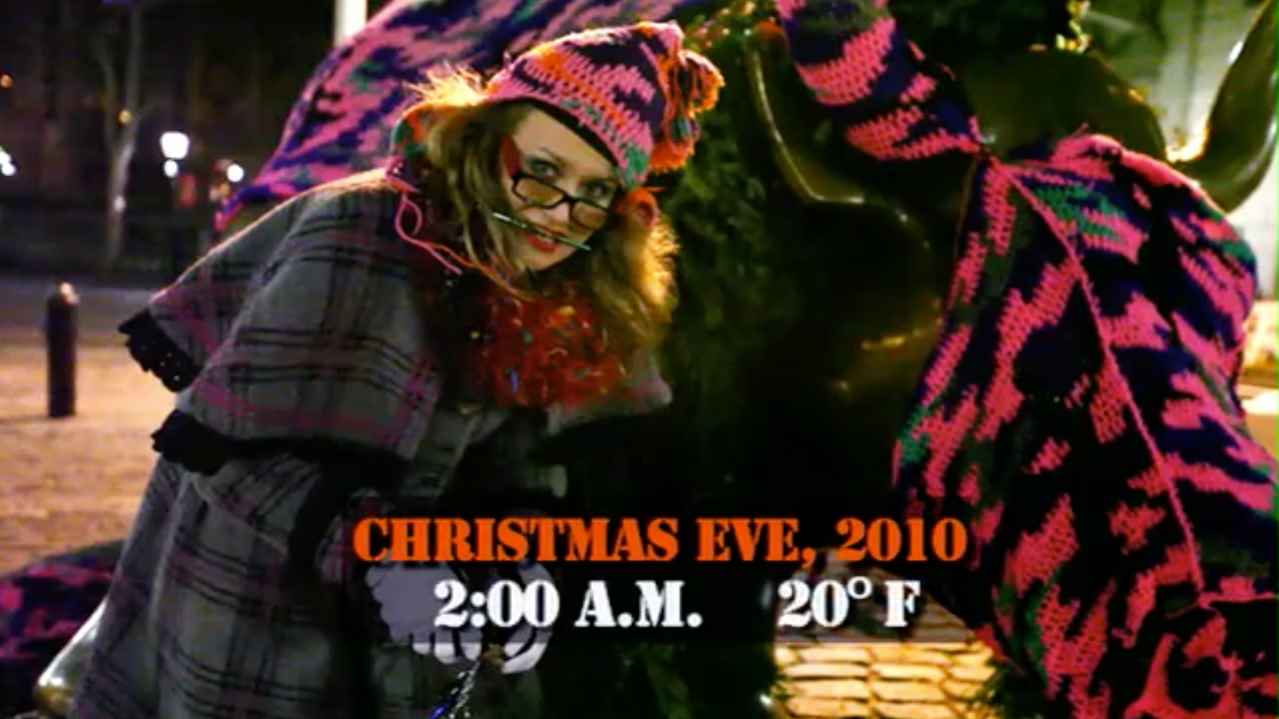
Twenty-one years later, at around 2:00 am on Christmas Day 2010, without city permission, Olek wrapped Di Modica’s sixteen-foot, 3.5-ton, bronze Charging Bull with bright pink (with hints of purple, teal and gray), camouflage-pattern, hand-crocheted yarn that they created without assistance. Olek titled the guerrilla intervention Project B or Project B (Wall Street Bull), which is actually absent from the majority of articles about the project.
Replicating Di Modica’s timing, two years after the severe 2008 market crash and also at Christmas time, Olek revived Di Modica’s original guerrilla intervention through Project B by wrapping Charging Bull with their camouflage crocheted yarn. Similar to Di Modica, Olek considered Project B their “Christmas gift” to the city or a “Christmas sweater” for the bull, in effort to uplift the country following the most recent financial crisis. According to the artist, Project B was a symbolic public gift for all those who couldn’t afford holiday presents that year or were unable to visit their families. Olek’s strategic reenactment of Di Modica’s timing (both after the financial crash and time of year), guerrilla-style action, and gift-intention categorize Project B an act of ritual. Olek later confirmed that it was a ritual, and prior to wrapping Charging Bull with yarn, they carried out a series of Polish Christmas rituals: “Christmas eve is a special day for Polish hearts. That night, animals speak human voice. I cooked a traditional dinner, and went to pasterka (midnight mass),” they explained.
The idea of revitalizing statues through ritualistic actions such as wrapping them with colored cloth is not new. It even dates back to Ancient Egypt, during which kings and priests would drape colored cloths around statues of deities during their daily offering ritual ceremonies to the gods to revive their ka, or, inner spirit. In Ancient Egypt, the colors of the cloths during the daily ritual had specific meanings for the ceremony to either refresh the deity (green cloth) or reaffirm its holiness (red cloth).
Olek’s use of the color pink for ritual cloth statue wrapping, when combined with the historically feminine medium of crochet, has given cause for some to consider Project B a political, iconoclastic act by the artist amidst Wall Street’s hyper-masculine environment. While noting Olek prefers to avoid the limitations of categorizing their art as “yarn bombing”, yarn bombing (street art involving yarn), is historically rooted in third-wave feminism during which domestic arts were celebrated. Project B is therefore on one hand, Olek’s public critique of the imbalance of the hyper-masculine environment of Wall Street and the failures of power imbalance.
However, rather than pitting the genders at war with one another through Project B, Olek was expressing maternal caretaking, the need for balance, the importance of self-love, and love of others. Olek, an immigrant from a formerly communist country, felt the need to symbolically take care of a failing capitalist system and lift it back up. Olek created a Yin-Yang duality whereas before there was only Yang energy.
Olek also believes all art is a self-portrait. Through spiritual exploration, Olek identified in recent years as gender nonbinary and considers themself to be a “two-spirit being”, fully male and fully female simultaneously. Wrapping the masculine, muscular, bronze bull with the feminine, soft, pink, crochet resulted in the temporary creation of a powerful, mirroring, two-spirit being in the public space of NYC’s Financial District.
Olek hugging Project B. Image courtesy of Olek on Vimeo.
Furthermore when I first met Olek at Art Basel Miami Beach last year, I became interested in their work because it immediately felt very Polish to me, and I was interested in the fact that none of the articles I was reading about Olek’s work spoke about how Polish it was. I have Polish heritage, and traveled to Poland in 2009.
I was driving from Czestochowa to Krakow in 2009, and noticed all the buildings were Brutalist gray rectangles or squares. However, every so often some stretches of buildings, that seemed to be apartment complexes, were painted over with wide, vertically striped swathes of rainbow colors. I asked my Polish friend why some of the buildings were painted over like this. She replied that after communism fell some cities and towns celebrated by painting buildings bright colors since the government didn’t allow any deviation from uniformity during communism. Similarly, Olek’s art intervention tactic of using a bright burst of color in homogenous gray public space with Project B represents their Polish way of expressing freedom from oppression.
The idea of combining the media of fiber art and sculpture also has roots in Poland. The artist Magdalena Abakanowicz (b. 1930) is a famous Polish sculptor who works with fibrous materials. According to the MoMA, “Abakanowicz and many artists of the Eastern Bloc were drawn to craft and textile traditions as expressive mediums less regulated by Soviet censorship.” When Olek first came to the U.S. with no money in 2000, their sculpture professor at La Guardia Community College also encouraged them to begin sculpting using any material, including yarn.
In our recent Zoom interview, Olek explained that while growing up in communist Poland, being an artist – or expressing individuality of any kind – was highly discouraged, and art galleries and museums were reserved for the elite. Olek believes they never could have fully become who they are as an artist, or individual, if they had stayed in Poland and not made the courageous decision to emigrate to New York. While Olek critiqued the failing power imbalance that Charging Bull came to represent with Project B, Project B was also Olek’s renewal of Di Modica’s celebration of possibilities and resilience available in a capitalist country, presented by an immigrant artist who couldn’t have had their career without its benefits. Their own experience of feeling excluded from art institutions while growing up poor in Poland led to their dedication to public art that can be accessed by anyone.










 artifactoid