Alone for the Holidays? Conceptual Photographer Suzanne Heintz has a Remedy for That

Sometimes when you walk into an art gallery opening, there’s a lot of craziness. The space can be packed shoulder-to-shoulder with people sipping booze and chatting loudly, and it can be difficult to actually get a good idea of the art you’re looking at through the sea of bright red lips and thick-rimmed glasses. While these aren’t ideal conditions for someone aiming to write an article about the art (like myself), having a glowing room of excited and supportive patrons is both a great sign for the artist showing her work, and fun!

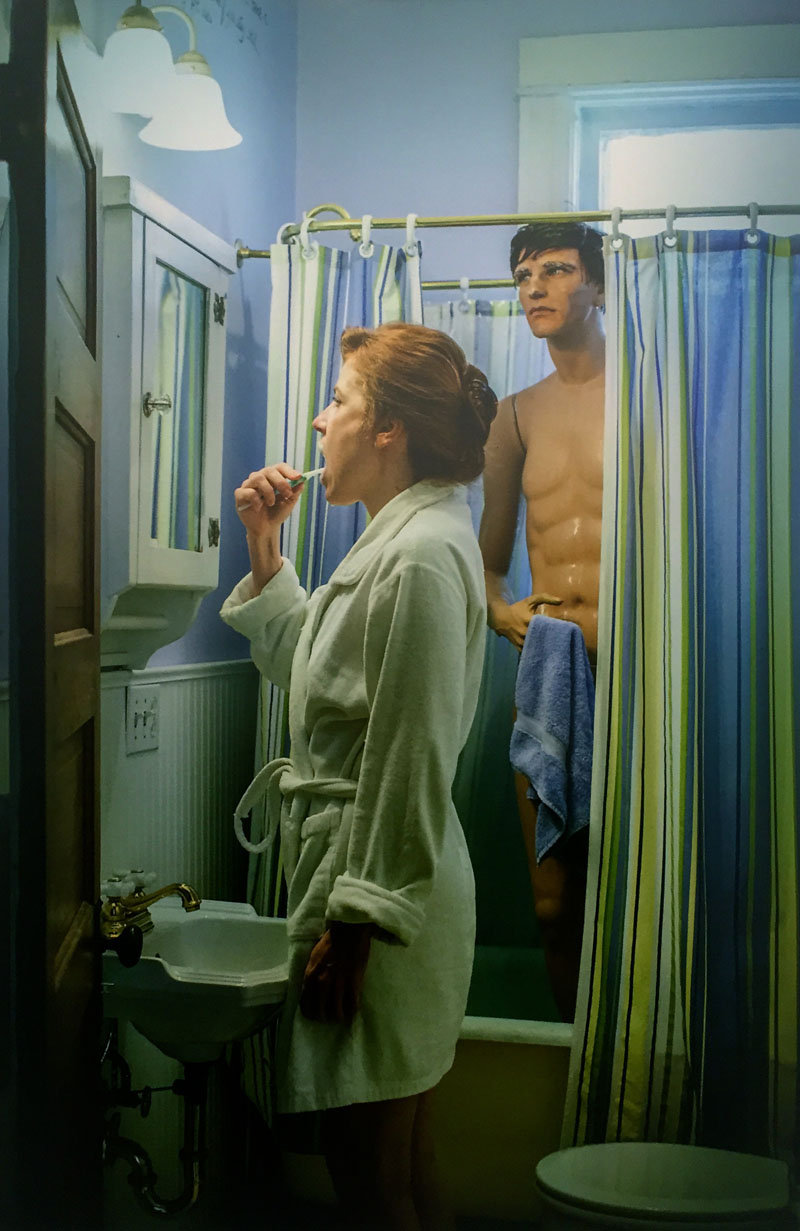
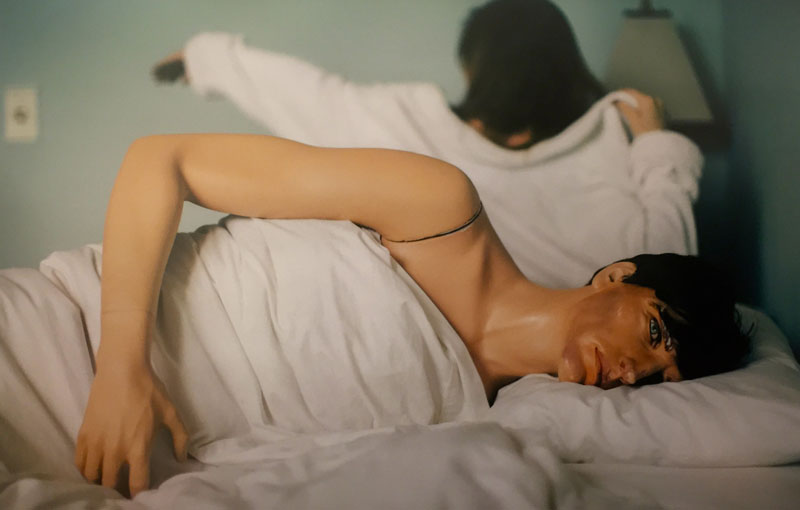
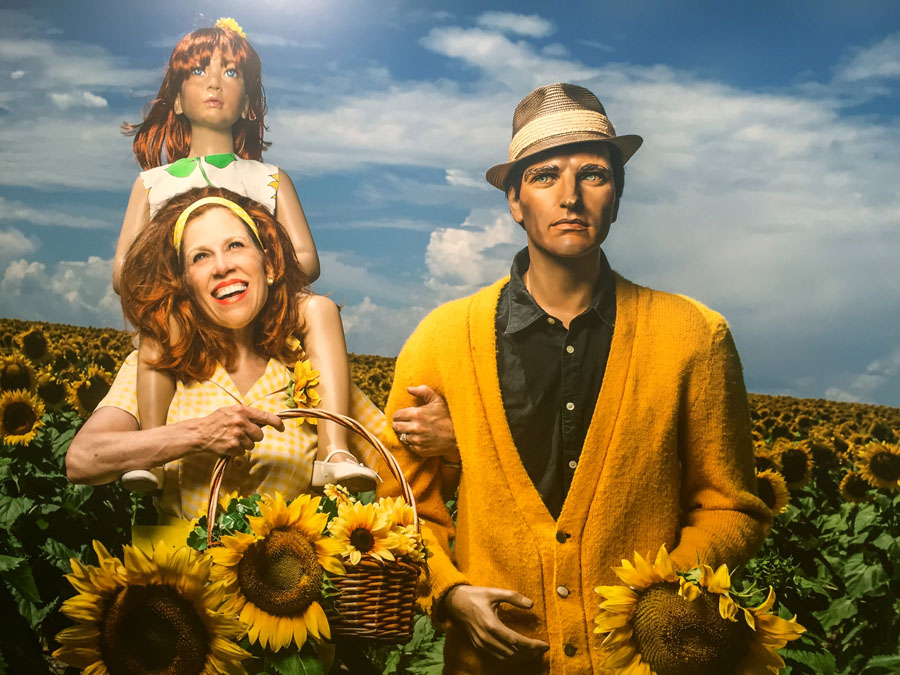
The aforementioned describes the scene where I met Conceptual Artist Suzanne Heintz: the bustling opening night of her show “Playing House” in Chelsea at the JoAnne Artman Gallery. While I couldn’t get a thorough grasp of the story behind her work at the opening, the striking, absurd, brightly colored photographs depicting Heintz with her husband and daughter in Paris, among other settings, stuck with me. This is because I learned that unlike my family and most likely yours, Heintz’s husband and daughter are actually life-sized fiberglass mannequins, or as she lovingly dubs them, “familyquins.”

Heintz1

With this in mind I decided to dive further into researching Heintz and her work, and what I found was, unexpectedly, a perfect story for the holidays — a time when for some singles, it can feel like there is added pressure from either society, family or self to be in a relationship.

Heintz2

Heintz, a conceptual artist, 20-year veteran art director at Starz, and self-proclaimed spinster among other things, recalls sitting around with her mom one day having a conversation that, per Heintz’s entry in the Huffington Post Blog, went along the lines of: “Suzy, there’s nobody perfect out there. You just need to PICK somebody, if you’re going to settle down.” [Heintz] snapped back, “Mom! It’s not like I can go out and BUY a family! I can’t just MAKE it happen!”

Heintz3

Then, one day shortly following this conversation, Heintz was walking around and passed by a shop that happened to have a “family” of mannequins for sale in the window. She had an “aha!” moment, and decided to literally “buy” herself a family: a husband, who she calls Chauncey, and an “eight year old” daughter, who she named Mary Margaret. Starting at that moment, Heintz set out on a fourteen year journey carrying Chauncey and Mary Margaret around to various locations, filled with countless family photo and video ops including holidays, European vacations and even a wedding.

Heintz4

Heintz does an incredible job of adding a dose of smart humor (plus what is now likely upwards of a decade and a half of mind blowing dedication) to her critical examination of an important topic. On one hand, with this project Heintz comments on normative role expectations for women, encouraging them to embrace their lives regardless of whether or not they have an “Mrs., PhD, or Esq. attached to their name.” On another, according to the JoAnne Artman Gallery, Heintz also comments on “The American Dream and the pressure to conform.” To note, I found the tie to The American Dream interesting because in 2015, that phrase, in its original sense, can seem antiquated. Stemming off of that, I think it could be an interesting follow-up study to examine Heintz’s work in the context of other artists who work with the idea of The American Dream, both currently and throughout art history.

Finally, Heintz’s work is really interesting to look at within the context of today’s era of social media (especially since Heintz began her “family life” with Chauncey and Mary Margaret before social networks really took off in a mainstream way). Specifically, people frequently post photos across various social channels that seem to demonstrate that they are fulfilling ideals of happiness, but for all anyone really knows, they may as well be posing with mannequins. Per the JoAnne Artman Gallery, Heintz’s use of “radioactive color and expressionless characters hint at the darker side of conformity, namely what is lost when the image, or illusion, of happiness is confused with happiness itself.”

Heintz5

Suzanne Heintz’s “Playing House” is showing at the JoAnne Artman Gallery through December 31st, 2015. Check it out in person if you’re in Chelsea this holiday season, and feel free to bring along your significant other. All shapes, sizes and materials are welocme.

Marta Minujín, MINUCODE at the NYU Institute of Fine Arts

The NYU Institute of Fine Arts, The Americas Society, and The Institute for Studies on Latin American Art recently hosted a panel discussion and book signing featuring renowned Argentinian conceptual and performance artist, Marta Minujín. The event focused on Minujín’s  1968 work, MINUCODE. The MINUCODE project comprised a publicly answered questionnaire followed by four cocktail parties with a sociological twist, and performance ephemera of various media including video, light and sound.
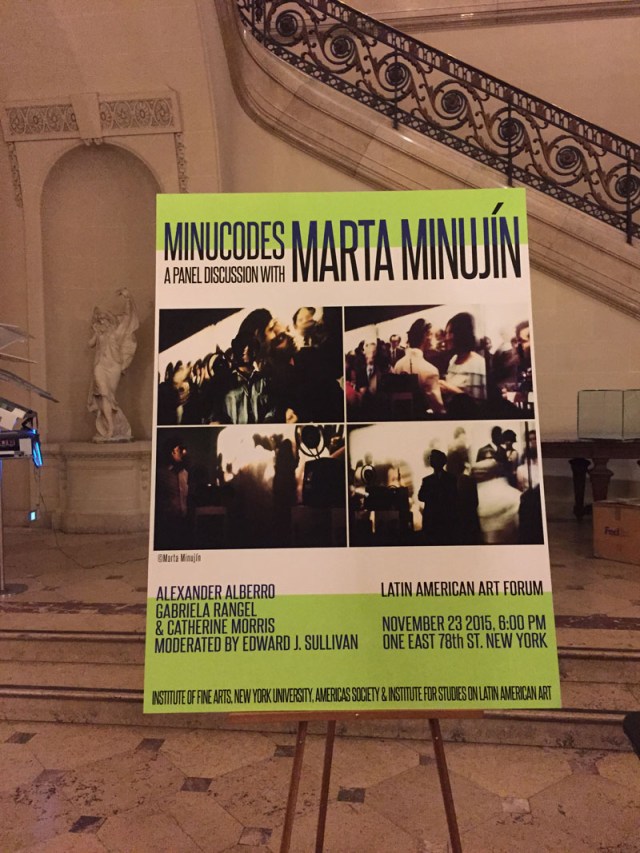
Minucodes1

While MINUCODE may seem like a work of performance art, it is a part of a genre of artwork that has usually been connected with Minujín since the mid-1960s, called “happenings.” Minujín described happenings as similar to performance art, but was exigent about distinguishing  the two. She noted at the panel:

No one else really did happenings. A happening is like a work that the people appropriate and decide: the work belongs to the people. Then, that word in the art world changed to “performance,” but I don’t believe in performance. With a happening, you never do it twice. For example, you can only do it for five minutes and never more. Conversely, with performance, you can do it 2, 3, 4, 5, 6 times. It’s a very different work, a happening versus a performance. Happenings are much more interesting than performance because you can use bits of time and space that are very short. You can live much more intense things in five to ten minutes than you can in eight days–you can be jumping out of a helicopter in Uruguay throwing chickens: in only eight  minutes!

I had first gone to see Minujín’s work exhibited at MALBA in 2010 in Buenos Aires, and then met her face to face in 2012 at a gala at the Museo Nacional de Bellas Artes.  So, I thought it would be amazing to see this incredible artist again, in person, and in my home town!

When I initially inquired about Minujín in 2012, she was explained to me as the “Andy Warhol of Argentina.” I am not sure how she feels about this comparison, but I do know that the two were friends, and used to collaborate. For example, the below is a 1985 performance project that Marta invited Andy to collaborate on, which symbolized the paying off of Argentina’s external debt using corn, or “the gold of Latin America.” Per the Henrique Faria Gallery:

Surrounded by 1,000 ears of corn, spray painted gold, Warhol and Minujín acted out the negotiation of the debt, symbolizing not only the interchange of merchandise, but also of artistic and cultural experiences…this piece has become a symbol of the cultural relations between the United States and Latin America, undertaken by the greatest Pop Art exponents of each country.
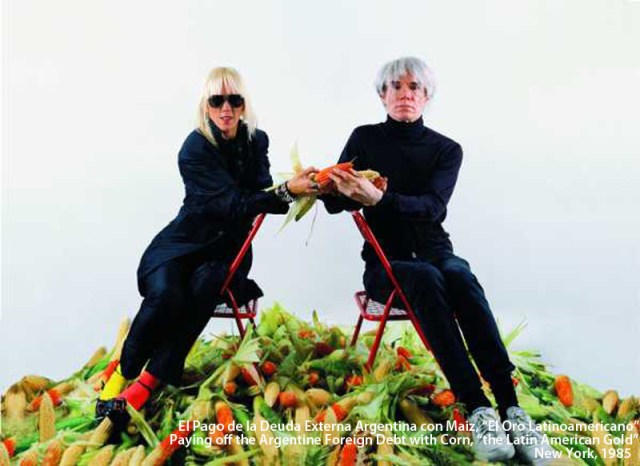
flfl‡fi

With this background information about Minujín’s reputation as an artist in mind, I’d like to turn your attention back toward MINUCODE, where Marta set up four cocktail parties in 1968 NYC for a social experiment that was considered itself the work of art.

To introduce MINUCODE at the panel, scholar Alexander Alberro contextualized the work as follows:

The normality of traditional artistic media came to be seen as a myth in the 1960s. For those pursuing innovation in the arts, the task at hand became not so much one of changing the contents and the formats of artworks, but one of taking a more radical approach to media as such. Many began to argue in favor of considering mass communications media as a valid aesthetic form: the media itself could be aesthetic form. Mediated images of objects and events could be transmitted simultaneously to widely dispersed audiences, and had the benefit of at once collapsing the hierarchy between popular culture and deep culture, and eliminating the need for original objects and performances around which the public had previously gathered to experience art. This is the context in which Minujin’s non-matrixed social environment, MINUCODE, was exhibited at New York’s Center for Inter-American Relations in the late spring of 1968.

Minucodes3

To execute MINUCODE, Minujín created a questionnaire for the public to fill out, and said, “if you want to come to a cocktail party, fill out this questionnaire and return it to this art galley.” While the questionnaire was more complex than this, the boiled-down explanation is that responses to the questionnaire divided people into four categories/social groups (decided upon by Minujín), based mostly upon occupation: Business, Art, Fashion or Politics. Each individual’s questionnaire results determined which of the four cocktail parties they would attend.

Minujín received over 1,000 responses to the questionnaire, which she divided with a machine into the four designated social groups: Business, Art, Fashion or Politics.

Each participant then went to his or her respective party happening. This first part of MINUCODE (a social-scientific environment) was essentially a sociological study on the identities of each cocktail party, and how the guests represented themselves, acting out their roles in real life through dress and behavior.

The second part involved different ways of recording the four experiences and working with various intellectual and artistic concepts of media and viewer vs. viewed. For example, the first 10 minutes of each party were filmed by Minujín’s 6-member camera crew, and the footage was edited together into one reel. Over the course of the project, Minujín continued to document the parties with different styles of video, sound and light representations. She also showed the video footage and other media interpretations of the party to the party guests themselves as well as to the public, adding an additional layer to the work.

There is so much to this project: the light shows were created in collaboration with Tony Martin, an artist and lighting expert  from The Electric Circus, there were side performances, constructed electronic environments, there was the act of showing the videos of the parties to both the attendees of the parties and the public (reversing/questioning roles of viewer and viewed), strong ties to Marshall McLuhan‘s media theory (specifically about media and technology’s effects on the social environment) and more — so many facets and layers that I could go on endlessly!

In any case, one of the most special things about attending the talk was not necessarily learning the academic explanation of MINUCODE (while that is fascinating), but seeing and hearing such a legend present her own work while sitting three feet away from her. Therefore, I’d like to close the post with some highlights from the post-discussion Q&A.

Minucodes2

Audience: You were so young; how did you know you could pull that off?

Minujín: Everybody was young then! Like the Beatles and the Rolling Stones. We were representing our generation. We were very very young and had such a powerful belief, we were like a revolution, and we were all young. When you were 30, you were out! 22, 23 okay but 30 years old is the end! I was living my dream. I did not have a real life.

Audience:  We are aware, that constantly and unfortunately, in Argentina, there were dictatorships, changing governments, etc. – issues! Given that, how was your art received? By the government, etc? Did you have any problems with that? Were you free enough to expose your artwork?

Minujín: They were not intelligent enough to know what I was doing! It’s true! Like when I did the project at the Obelisk calling it “the military’s erection,” they passed by and didn’t understand at all that the work was talking about them, to the military. So you see, I was too far out for them.

Audience: So basically, you were free to do your own thing?

Minujín: Yes, I could do it because they would never understand what I was doing! But, what we were doing was political, and our concentration was powerful.

Audience: How did you connect with the scene of Howard Wise, and the people who were involved in experimenting with art and technology?

Minujín: The art world was very small. I arrived in New York and got to a gallery with Al Hansen. I was greeted at the gallery, and showed there. Lichtenstein’s wife was the secretary at the gallery and invited Warhol, and others. That’s how I met Warhol, Lichtenstein, Rauschenberg, Umberto Eco…and we would go to Kansas City. We would meet, and discuss–everything was together: music, literature, art– it was my time. Every day something happened. We were all together, doing happenings every day.

Audience: What do you think of the return of a great interest in your work 45 years later?

Minujín: I believe that maybe I am like the Beatles and the Rolling Stones. I’m more like a rock star than a visual artist. I am not modest!

To conclude, beyond MINUCODE and other stimulating happenings, Minujín is known internationally as a pioneer in art movements including “el arte de los medios,” (media as art), pop art, conceptual art, visual art, psychedelia, video art, “the art of action” and more. She is also famous for being the person responsible for “importing” hippie culture to Argentina with her 1968 work, “Importación/Exportación.”

Her artistic practice is influenced by thinkers like Marshall McLuhan, Roland Barthes, Ferdinand de Sausseure, Federico Fellini and more.
 

Constant Thinking, Museo Reina Sofia

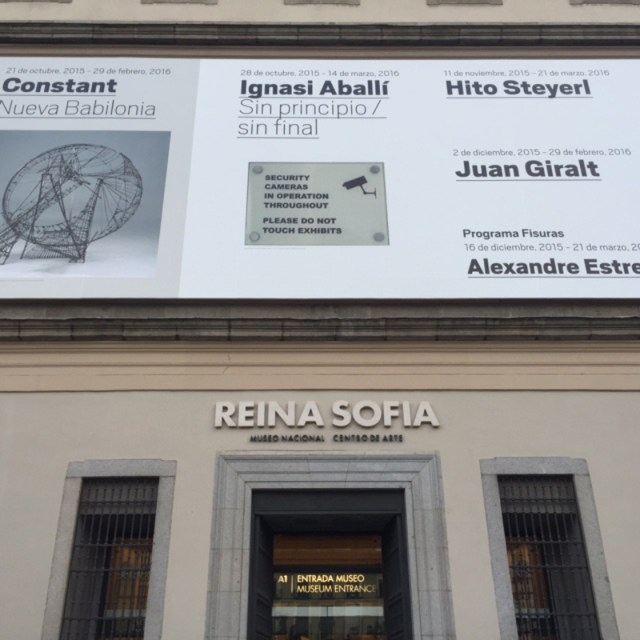
On a recent trip to Madrid I visited the Reina Sofia Museum. I’d been waiting to see this museum in person for years since in 2011, I’d created subtitles for a video interview that was included in a Roberto Jacoby exhibition there titled El Deseo Nace en El Derrumbe.

ReinaSofia4

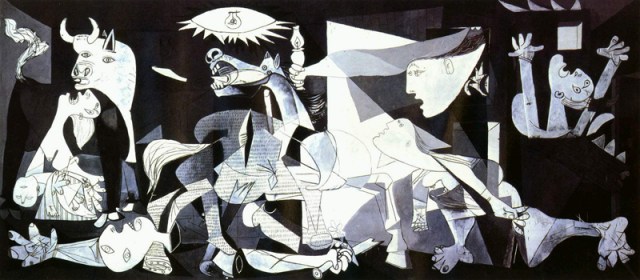
When I finally got to the Reina Sofia this October, it was everything I’d hoped it would be and more. Walking around inside the physical building was a beautiful experience. Its features included giant windows, stone hallways, modern exoskeletal glass elevators exposing sweeping views of the city, and a romantically-lit garden courtyard as the edifice’s centerpiece. There were floors of modern and contemporary art including some breathtaking very famous works, like Picasso’s Guernica (which I stood in front of for about 20 minutes; actual size=11′ 5″x 25’6″) and Dali’s The Great Masturbator

Guernica

Dali1

Aside from the museum’s impressive permanent collection, one of the temporary exhibits really stood out. It was the Dutch artist Constant Nieuwenhuys (1920-2005). Constant’s earlier works had a dark yet whimsical painting style which I absolutely love. I wondered why I hadn’t heard of him before, because to me he seemed like he should have been as famous as Picasso or Dali.

Constant2

Constant3

Other works of Constant’s were architectural, and some worked with the concept of the labyrinth. One project that Constant was very well known for was called “New Babylon.” The idea of New Babylon was an anti-capitalist city that would promote creativity as one of its main focuses.

Constant1

I am interested in researching more about Constant and New Babylon in the future. There is so much to find out about his diverse career, and I’m glad to have had my eyes opened to his work by the Reina Sofia.
Jan De Ruth, An Unexpected Encounter

Recent releases of films like “Woman in Gold” (2015), which chronicles the righteous return of Gustav Klimt’s world famous eponymous painting to its rightful owner, and George Clooney’s “The Monuments Men” (2013), which tells the story of a World War II platoon sent to Germany rescue stolen art from Nazi thieves, brought the topic of art and the Holocaust to mass attention through Hollywood. While these two films focus on the recovery of artwork once sequestered by the nazis, my attention was recently turned toward another aspect of the story about art in the Holocaust: the artists.

I had always wanted to go to an art auction, and a couple of months ago I spontaneously went for the first time, almost as a “bucket list” experience. I was not aiming to spend thousands of dollars on a painting, and this was not Christie’s or Sotheby’s. It was an estate sale auction in the Village. I went there with no expectations, hoping to possibly bid on a special piece of art if I ended up seeing one. The hours went by and nothing called out to me. Until I saw one limited edition lithograph print of a painting that I thought had beautiful energy. I connected with it.
When the auctioneer called out for bidders, I raised my card for $75, sure that someone would out-bid me. But, no one did, and as the beauty of auctions goes, if no one bids higher than you, the item is yours! So, to my surprise, I was now the owner of this lithograph. I had no idea who the artist was, or the real value of what I had acquired. Naturally, I turned to Google and found out that the artist was named Jan De Ruth, and the original painting was called “Daydream.” Who is Jan De Ruth?, I thought.

I kept researching, and learned that Jan de Ruth was a Czech artist who was moved through five different concentration camps during World War II and made four escape attempts, only succeeding on the fifth. He risked his life constantly to pursue art while in the camps, stealing, when he could, art materials including scraps of paper from a factory where he labored, a pencil, coffee, and often created his works on scraps of cloth torn from his clothing: the only possession he was permitted to have. Per Ro Gallery:

“Jan drew a mother and child on a scrap of paper he scrounged from the factory where he worked, filled it in with shadings of coffee in various strengths-his finger was his brush. He exchanged the sketch for a piece of bread from a camp guard, and in effect, sold his first painting.”

In 2008, Hilary Helstein created an award-winning documentary about the topic of artists in the Holocaust titled, “As Seen Through These Eyes,” narrated by Maya Angelou, which exposes the plight of artists like Jan De Ruth. While I wasn’t necessarily planning to purchase a painting at the auction that day, I am grateful to now look daily at a piece that reminds me of Jan De Ruth’s strength, courage, and perseverance.

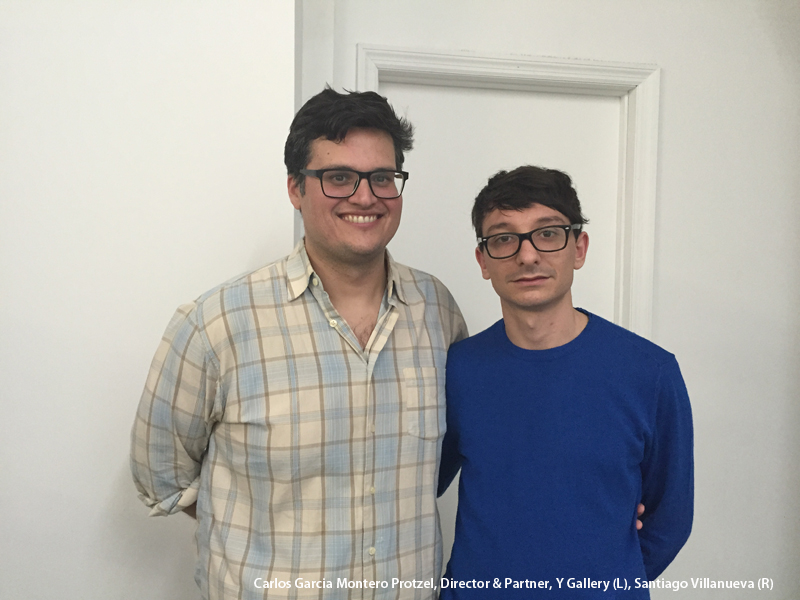
Santiago Villanueva, Y Gallery

I first met Artist Santiago Villanueva in 2010 in Buenos Aires. We were inside of the University of Buenos Aires social sciences campus, called “Marcelo T. de Alvear,” spending the day hijacking social and political student protest posters that would later be utilized in another artist’s exhibition in Scotland. That university campus is known as the most activist campus in the city.

SantiagoVillanueva7

At that time I was very wide-eyed and excited, witnessing first-hand this incredibly palpable activist energy in Buenos Aires. I was noticing the strong sociopolitical commentary both in the city’s daily life, as well as in art and expression in Argentina in general. It was coming from students and citizens of all walks of life, as well as from the top contemporary artists in the country.

YGalleryVillanueva2 copy

I’m thrilled to share that Villanueva, one of the influential contemporary artists I had the privilege of spending time with there, is currently exhibiting at NYC’s Y Gallery on the lower east side with a show titled “First Impressions.” The exhibition comprises a series of recent works that reflect his continuing revision of Argentinian history and art history.

YGalleryVillanueva4

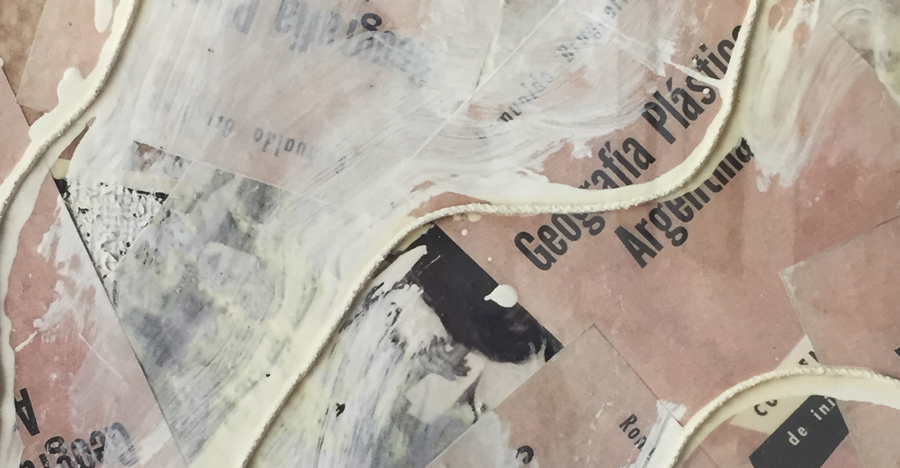
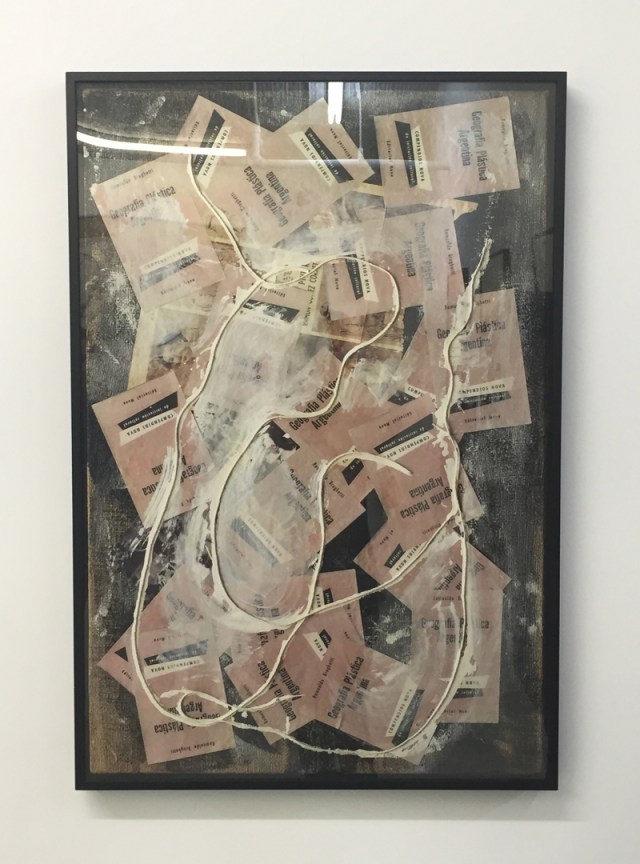
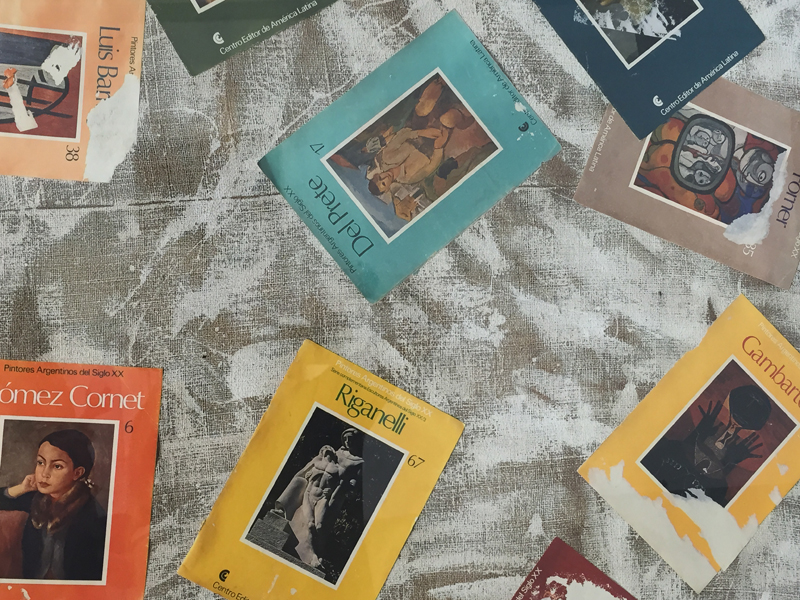
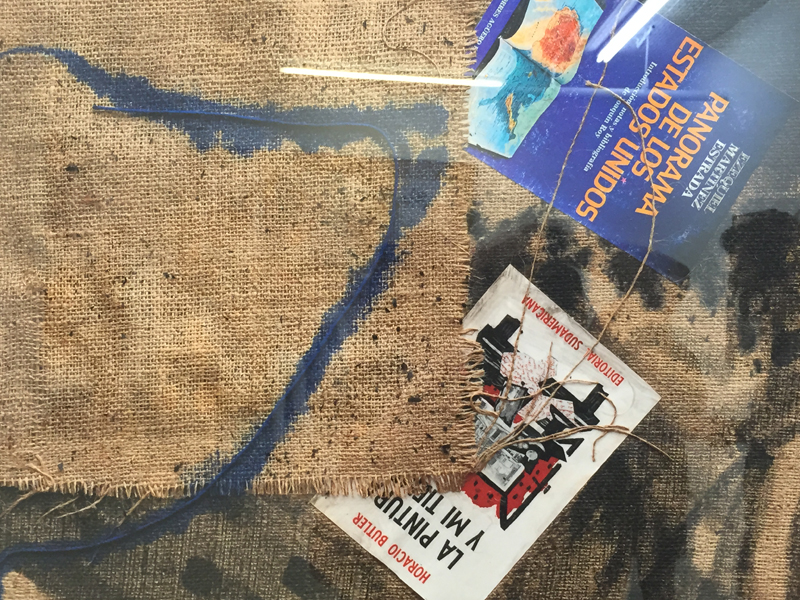
“First Impressions” combines a mid-19th century Argentinian visual tradition called the “disorderly table,” or, “mesa revuelta” (imagine it as a messy still life), with the results of Villanueva’s past two years of research about Argentinian art history. For the project, Villanueva worked with a variety of media including papers, threads, letters, documents and images selected from both the mass media and the works of specific artists. The result is a personal map or atlas of Argentinian art history that both changes the usual visual expectations of a still life, and provides a unique, non-linear methodology for the understanding of art history that breaks from traditional pedagogic approaches.

Villanueva8 Villanueva6

This exhibition marks another success in Villanueva’s exciting career. In recent years he has received a consistent stream of honors from prestigious organizations, including scholarships at the Center for Artistic Research (Centro de Investigaciones Artísticas – CIA) and the Cisneros Fontanals Art Foundation (Fundación Cisneros Fontanals – CIFO), as well as appearances in museums and institutions including the General Argentine Consulate in New York, the Museum of Modern Art of Buenos Aires (MAMBA), and the Museum of Latin American Contemporary Art (MACLA).

Villanueva9

Stop by Y Gallery (319 Grand St.) to see “First Impressions,” open through November 15th, 2015.


Jung Uk Yang, DOOSAN Gallery

One of the things I love most about going to art galleries without knowing what’s showing is that it feels like I’m on a treasure hunt: behind any gallery door, there is the possibility of finding unique creative treasures that carry inspiration and ideas.

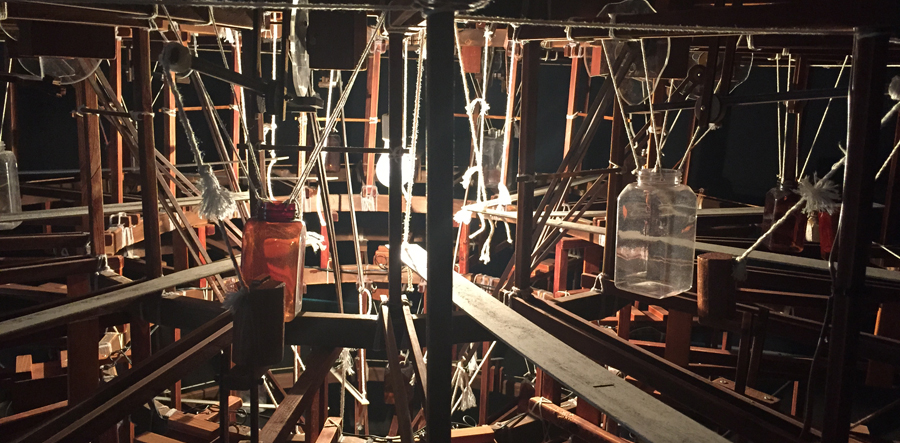
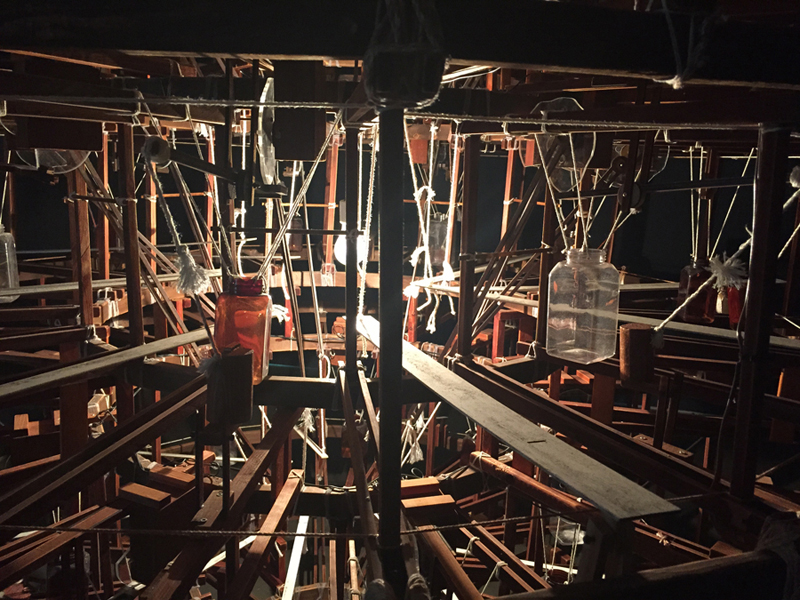
Recently in Chelsea, I found one of these treasures. I was walking down West 25th street on a sunny Friday afternoon and popped into the DOOSAN gallery. The second I walked through the door, I was confronted by a dark, frantic, monotonous, anxious, yet simultaneously quirky and upbeat, piece of mechanical art installed directly on the gallery wall.

The work was created by Korean artist Jung Uk Yang as a part of the exhibition “A Man Without Words,” which was on view from July 9th through August 27th 2015. Per the gallery’s description, “A Man Without Words” encompassed Jung Uk’s reflections upon the everyday, simple things that would occur in both his life and the lives of the individuals around him who seemed to lead monotonous, repetitive lives.

For example, the piece, “A Fatigue Always Comes with a Dream,” (featured above and below) was created as a metaphor for the lives of apartment security guards in South Korea, who, “must stay awake until dawn while most people are asleep.” Jung Uk’s work is independently visually powerful, but the unusual story behind it makes it even more provocative than the visuals alone.  junguk3

Through his work, Jung Uk provided me with an experience that ruptured the monotony of my life that day. He piqued my curiosity about DOOSAN, an incredible art space, as well. The DOOSAN Gallery New York is dedicated to the discovery of and support for young and emerging Korean artists. It also has a residency program. Its mission is to serve as a gateway to significant exposure and opportunities for the artists by nurturing their creativity and helping them share their work with a broader audience.

Learning about the South Korea-headquartered DOOSAN gallery and its mission in support of Korean creativity led me to think about it in contrast to a recent Huffington Post article I came across on my twitter feed titled, “North Korea’s Art Scene is Just as Mysterious as the Nation Itself.” In the article, writer Sara Boboltz notes that North Korea’s largest art institute, Mansudae, is government-run and is used “primarily to churn out work extolling the state’s leaders.” She concludes that, “For all the impressive skill of its talented pool of artists, artistic freedom in North Korea might only be an optimistic myth.”

JungUk4

It would be interesting to know what the DOOSAN gallery opines about this issue, especially within the context of the gallery’s mission to nurture the growth of Korean contemporary art. While Jung Uk Yang’s work is no longer currently on view at DOOSAN’s Chelsea space, I invite you to check out their current exhibition, Revelation, an equally inspiring solo installation featuring the work of artist Jungki Beak.

Sarah Charlesworth, The New Museum

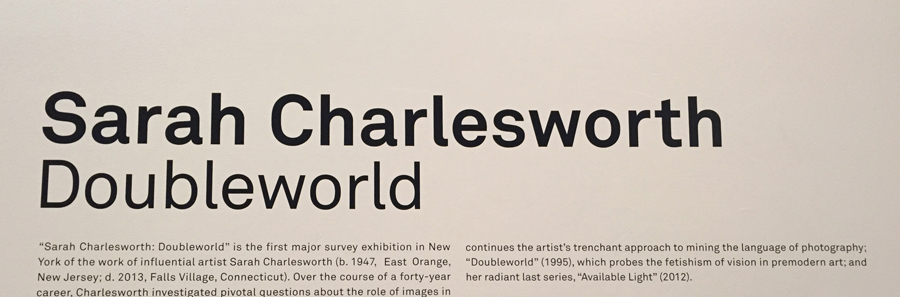
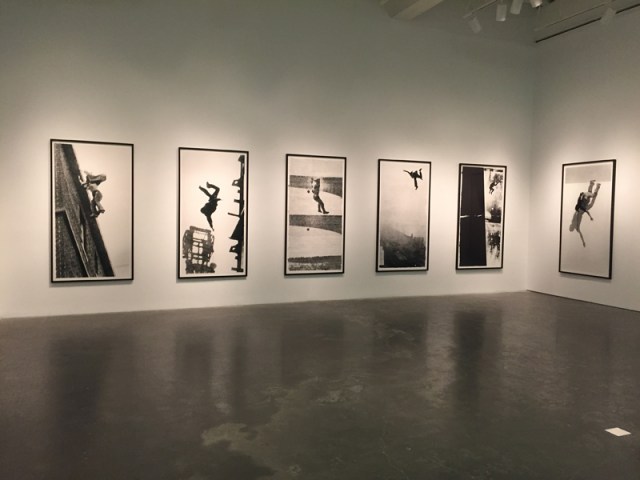
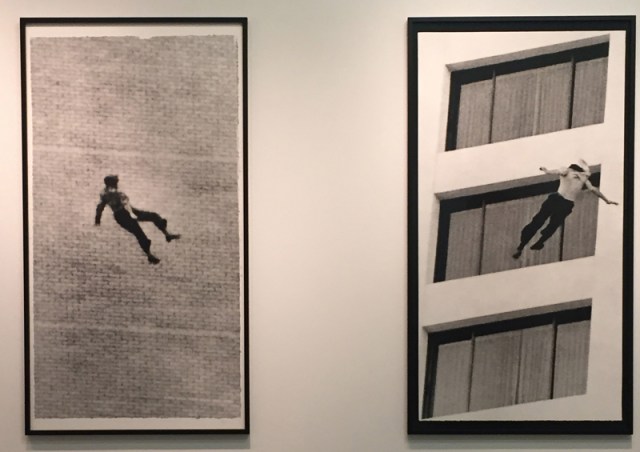
At the New Museum installation, “Sarah Charlesworth: Doubleworld,” I came upon Charlesworth‘s emotionally gripping 1980 photograph series, “Stills.” It was the type of exhibit where the moment I walked into the room and realized what I was looking at, something inside my core sank.

For “Stills,” Charlesworth collected newspaper clippings of photos depicting various individuals falling or jumping off of tall structures, presumably to their deaths.* Charlesworth re-photographed and enlarged the clipped images to measure 6’6” in height. The result is that viewers experience the visuals at a size larger than their own physical bodies.

Charlesworth1

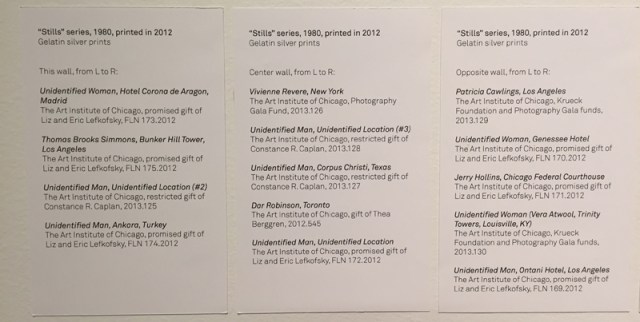
In the descriptions of each piece, the individuals depicted are identified with varying degrees of anonymity, depending upon the information that was available. They range in detail from completely unknown, i.e., “Unidentified man, Unidentified location,” to full name and location, i.e., “Patricia Crawlings, Los Angeles,” leaving viewers with infinite unanswered questions about each one.

Charlesworth11

For me, it was incredibly humbling to walk into a room surrounded by photographed portraits, larger than my physical body, which captured the last seconds of fourteen strangers’ lives. Their last breaths and the thoughts that were going through their minds during their final few seconds in the air live eternally inside these images.

Charlesworth4

It’s important to reiterate that Charlesworth didn’t take the original photographs herself. Her “photographing photos” technique for “Stills” wasn’t straightforward, and calls into question the definitions of “photographer” and “photography.” Upon looking into this further, I found out via a recent New York Times article that Charlesworth is known to be a part of the 1980s artist group dubbed, “The Pictures Generation.”** Per the article, “The Pictures Generation” is a loose title referring to a group of photo-based artists who gathered the imagery they worked with from the media. For reference, this group also includes other well-known artists Barbara Kruger, Jack Goldstein, Louise Lawler, Richard Prince, Sherrie Levine, Cindy Sherman, and Laurie Simmons.

CHarlesworth7

Notes:

*For the entirety of this post, I assume that the falls/jumps depicted in “Stills” resulted in death.

**Charlesworth’s connection to “The Pictures Generation” is also mentioned at the New Museum.

Theresa Byrnes, TBG

I’m privileged to have spontaneously met Australian performance artist Theresa Byrnes a few weeks ago while strolling down East 9th Street. What a remarkable person. I was walking home from an estate auction in Greenwich Village, and popped my head into what appeared to be an open gallery space called TBG (Theresa Byrnes Gallery). I entered the bright, colorful room, filled floor to ceiling with an abundance of kinetic paintings created by Theresa Byrnes and her mother and fellow artist Lorraine Byrnes.

Lorraine warmly welcomed me into the gallery. I felt like she was my mother, too! She and Theresa had recently debuted “Offspring,” their joint exhibition, with an opening reception that took place at TBG on July 30th.

Tbyrnes1

It wasn’t until I’d made my way to the back of the gallery that I met Theresa. She told me that the back portion of the space was her studio.

Theresa was one of the coolest-dressed people I’d seen all day. I immediately fell in love with her style and arresting smile. She was wearing a funky black hat, a pale pink punk-rocker style T-shirt, black jeans, and a set of badass red high-top kicks. Finally, there was her most unique accessory: her wheelchair.

Theresa and I spoke for close to an hour, getting to know each other. After reading more about her following our meeting, I found out that she has a degenerative disease called Friedrich’s ataxia, that causes progressive damage to the nervous system. I am incredibly inspired by how clear it is, from both meeting Theresa and reading about her, that she doesn’t allow the disease she lives with to define her or control her. She finds freedom in her work and nothing seems to hold her back from being her full, powerfully talented creative self. This fascinating article from The Villager can tell you a bit more about her story. I’m in awe of her.

IMG_7192

Theresa’s infant son, Sparrow, was with her in the gallery space. I loved the way her passion came through so clearly when speaking about art, creating, and her son. Her palpable joy and refreshing attitude toward life and art made me feel happy.

I am pleased to share a preview of her piece, “Being Two,” shown below.  I also invite you to watch this video interview, conducted with Theresa last year on ABC (Australia). It will give you a sneak peek of the amazing person and artist that I had the opportunity to meet face-to-face. Finally, I hope that if you’re planning to visit Alphabet City any time soon, you take a moment to stop by TBG at 616 East 9th St. between Avenues B & C to check out her work.

Tbyrnes3


Jack Pierson, Cheim & Read

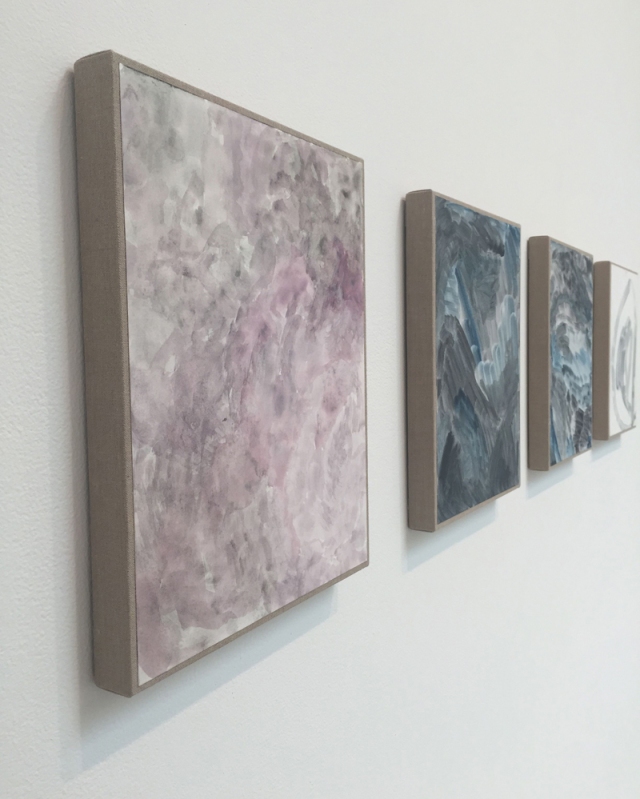
Cheim & Read’s installation of Jack Pierson’s “onthisisland,” a collection of 150 small watercolor and graphite works on paper, was curated excellently.

jpierson9

I stepped into the gallery and wanted to stay there longer just because of how well the presentation and the work amplified each other in such a satisfying way. In the front room of the exhibition, the paintings and drawings were so clean, simple, elegant and fresh, that they required a display that echoed those elements throughout the room.

jpierson2

Mounted on “boxes” stretched tightly with natural-tone linen, the paintings and sketches were given the opportunity to invite viewers to contemplate their simplicity, and possibly even turn it on its head.

jpierson4

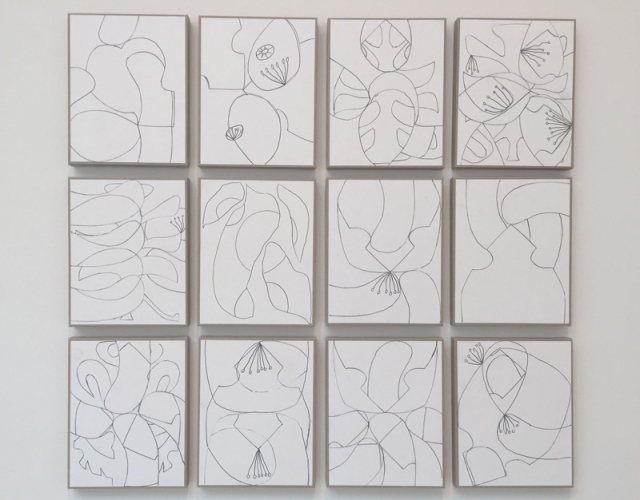
This sensation continued into the back room of the installation, where Pierson’s larger graphite drawings were on display.

jpierson7

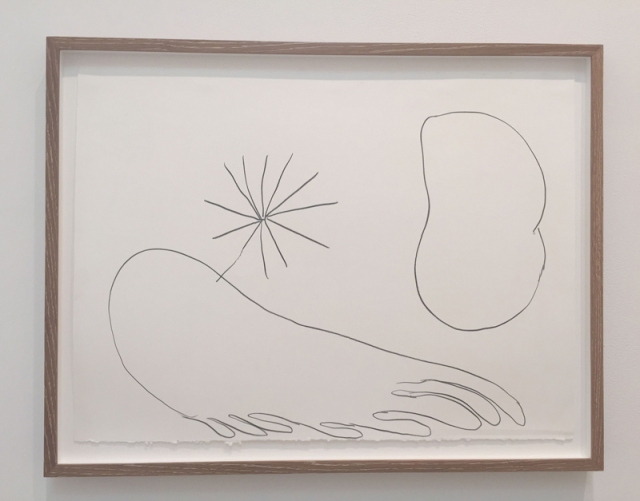
These dark, striking, doodle-like drawings with seemingly surrealist and op-art influences commanded me to recognize their complexity. The below piece is one I’d like to spotlight in this post:

jpierson1

I’m a fan of this piece in particular because it brought a flood of questions to my head that I am grateful to have circulating in there, including:

  • Why do I look at something like this and think that there is more depth to it than a child’s doodle? Or is there not?
  • Or, does a child’s doodle have the potential to be deep, so there isn’t even a conflict with that comparison?
  • Also, am I thinking there’s something to this only because it’s galleried artwork? How much is the gallery’s affirmation of the art affecting my overall perception of it?
  • Was the placement, shape and size of the forms in the piece spontaneous or premeditated?
  • Does each have a meaning, meant to be decoded? Or do they each mean nothing?
  • It looks like the artist has disregarded many conventional rules of composition and drawing technique. To what extent is that true, and what does that mean?
  • Is this piece irreverent, or is it genius? Or both? Or neither?

I think that in conversations about art, works like this are generally controversial, because people really do wonder, why is this in a gallery or museum? Why or how does this piece display talent or have value? So, since I am fascinated and looking for more understanding, I’m looking forward to hopefully receiving some comments about this piece and this concept as a whole.

jpierson5

Albert Oehlen, The New Museum

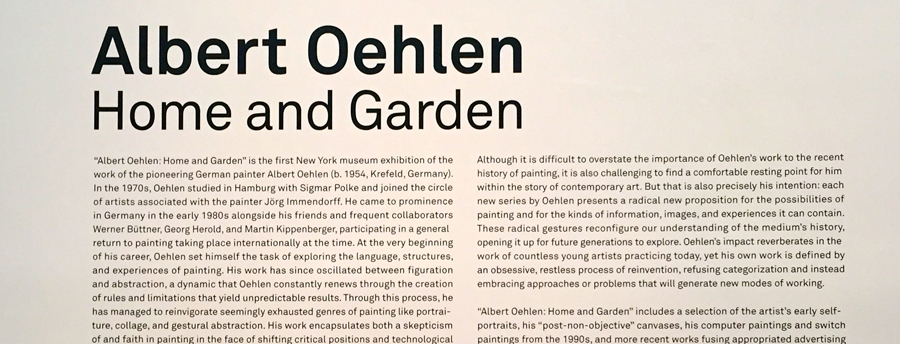
I was inspired to think about technology and art at the New Museum’s current exhibition, “Albert Oehlen: Home and Garden.”

oehlen-computerpainting4

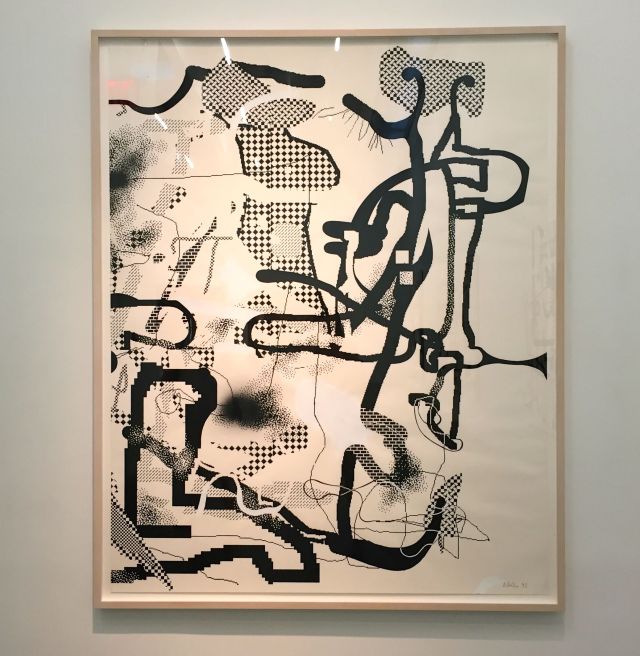
Albert Oehlen’s black and white computer paintings captured my attention once I noticed they were created in 1992. I think it’s interesting to see artwork with computer-generated imagery from nearly two and a half decades ago. While galleries and art fairs today are saturated with computer-generated imagery in various forms, Oehlen’s work inspires me to think about who preceded him in mixing digital art with “analog” art, who were some of his contemporaries in creating computer-generated art in the ‘90s, and which artists working with computer-generated art today consider Oehlen to be one of their important influences.

Here is an interesting New Yorker article, stating that this series that “deploys hectic designs created with primitive drawing software on a Texas Instruments computer made [Oehlen] the first significant artist to exploit, and incidentally to burlesque, the emergent lingua franca of computer graphics.”