
By Jonathan Goodman
Jamie Martinez, an artist originally from Colombia and founder of Arte Fuse, the increasingly recognized art blog, has rented a small space on the first floor of the 56 Bogart gallery building in Bushwick. “The Border #1” is his first show there; it is composed of five artists, including Martinez himself. This show, and his project generally, comprises a comment on and support of the immigrant artists in New York; as everyone needs to recognize, and current politics is determined to evade, we are all from somewhere else–either recently or a few generations ago. This is obviously true in recent art, especially in New York; if we think of abstract expressionism’s importance, two of the artists making up its famous triumvirate, de Kooning and Gorky, were born outside America (the third, Pollock, of course was not).

Installation view, The Border #1. © Jamie Martinez.
The infusion of work from artists new to our shores is nothing new, especially now, and Martinez is determined to offer space to and document the very good art being made by people recently established here. In this highly interesting show, five artists from elsewhere else offer works that do not necessarily look like they come from a geographical distance–an artist’s origins are no longer easily Identifiable at all, in a formal sense, in contemporary art. But the point needs to be made repeatedly that the current influx of artists globally to New York, who are attracted by the city’s history of international modernism and social freedoms (not by its high rents!), are contributing to the scene some of the best work being made today. This show demonstrates this high achievement extremely well.
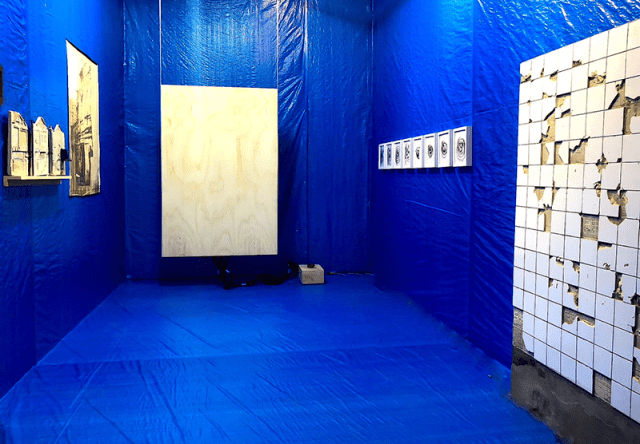
Installation view, The Border #1. © Jamie Martinez.
Martinez put himself into this small artists’ group deliberately, being that it is the first exhibition in the space he himself set up. His art consists of pages taken from The Book of the Dead, their individual hieroglyphs framed and emphasized by thin copper wire; a printed poem, “America” by Maya Angelou, treated the same way; and two abstract sculptures, made of triangles of metal and thin, pink neon-lit lines. If we think about it, the hieroglyphs describe, seemingly visually but indicating something readable, a voyage somewhere else, while Angelou’s poem presents the harsh but actual reality of many people’s experience here. Finally, Martinez explained in conversation that the triangles of metal in the two wall sculptures demonstrate the social process of tringulation, suggesting the meeting of people.

Jamie Martinez, (L-R) Copper Mesh 1, modular sculpture with copper, plexiglass, paper, jump rings and rubber cement, approx 20 inches with fiber optic lights and battery. Flow, Steel and fiber optics and battery, approx 36 inches. © Jamie Martinez courtesy Jamie Martinez.
The space is small, and so Martinez’s works are too; but he communicates the inevitability of an American world that is based on immigration–to say otherwise is lying! The artists in the show mostly make work that doesn’t directly address immigration, or New York, with the exception of the Peruvian-born woman artist C.J. Chueca, whose wall of whole and broken ceramic tiles, titled the Wall #1 (New York) (2016), clearly references our subway system. The piece is added to by a small black ceramic work on the floor, which partially represents a black plastic bag tied at the top. Called Shoes in a Trash Bag (2016), it combines with the tile wall to capture the physical decay and detritus that is so much a part of the New York experience, strange as that may be in so wealthy an urban place. Other artists’ efforts here are not so transparently illustrating New York life.
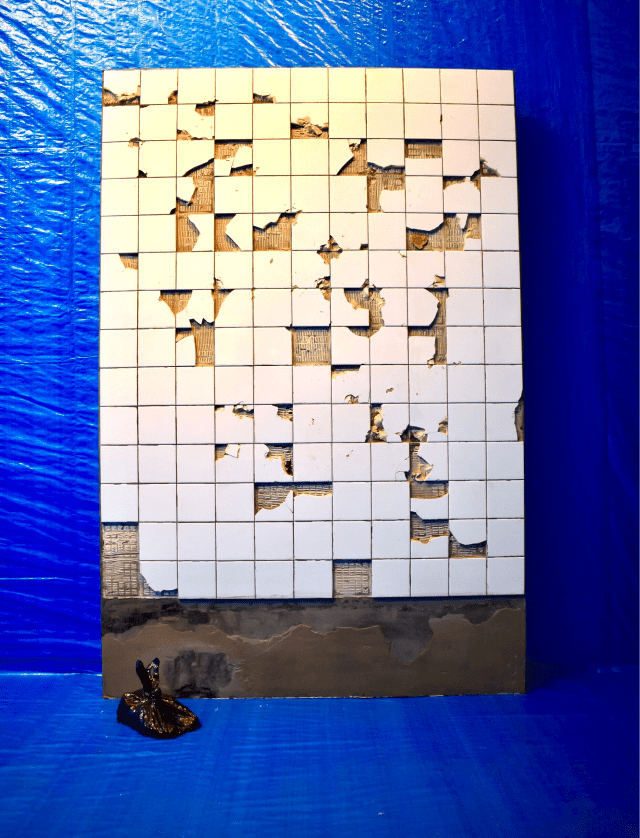
C.J. Chueca, Wall #1 (New York), Ceramic tiles over wood, 2016. © C.J. Chueca courtesy Jamie Martinez.
Peter Kaspar’s large, flat wooden piece (2018) must be activated by a small rock-shaped magnet that is placed on top of a rectangular box containing necessary machinery; when this is done, tiny lights, separated a bit from each other on the expanse of the wooden plane, come on. The effect is exquisite–a bit like stars flashing in a night sky (the pieces is best viewed in semi-darkness). On the other side of the panel, there is an intricate nest of wires used to activate the lights in front. There is no ostensible orientation toward the immigrant theme in this remarkable, low-tech but highly achieved work of art. But Kaspar comes from Slovakia, and that is far away. He participates in the intersection of technology and the sublime that is part of recent art history, and this work shows he is very good at it.
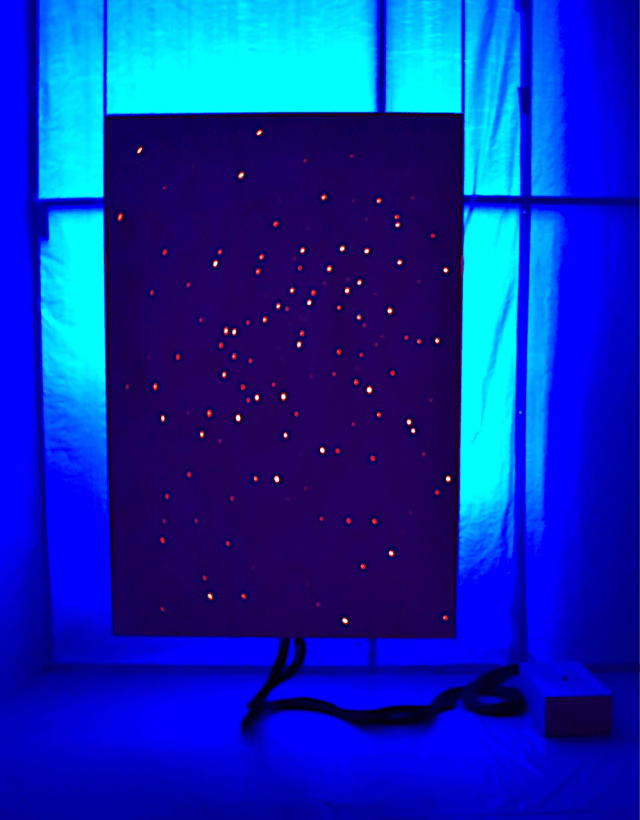
Peter Kaspar, wood, aluminum, rocks and fiber optics with machine, 2018. © Peter Kaspar courtesy Jamie Martinez.
Levan Mendiashvili’s suite of three small, plaster-and-wood building fronts and cloth-backed photo of what looks like a discarded building’s facade, both taken from his ongoing series “Urban Archeology,” feels like an abstracted treatment of homes and city fronts taken over by decay; it is impossible to specify the specific place of either the reliefs or the photographic image. Still, the point is made–we are living in a time when urban life is constantly being rearranged by the rebuilding of neighborhoods. It doesn’t matter where–this is happening all over the world. This Georgia-born artist creates work that documents the change without specifying where it comes from, so that it becomes a general feature of immigrant/urban experience.
The last artist to be mentioned, Aphrodite Desiree Navab, is of a mixed background: Iran and Greece. Her suite of eight small ink-on-paper works, titled “Love Labyrinth,” refers to the Minotaur myth, in which Ariadne gives Theseus the string to make his way out of the labyrinth after slaying the Minotaur, the half-man, half-bull figure ruling the maze. According to Navab, after Ariadne betrays her father King Minos by giving Theseus the thread to escape, Theseus betrays her love for him. The artist makes it clear in notes that the drawings, beautiful improvisations on a maze-like form, are meant to illustrate the problem of such a story occurring regularly in real life. It is the theme of betrayal, referred to indirectly, which concerns the artist. As for the drawings, they are marvelous squared or circular treatments of a labyrinthian form. This is ancient mythology, treated in a contemporary fashion; we remember that the artist’s background is Iranian and Greek, sites of archaic stories.

Aphrodite Désirée Navab, “The Love Labyrinth”, 2018, Ink on paper, 8” x 10.” © Aphrodite Désirée Navab courtesy Jamie Martinez.
Despite their very old origins, the drawings feel quite new; they were executed this year. They are not relevant to the notion of immigration in a particular manner, but we know that an immigrant made them, and the myth originated in the Mediterranean’s venerable culture. Navab, like the rest of the artists in this very fine introductory show, is committed to making something new. But her inspiration here, like the visual materials made available by Martinez’s use of The Book of the Dead, is very, very old. The themes must be contrasted with art experience in New York City, where our vision is supposed to be utterly new. Novelty may not be possible visually anymore–we may have come to the end of the road, imagistically speaking (this can be argued about). But the real-life event of immigration provides a continuing newness to the art world in this city. One of the excellent things about “The Border #1” is its penchant for originality, as expressed by people who are recently established here. It doesn’t matter if the origins of the work are archaic or recent, but it is very important that we take notice of art made by people whose lives might, wrongfully, be considered too marginal, or too recently evident, to take part in our political and cultural life.
Take a tour of the show here courtesy of Jamie Martinez and © VTV:
Jonathan Goodman is an art writer based in New York. For more than thirty years he has written about contemporary art for such publications as Art in America, Sculpture, and fronterad (an Internet publication based in Madrid). His special interests have been the new art of Mainland China and sculpture. He currently teaches contemporary art writing and thesis essay writing at Pratt Institute in Brooklyn.

 John Torreano, “Sea Sky Gold,” 2018. Acrylic paint and gold leaf on plywood 45 x 180 inches. © John Torreano courtesy Lesley Heller Gallery.
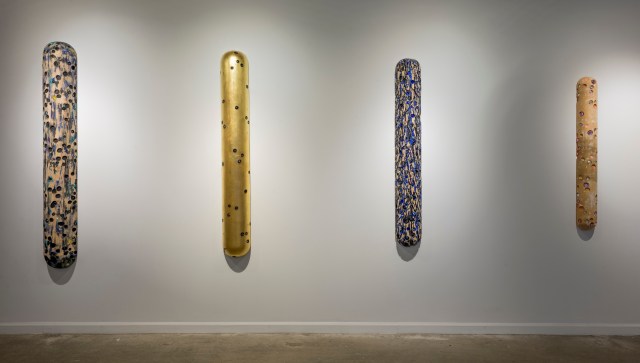 John Torreano: Dark Matters Without Time (installation view, Lesley Heller Gallery, New York, 2018). © John Torreano courtesy Lesley Heller Gallery.


 artifactoid