Sarp Kerem Yavuz’s AI Polaroids from the Ottoman Empire

Above: Sarp Kerem Yavuz. “Manço,” 2023. Polaroid, 4.2 x 3.4 in. Courtesy of the artist.

This article was originally published in Cultbytes on June 22, 2023.

By Alexandra Goldman

Turkish-French artist Sarp Kerem Yavuz loves photographing handsome men. His various bodies of work include sculptural photo-portraits of nude male models adorned with projected imagery of ornate Turkish Bathhouse tiles, sensuous, homoerotic photos of young American men convening in sports locker rooms (another homosocial space), and mixed media including neons, works on LED screens, and a functioning backgammon board created entirely out of Legos.
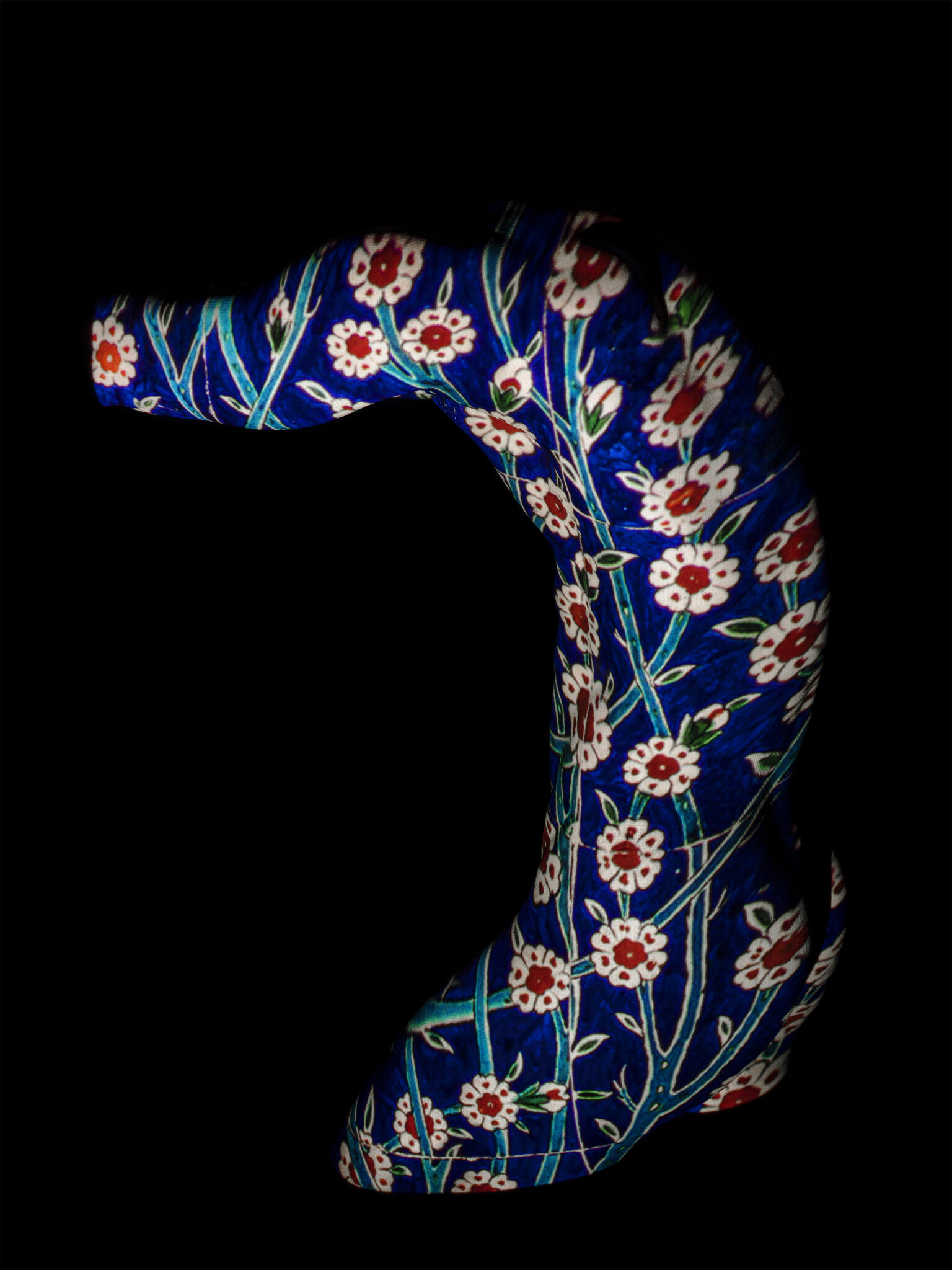
Sarp Kerem Yavuz, “Bahçivan,” 2022. Glicée print, 40 x 30 in. Courtesy of of the artist.

Thematically, Kerem Yavuz’s artwork is a reflection of himself: both Turkish and gay. These two elements haven’t historically been able to mix without conflict in his life, and he has always been interested in exploring those challenges. “For the last decade, I’ve been interested in deconstructing masculinity within an Islamic context. I often do this by queering (arguably already queer) orientalist imagery. My largest body of work to date, Maşallah, comprised of scanned Iznik tiles and later, scanned porcelain dinnerware, projected on male nudes to talk about the superimposition of conservative politics onto my generation. I would also periodically visit various Turkish baths to create cinematic scenes that were meant to imply the existence of broader, imagined, queer narratives unfolding in these traditional homo-social spaces. I guess I could say that I was always more interested in the story than the particular medium, although I am partial to photography.” Now that he lives and works in New York City, Kerem Yavuz is able to openly express these two important facets of his identity without suffering censorship from the Turkish government and death threats, among other significant challenges he has faced that many people may not have the courage to stand up to in the name of creative expression.

Sarp Kerem Yavuz. “Boğaz,” 2023. Polaroid. 4.2 x 3.4 in. Courtesy of the artist.

This year, he expanded upon his traditional art and photography practice by utilizing the AI software, Midjourney, to create AI-generated imagery for his latest series: Polaroids from the Ottoman Empire, currently on view at Palo gallery in NoHo. He discovered Midjourney “while looking into new digital art trends…its aesthetic capabilities felt more in line with my style than Dall-E.” The cinematic images on view in the exhibition Polaroids from the Ottoman Empire include images of two fit, ostensibly Turkish, shirtless men romantically gazing at the moonlight over a Mosque along the Bosphorus, a bejeweled drag queen making her grand entrance in an invented 1920s-style speakeasy nightclub in Istanbul, and bust-style portraits of handsome, turban-clad men gazing seductively at the viewer from inside a Hammam setting, among other fantasy, homoerotic, faux-vintage Turkish narratives.

The lighting in each of Kerem Yavuz’s AI-generated images is filmic and romantic, with mainly dark or jewel-tone color palettes. There are also a few black-and-white shots included in the series, which feel a bit out of place when thinking of traditional Polaroids. Some of Kerem Yavuz’s AI images are reminiscent of the style of a Jacques-Louis David painting, among other art-historical references and sources of stylistic inspiration. The Polaroid borders Kerem Yavuz chooses to print each image within – because no one likes to see a Polaroid without that iconic built-in bottom-heavy frame – are black, white, or gold. Before framing, Kerem Yavuz finally mounts each printed Polaroid on a mat, which represents a common color of velvet in traditional Ottoman interior decorating.

Importantly, Kerem Yavuz also shoots with real Polaroid film in a different series of his work, Shadows of the Empire, photographing staged scenes of his friends in Istanbul that comment on parallels between LGBTQ+ and women’s rights being taken away in both Turkey and the United States in recent years. “Shadows of the Empire” is currently on view at Zero Bond, where he is this month’s artist in residence via Apostrophe gallery. It is not easy to tell the difference between Kerem Yavuz’s real Polaroids and his AI-generated Polaroids. It’s clear Kerem Yavuz is using AI to mimic and expand upon his own photographic language, rather than copying another artist’s style: a major current plagiaristic danger of AI in the digital art space.

Sarp Kerem Yavuz. “Away,” 2022. Gold Frame Polaroid, 4.2 x 3.4 in. Courtesy of the artist. 

For Kerem Yavuz, as both a traditional photographer and AI artist, the inevitable element of financial investment also comes into consideration. Kerem Yavuz elaborates, “I think most people who insist on traditional photography tend to forget how extraordinarily expensive high-end digital photo shoots are. Buying a decent medium format digital camera, which is what I have been using for the past decade, runs you between $10,000-$20,000. You can rent, but then you also need to get really good equipment insurance so that tends to be around $1000 for a week of shooting, just for a camera with a regular lens attached with a spare battery and some flash drives, (not including any lights, stands, sandbags to keep the stands where they are, portable batteries, backdrops, studio space if you need it etc.). Then, there is the additional cost of paying models, assistants, and the time cost of processing and editing the images, plus transportation if you are shooting on location. I have done all of these for years, and I have greatly enjoyed the process, but it is a costly endeavor, which often means you need commercial work to be able to afford to make artistic work. It is also incredibly time consuming. AI photography, at least in the way I have been engaging in it, feels a little more like street photography, where the production element is removed in favor of chance and spontaneity. It’s trickier to get what you want, since there is inevitably a lesser degree of control, but it does offer a greater degree of access to people without the means or the network to dive into photography as it is structured today.”

Whether shot in the flesh or rendered digitally, iconic gay male nude portrait photography can call to mind the explicitly sexual, stark, sensuous, and formidable black and whites by Robert Mapplethorpe, or perhaps the striking, colorful photography of nude or semi-nude male dancers and religious figures in fantastical staged scenes by David LaChapelle. Unlike Mapplethorpe’s homoerotic photography, Kerem Yavuz’s is understated in its eroticism. Unlike LaChapelle’s staged fantasy photography, Kerem Yavuz’s imaginary gay scenes incorporate an Ottoman visual language and color palette. Kerem Yavuz has his own visual language, and experiments with the reverse process using Midjourney to see how it categorizes his original images. “What is fascinating about Midjourney and other internet-based algorithms is that their ‘imagination’ is ultimately shaped by whatever dominates the web. Midjourney has a fun tool that allows you to upload your own images and have it describe them to you. With my photographs, it often says ‘in the style of Hasan Hajjaj’ which is flattering, as I love his work, but I was never inspired by his practice and our aesthetics are quite different. It just goes to show that online media and discourse around Middle Eastern imagery has a long way to go.”
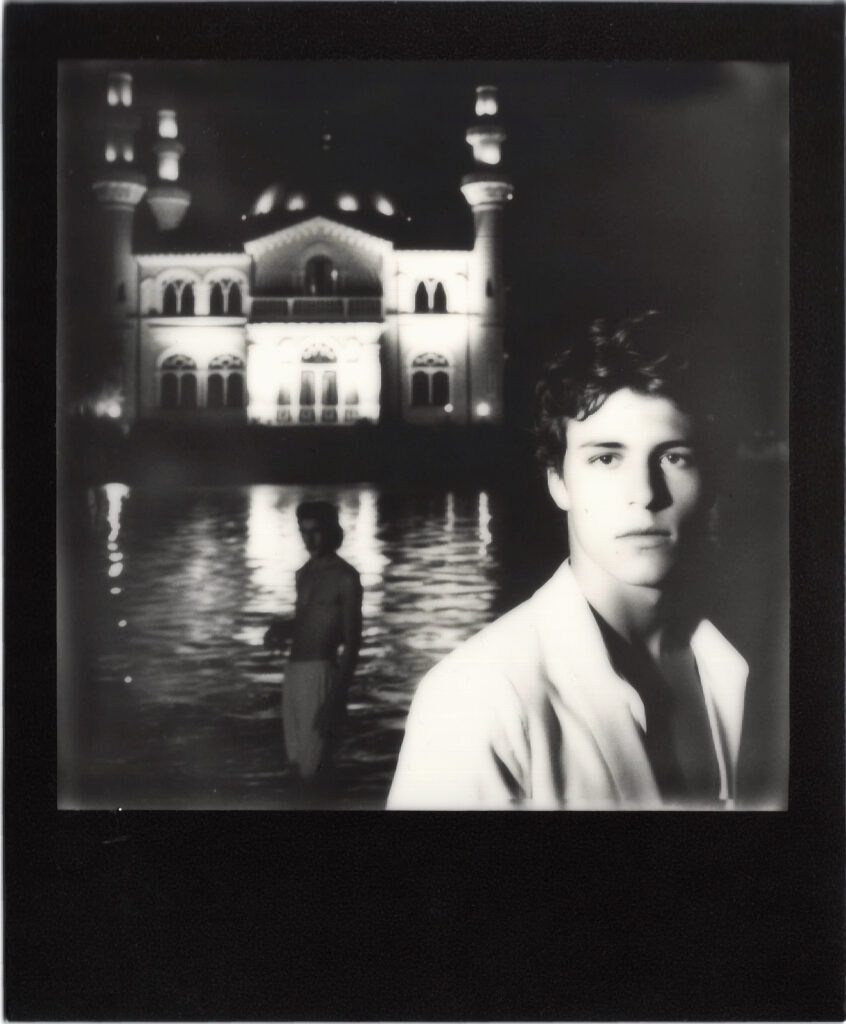
Sarp Kerem Yavuz. “Sahilde,” 2023. Polaroid. 4.2 x 3.4 in. Courtesy of the artist.

The subtly erotic and Middle-Eastern qualities of Kerem Yavuz’s photography stem from his relationship with his father, or the idea of “the father-son relationship.” When Kerem Yavuz came out at age thirteen, his father did not accept his homosexuality and was consequently absent for most of his life. Today, the two are estranged. When asked if he knows other artists working with the idea of the father-son relationship, Kerem Yavuz replied that the father-son relationship is a very vulnerable topic, in almost a banal way. He commented, “Mapplethorpe’s hypersexualilty functioned almost as a protective armor – people don’t accept regular male vulnerability, which is what my work speaks to.”

Another through line in Kerem Yavuz’s artistic career is he is frequently ahead of the curve as an innovator, which, he commented, “can be lonely at times when no one yet understands [his] ideas.” AI is a contentious topic worldwide in industries spanning art, tech, medicine, politics, law, advertising, and many more. In photography specifically, it is already a topic that has entered the forefront of the conversation. Recently, German Photographer Boris Eldagsen won a photography award with his AI-generated photograph (created on Dall-E 2 software), The Electrician, at the Sony World Photography Awards, and declined to accept the award because of his concern for how AI will affect (and compete with) the photography world overall. That perspective is understandable, as the judges of the award were unable to discern his AI-generated photograph from real photographs in the competition.

Kerem Yavuz’s AI Polaroids and “real” Polaroids also look similar to one another. There is something about the people or settings in the AI-generated images that is a “little too perfect,” which can give them away upon close examination, but it’s not always obvious which are which. The catch is that none of the people or places in the AI-generated imagery are real, and they all appear to exist in an unknown, historical place and time in a Turkish, Ottoman past. They’re like memories from a homoerotic dream version of Istanbul during the Ottoman Empire, that never existed, nor would have been able to exist, because of the Ottoman Empire’s extreme homophobia. Kerem Yavuz commented on his inspiration for the series,“I loved the notion that in a parallel universe, I would have been traipsing around a present-day Ottoman Empire, photographing my queer friends in various places in Istanbul.”

Sarp Kerem Yavuz. “Banyo,” 2023. Polaroid. 4.2 x 3.4 in. Courtesy of the artist

Even though Kerem Yavuz’s AI-generated images look – in one way or another – “real”, with Kerem Yavuz’s title of the series, he “confesses” another hint into the photographs’ fictional origins: while the Ottoman Empire ended in World War I, Polaroids were not invented until World War II. Therefore through just his title, Kerem Yavuz lets viewers know his Polalroids from the Ottoman Empire are technical impossibilities.

For Kerem Yavuz, Polaroids from the Ottoman Empire is also about the “believability” of images in the current AI era. However, questioning the believability of photography, while now heightened due to AI, isn’t new. Falsified imagery in photography has been explored since Yves Klein’s 1960 Leap Into the Void, in which Klein created an early, analogue visual illusion to “document” a man jumping out of a window even though it never really happened. Edward Weston’s 1920s and ‘30s vegetable still lives, Peppers, look at first glance like black and white photo portraits of muscular male torsos, tricking the eye at first glance. With the eventual invention of Photoshop and an infinite array of postproduction effects and image-generating software, the notion of photography as solely a medium that documents reality is nearly a century gone. Kerem Yavuz’s decision to print his images on Polaroids is another layer of his trickery: “Polaroids bring a plausibility to the narrative because we are culturally conditioned to think of them as documents. No one thinks a Polaroid is faked, even though the technology to expose images onto a Polaroid digitally has existed for a decade,” he emphasized.

To create the AI Polaroids, Kerem Yavuz teaches Midjourney software how to make an image look gay, glamorous, exotic, romantic, antique, Ottoman, or express other features simultaneously, using his words. He even gets specific in the sense of telling the software, “make this image look like it was shot with a Nikon 110 millimeter lens,” or “give me an image of two men in front of a mosque in Istanbul in the style of Jodorowsky,” and the software generates that effect or visual. Through repeated processes of trial and error, Kerem Yavuz communicates different combinations of these key words to the software until he gets his desired imagery in return – a tedious practice that requires a lot of patience and nuanced communication between man and machine. Each time, the AI software transforms Kerem Yavuz’s permutations of adjectives into generated imagery based on other imagery it has been introduced to previously online. Kerem Yavuz explains, “In photography, we often shoot the same shot hundreds of times with small tweaks and iterations. This also applies to AI-generated imagery, where sometimes Midjourney will give me almost what I’m looking for, but not quite, so I will spend hours telling it to iterate on one specific thing. Sometimes, in both cases, the image just doesn’t work. Or you end up needing to edit in post.” As result of the collaboration between Kerem Yavuz and Midjourney (which actually lives on Discord – a platform he describes comically as “the unholy love child of Reddit and WhatsApp”), the scenarios in the imagery look, to some degree, believable.

A serious problem with this, that Kerem Yavuz recognizes and addresses, is Midjourney software’s inherent biases. He remarked that he has noticed, through his use of this software to create his imagery, that if he asks it for an image of “two handsome men,” it will most often provide images of two white men. If he asks for “two gay men,” it will similarly give him images of men covered in rainbow clothing, or holding Pride flags. It barely understands when he asks it for images of “two men kissing” and shows him images of two men pecking on the cheek rather than engaged in any type of romantic kissing. There is very obvious heterosexual, white, cisgender bias in this process that Kerem Yavuz continues to notice, critique, and do extra work to find ways around to get his desired image results, repeatedly putting the technology to the test.

Like artists and photographers working throughout history, Kerem Yavuz is working with the technology of his time. It’s not long ago that everyone was talking nonstop about NFTs – now, the new buzzword is AI. There’s inevitably a coalescence of the two as well. Many question if either of these two technologies have potential to exist on par with more traditional art forms. But, more than just buzzwords, there is real artistry in the conceptual aspect, detailed communication technique, choice of software, printing and exhibiting decisions, visual composition, color palette, light source simulation, and more that Kerem Yavuz employs to create his AI-generated imagery for his Polaroids from the Ottoman Empire.

Conversations today about AI – across industries and contexts – often involve sensationalist notions of “Is it good?” “Is it bad?” “Is it scary?” “Are we doomed?” What I think Kerem Yavuz is proving with Polaroids from the Ottoman Empire is that there is a way to authentically make original art using AI software as a tool. When executed thoughtfully and with the level of care and critique he uses, art creation becomes one of the technology’s positives. He concludes, “In its current form, I feel like AI is making poets of us all, and I find that delightful.”

Sarp Kerem Yavuz’s solo exhibition Polaroids from the Ottoman Empire is on view at Palo Gallery until July 1st, 2023 and Shadows of the Empire is on view at Zero Bond.  

Zoe Young’s Hollywood Dinner Party Daydreams

Above image: Installation view, Zoe Young: Still. Life. Courtesy of Gruin Gallery and domicile (n.).

This article was originally published in Whitehot Magazine of Contemporary Art

By Alexandra Goldman

Still. Life., a strong solo exhibition of sizeable still life paintings by Australian artist Zoe Young, opened October 15th as the third successful exhibition collaboration between Gruin Gallery, founded by formerly New York-based gallerist Emerald Gruin, and domicile (n.), an innovative East Hollywood multi-modal artist project space created by Cyrus Etemad and curator Margot Ross. Still. Life., Young’s first breakout solo exhibition in the U.S., will remain on view at domicile (n.) in LA’s Merrick Building until November 22nd , 2021.

Zoe Young and Emerald Gruin met one another while studying together at the National Arts School in Sydney over a decade ago, and have since maintained a friendship and mutual appreciation for one another’s work. Still. Life. represents a  consummation of their meaningful relationship over many years.

The title of the exhibition, Still. Life., is immediately sobering. Young created all the still life paintings in this exhibition during pandemic quarantine lockdown in Australia, isolated and alone in her studio. By breaking up the two words, it poses questions and presents thoughts about these words individually. What does it mean to be still? What does it mean to be alive? What does it mean to be separated, when you’re used to being together? And, most importantly, when and how does life still go on? These reflections are all embodied in each of Young’s still life paintings.

Australia had one of the world’s strictest pandemic travel regulations, only opening its borders for the first time after twenty months this week on November 1, 2021. Young’s artistic practice frequently included portraits and other figurative imagery of people prior to the pandemic, however in lockdown, she turned to the still life, focusing on the decadence and pleasure of objects in the absence of people. 

Young is a multi-year finalist of Australia’s Archibald Prize, which is considered Australia’s most prestigious award for portraiture. When there are not people around to paint, what could better express the stories of people than their things? Young’s paintings in Still. Life. are in this way imagined portraits of people, showing evidence of their tastes and existence through books, cassette tapes, food, drink, and décor without revealing their physicality. 

Zoe Young, Squid ink pasta for breakfast before breakfast at Tiffany’s, 2021, Acrylic on Belgian linen, 59 x 59 x 1 5/8 ” (150 x 150 x 4 cm). Courtesy of Gruin Gallery and domicile (n.).

Each painting details one of Young’s imagined fantasy dinner parties in Tinseltown, which she yearned for while in solitude. The artist had never been to LA, but always dreamed of going to experience its patina, glamour, and allure. The lengthy quarantine she weathered only heightened her desire to bring these fantasies to life through her art: both of traveling, and intermingling with people in the most basic of ways. There is a unique joy that comes from clinking glasses and sharing food off of the same plates as others, evident in Young’s paintings. 

Formally, the works show off the artist’s hand with generously applied paint and visible brush strokes. Young’s soft, Francophile color palette is optimistic, with what feels like dappled sunlight pouring into each scene and highlighting the architecture of her objects. Young’s style of painting is reminiscent of Matisse, Alice Neel, and Wayne Thiebaud. Some moments in the paintings reveal Young’s affinity for French culture by way of certain wines, cheeses, Louis Vuitton, perfume, and even a tiny French flag on a toothpick, while others such as fish heads and lemons recall 17th century Dutch vanitas still lives. One of my favorite moments in the exhibition is how, in the work “Chablis, Surf shacks + Olives”, 2021, Young paints the reflection of a striped tablecloth refracting within a white wine glass, demonstrating her attention to detail and technical prowess. 

The paintings also evoke a cross-continental playfulness and sense of humor. Young’s scenes often pretend to feature L.A. beaches, but as many Australians may recognize, actually depict Sydney’s Bondi Beach. Nods to surf culture from both California and Australia make appearances throughout the exhibition, and in an Oscar Wildian fashion, Young paints herself into her work fusing her own name onto one of her painted book covers.

Zoe Young, Bribery and corruption over brunch, 2021, Acrylic on Belgian linen, 68 1/8 x 88 1/4 x 1 3/8 ” (173 x 224 x 3.5 cm). Courtesy of Gruin Gallery and domicile (n.).

Finally, many of the fruits in young’s still life paintings are fabulously mythological and sexual, such as pomegranates, strawberries, pears, grapefruits, and avocadoes; a possible commentary on the desire for human touch, absent for many in isolation during the pandemic. Several of these fruits also grow in gardens in both Australia and California, linking the two geographic regions. Emerald Gruin holds gardening dear to her heart as gardening was her mother’s lifelong passion and exceptional talent. Therefore the heavy presence of flowers, fruits and vegetables throughout this exhibition is additionally an important connection between artist and gallerist. 

Young was deeply saddened believing for a long time that due to the continued lockdown in Australia, she would not be able to make it to her own first ever U.S. exhibition in LA. However, because of the recent opening up of Australia’s travel restrictions on November 1st, Young will finally travel to Los Angeles. In her honor, Gruin Gallery and domicile (n.) extended the exhibition and will be hosting a real Hollywood dinner party for Young in the gallery space, surrounded by her paintings, with plans to have the real dinner mirror the aesthetics in the paintings. It seems for this powerful, manifesting artist, that fantasies do come true.  

Zoe Young, Still. Life. is on view at Gruin Gallery x domicile (n.) in the Merrick Building, 4859 Fountain Avenue, Los Angeles, CA, from October 15 – November 22, 2021.

Are We All Just Clowns in a Graveyard?

Thoughts about Brian Whiteley’s Mid-Career Retrospective, “I Know What You Did Last Summer” Now on View at Hashimoto Contemporary

By Alexandra Goldman

Performance Artist Brian Whiteley’s bizarre multidisciplinary works come across as very genuine and lack self-consciousness. Whether it’s his performance, video, painting, sculpture or installation, Whiteley’s work is usually either highly politically charged, related to mortality, about clowns, or a combination of all three elements. When I walked into his mid-career retrospective at Hashimoto Contemporary earlier this month, I saw his highly publicized Trump-engraved tombstone, a very well done oil portrait of Vladimir Putin sitting in front of the White House in the style of a traditional U.S. presidential portrait, and a pair of giant, spinning conehead clowns/Lucha Libre fighters that looked like Nick Cave sculptures made out of craft materials from a party supply store. I’ve never been a fan of clown art, but it’s growing on me.

Installation view, I Know What You Did Last Summer

As one may be able to quickly recognize, Whiteley isn’t a fan of the 45th president, but his parents are. He told me that he’s had to seriously struggle with an irreconcilable divide in his nuclear family because of these differences of opinion. His isn’t the only family broken up by this highly polarizing situation.

As much as you don’t like someone, is it “wrong” to make a tombstone for them? After speaking with Whiteley about the project, I realized that his intention wasn’t a death wish, but rather a call for the President to recognize his own mortality. Whiteley told me that he had a personal moment canoeing upstate in which “a wave of intense thinking about his own mortality rushed over him,” after which the thought remained a bit obsessively on his mind. When he saw Trump campaigning for President in 2016, he perceived his attitude as one of immortality and a lack of awareness of how his actions affect others. That is why he had a real tombstone created engraved with the words “TRUMP, Made America Hate Again,” and anonymously abandoned it in Central Park leading to major controversy and his placement on the U.S. Secret Service watchlist. Whiteley is now permanently legally banned from attending any political rallies in the U.S.

I found that seeing a photo of the tombstone is much different than experiencing in person. When I saw a photo of it I thought, “ok, that’s cheeky, we all hate Trump, I get it.” But, when I was at the exhibition and felt the tombstone with my hand (you can touch it), I felt its weight (500 lbs to be exact) and gravity. It’s so stable and solid. It became clear that to have it made was a serious commitment. The tactile memory sucked me directly into a time tunnel and sent me straight back to the last time I touched my own grandparents’ tombstones in in Queens. It was the moment when I realized that what Brian had on display wasn’t a prop or a replica or joke of any kind, it’s the real thing and it’s creepy. 

This also isn’t Whiteley’s only project related to mortality. He also dressed up as a clown, and paraded around a graveyard. When you get onto the homepage of his website, the cursor symbol is a hand holding a cigarette, in 2020, a well-known death wish of sorts. Not only that, but I immediately found the idea of a “Mid-Career Retrospective” to be morbid. For example the last couple retrospectives I saw at MoMA PS1… Vito Acconci…Carolee Schneemann…they both died within the year after their retrospectives ended. Calling his show a “Mid-Career Retrospective” immediately registered to me that Whiteley actively has his own lifespan on his mind.

View of Whiteley’s portrait of Vladimir Putin hanging in a Washington DC Trump Hotel suite

Whiteley is a highly committed artist in general. That’s why I’m intrigued by his work. For example, not only is his relatively large presidential oil painting of Putin technically impressive (it is evident that he is a trained, talented figurative painter), but he then went the extra mile and utilized that painting – which is already intrinsically a work of conceptual art – for a high-risk performative action. While the painting is good, it doesn’t necessarily stand on its own, but the thing about Whiteley as an artist is I think he knew that, and he pushed himself to the limit. After completing the painting he stealthily hung it in the Pennsylvania Avenue suite of a Trump Hotel in Washington DC, where it remained on the wall for a full month without anyone noticing that it wasn’t a part of the intended hotel room decor. 

With such a focus on politics and mortality in Brian’s work, I thought, where do clowns fit in? If his works aren’t physically depicting clowns, they are in a way all clown-like pranks. He’s the class clown and the world is his schoolhouse. We’re also now unfortunately used to the phrase, “The Clown in the Whitehouse,” or even regarding life in general, common phrases like “Man plans, God laughs” give some sort of hint that we’re all court jesters or buffoons here in one way or another. I did ask Whiteley on the phone, trying to hold back my own laughter, why clowns? And in a very clownlike fashion, he began the story as, “Well, when I was going through puberty, my parents sent me to summer camp…” But in all seriousness, he continued, “my parents were really hoping that at camp, I would choose activities like different team sports, but in reality I chose to sign up for art classes and clown class. I liked the way that being a clown allowed me to become a different character and play a role.” 

Installation view, I Know What You Did Last Summer

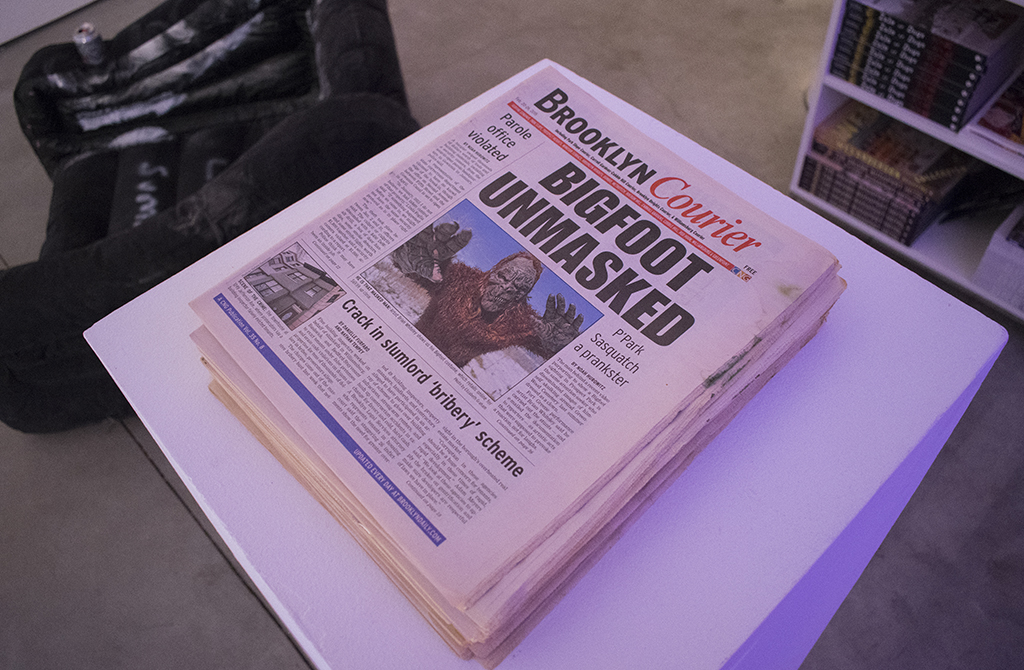
Brian’s lifelong interest in clown work has manifested in even more of his diverse projects, including one in which he did extensive long-term research on believers in Bigfoot and Bigfoot sightings. He used his findings to accurately dress up and roleplay as Bigfoot roaming around Central Park, uncannily in character, contributing to more “sightings” and examining the Bigfoot myth. In his Mid-Career Retrospective, several of Whiteley’s small paintings and mixed media wall pieces based on clown imagery were also on display, along with his video “Clown’s Night Out II,” based on the artist’s imagined scenario of what a clown might do after a long day working kids’ birthday parties. His answer? The clown goes to a gogo bar with a male dancer (played by Whiteley). The awkwardly transfixing film was a big hit at the 2019 Spring Break art fair. 

Speaking of art fairs, Whiteley also is the Founding Director of the Satellite Art Show, which I visited during Art Basel Miami week this year. Taking an anti-market stance in all that he does in the art world, Whiteley’s model of the Satellite Art Show is different from traditional commercial art fairs. Since its founding in 2015, Whiteley annually finds different affordable, nontraditional abandoned spaces like pharmacies or old shopping centers located in the vicinity of the main fair of a given city, and rents out booths to artists at very affordable rates that they can easily recuperate. For example, while a gallery may easily spend upwards of $30,000 on fair participation (with several thousand on just the booth rental alone), some of Whiteley’s booths have rented for only $700. Whiteley said that participants have been happy with their results and return on investment, including gallery representation and institutional acquisitions. 

Installation view, Satellite Art Show 2019

Whiteley intends for Satellite to provide an antidote to what he views as the market-tested, overly distilled art that is on view at main fairs due to galleries’ pressure to sell to make back the money invested (which he doesn’t blame them for). Whiteley is creating an alternative space to feature a plurality of emerging artistic voices that otherwise may not have the chance to be seen or heard during fair weeks, due to these financial realities that many people in the art world don’t want to admit are such a huge factor in what is seen and heard when it comes to contemporary art today, at least in the U.S. I have experienced that there is more room for this type of experimentation in Latin America where, for example, rent of space may be less astronomically priced. I was personally really interested in Satellite because it reminded me of certain great Latin American art spaces like Proyecto AMIL in Lima that traditionally has a big opening during the PARC and Art Lima fair week. The next activation of Satellite is set to take place in Austin, TX, March 13-16 in tandem with SXSW 2020. 

Installation view, Satellite Art Show 2019

Throughout all of Whiteley’s work both as an artist and Director of Satellite, his anti-market stance has not been immune to consistent pushback from institutions, fairs, and galleries. When he created the Trump tombstone in 2016 while Trump was on the campaign trail, the Queens Museum was interested in acquiring the piece for their sculpture garden. When Trump was actually elected that fall, the museum dropped the acquisition because, Whiteley believes, when it became real that Trump was President, the piece became too potentially controversial to certain major museum financial donors of theirs who may support him. Another example is when in 2018, the Art Basel Miami main fair sent Whiteley a cease and desist letter in response to his use hashtag “#NotBasel” to describe the Satellite Art Show on social media. Their argument was that people might confuse it to think that Satellite is or is connected directly with the Basel fair somehow. However, Whiteley explained that the cease and desist was sent suspiciously in tandem with the main fair’s interest in adding more installation-based and experiential art to their own program, and Satellite was on the rise a growing threat. Because of that cease and desist letter, Satellite can no longer take place during Miami Art Week in South Beach, which is why Whiteley relocated the fair to Wynwood. 

Installation view, Satellite Art Show 2019

Finally, Whiteley even admitted that Hashimoto Contemporary told him that his mid-career retrospective could be a financial risk for them, since his pieces aren’t particularly what most galleries would deem sellable. However, I’m glad they hosted it, because Whiteley is an interesting artist, it’s a different kind of show for the Lower East Side, and if you haven’t seen it, I hope you catch the final day tomorrow, Saturday, February 1. 

All images and videos featured in this article are courtesy of Brian Whiteley.