Pictured above: NYCCC 2nd Annual Benefit. Photo by Casey Kelbaugh/CKA and Ilya Savenok/CKA.
This article was originally published in Cultbytes.
Brothers Parker and Clayton Calvert, founders of NYC’s Culture Club (a 501c3 art nonprofit with a brick-and-mortar gallery component) do not only create and curate art; they curate people—warm, kind, and intelligent people spanning all areas of the art world from artists, to curators, to dealers, to critics, to auctioneers. For their spring benefit, a community of three hundred guests and committee members rallied around the Calverts and the NYC Culture Club to support their cause at 7 World Trade Center. I felt lucky to be in attendance this year; vibes were high.
The evening’s honorees were the author, curator, art critic, activist, and NYU professor Dr. Nicole Fleetwood, and the artist and educator teaching between New York and Florence, Italy, Salvatore Catalano. The benefit featured a silent auction and a live auction led by auctioneer Ruth Maudlin with work by fifteen artists Enzo Barracco, Gabe Aiello, John Black, Michael De Feo, Michael Sadowsky, Minku Kim, Michela Roman, Hope Buzzelli, Djordje Skendzic, David Hollier, Cavier Coleman, Faustin Adeniran, Michael Sadowsky, Ricardo Arango, and Natasha Blodgett. The auction lots looked beautiful against the backdrop of the New York City skyline from the fortieth floor.
Guests danced to a DJ set by Timo Weiland, and plentiful servings of champagne and caviar from brilliantly appointed sponsors Billecart-Salmon Champagne and Kaviari Caviar were enjoyed. In light of the success of the event, I sat down with Parker Calvert for an interview to discuss NYC Culture Club’s upcoming plans.
NYCCC 2nd Annual Benefit. (L to R Dr. Nicole Fleetwood, Parker Calvert). Photo by Casey Kelbaugh/CKA and Ilya Savenok/CKA.
Alexandra Goldman: In your opinion, what is particularly important about nonprofits like New York City Culture Club right now, especially considering the current political climate and budget cuts affecting the arts?
Parker Calvert: Nonprofits like ours are critical to providing opportunities to artists and curators that otherwise don’t exist. Too often in the art world, the commercial viability of shows keeps certain exhibitions from being put on. This lack of risk-taking means lots of rotating exhibitions with established and already renowned artists. We believe that creating space where artists come together, regardless of if a show can sell out or not, creates organic opportunities for connection and discovery. This is even more important now than ever as the arts have been attacked at the highest level.
How did the idea to found the NYCCC nonprofit come about?
Clayton and I founded NYCCC during the pandemic, when we saw artists leaving NYC and empty retail locations. We felt like this project would be a great chance to contribute back to the NYC cultural scene by creating a community hub for talented artists, without the commercial pressures of having a sellout show.
Could you share some of your favorite recent artist-related highlights or success stories from your work with the organization?
Many of the artists we have exhibited have gone on to join great residency programs, exhibit in major galleries and have their work collected into major institutions. Rather than highlight specific artists, I think it would be great to note that many of the artists we have exhibited have gone on to residencies at Silver Art Projects, gotten their MFA’s at New York Academy of Art, taught at Pratt and Columbia, and exhibited with Jeffrey Deitch and Gagosian.
What are your plans for NYCCC in the coming year and in the longer term?
We plan to continue exhibition programming in more spaces, as well as to offer more residency opportunities. We love to connect the dots and bring together our community of artists—which at this point comprise more than 500 artists exhibited. We would love to continue to foster career development and help guide emerging artists in their careers.
NYCCC 2nd Annual Benefit. Photo by Casey Kelbaugh/CKA and Ilya Savenok/CKA.
In what specific ways are you looking forward to using the funds raised at the benefit to support artists in your community?
We plan to spend the funds raised on our operational budget. We have a very lean structure, as Clayton and I have volunteered for the last four years. Our budget is devoted to exhibition expenses and staffing exhibitions.
How can people view work by NYCCC artists this summer, and what are some ways they can continue to support the organization throughout the year?
We are focusing on our artists basketball tournament, Ball for Art, which features artists, gallerists, and art dealers playing basketball to support five arts nonprofits. This game is free and open to the public. All funds raised go directly to supporting: NYC Culture Club, ArtNoir, Silver Art Projects, Artolution, and ArtsConnection. Our exhibitions are on a summer break as we find a new gallery space. We will have more programming in place as soon as our next space is squared away.
What keeps you inspired and motivated in your work with NYCCC?
Seeing the direct impact of our programming both on the artists and the general public is very rewarding. We have seen many artists who needed a boost at just the right time to persevere through this difficult climate. It is very meaningful to be a part of a bigger NYC art community—especially in a way that values art for the creativity and expression, and not just the market value. We are actively seeking more ways to engage our community of artists, to create opportunities, and to spread the power of art.
More Photos from the Benefit
NYCCC 2nd Annual Benefit. (L to R Chellis Baird, Josh Campbell). Photo by Casey Kelbaugh/CKA and Ilya Savenok/CKA.
NYCCC 2nd Annual Benefit. (L to R Jason Wallace, Jamel Robinson). Photo by Casey Kelbaugh/CKA and Ilya Savenok/CKA.
NYCCC 2nd Annual Benefit. (L to R Vajra Kingsley, Erica Boginsky, Esther Park). Photo by Casey Kelbaugh/CKA and Ilya Savenok/CKA.
NYCCC 2nd Annual Benefit. (L to R Anwarii Musa, Aiza Ahmed, Tariku Shiferaw). Photo by Casey Kelbaugh/CKA and Ilya Savenok/CKA.
This article was originallly published in Cultbytes.
Hanae Utamura. “Into the Light,” 2023. Acrylic on Paper. 57.5 x 42 inches. Courtesy of the artist.
In a life-changing instant—the sudden death of her husband—Japanese artist Hanae Utamura went from creating artwork that spoke to geopolitical collective memory in Japan, to exploring the realm of the personal through the body and the metaphysical. Her prior series of projects looked outward to the world and spoke to collective pain, suffering, death, loss, and trauma. Her newer work looks inward to our spiritual being, birth, grief, and the biological earthly entities that create us. Despite this challenge, Utamura is light-hearted and thoughtful. We met while welcoming El Salvadoran artist Beatriz Cortez’s time-based visual art project, Ilopango: The Volcano that Left: a Calder-stabile-like metal sculpture to Troy. In the shape of a volcano—a symbol in both Salvadoran culture and in Mesoamerican codices—it brings ideas of the Mayan underworld to the fore. In Troy, we participated in a ceremony to bless the Native American burial site with tobacco while Ilopango passed by us on the river.
Unbeknownst to Utamura’s recent loss, I was drawn to her bubbly and friendly nature and intrigued by her knowledge of indigenous practices. Perhaps it was our proximity to other realms that connected us—my mother lost her mother at a young age and has explored modes of communication with spirits, exposing me to conversation and practice surrounding energetic transitions. In recent years, spiritual art by women tracing back to modernist and proto-modernist abstraction is more widely known, facts that Jennifer Higgies writes about in her new surveyThe Other Side: A History of Women in Art and the Spirit World. As we offered tobacco to the land, Utamura invited me to visit her studio on the Rensselaer PoIytechnic Institute’s (RPI) nearby campus, where she is enrolled in a practice PhD program, and I accepted.
At her studio, Utamura told an unexpected and moving story about the recent transition in her artwork style. Her husband, Robert Phillips, was an American new music composer. They were an artistic couple who met in 2014 at Akademie Schloss Solitude, an international artist residency in Stuttgart, Germany. Within a very short period after the world entered the pandemic, Utamura experienced bringing life into the world, giving birth to their son, Kai, in 2021. Shortly thereafter, in 2023, she saw life leave the world with Robert’s death due to sudden illness. It was a devastating and unexpected tragedy for the young couple and their family.
On the 49th day after Robert’s passing, which in Buddhist tradition marks the day when one’s spirit and energy are fully released, Utamura performed a ritual to honor him. She had saved the placenta from Kai’s birth (which is dried in the shape of a bowl), placed Robert’s hair inside the placenta, and buried both together beneath a tree. When Utamura and Robert spent their last moments with each other, they exchanged locks of hair. The placenta provides oxygen and nutrients to the child through the umbilical cord, which also brings waste products away. It is shaped like a brain, or as Utamura describes it, a “half-cut earth,” and symbolizes growth and birth. “Placenta is treated as medical waste after birth in the Western medical world, but many cultures have a sacred, spiritual relationship to the placenta,” she commented. The placenta is often referred to as the “tree of life” for the branch-like patterns made by its blood vessels. The site continues Robert and Utamura’s life together, as the placenta’s nutrients—parts of their DNA—enrich the grass and tree roots, and other, in her words, “non-human species.” And, Utamura’s ritual symbolized Kai protecting Robert’s spirit, and carrying him into spiritual transcendence, with the eternal protection of his son.
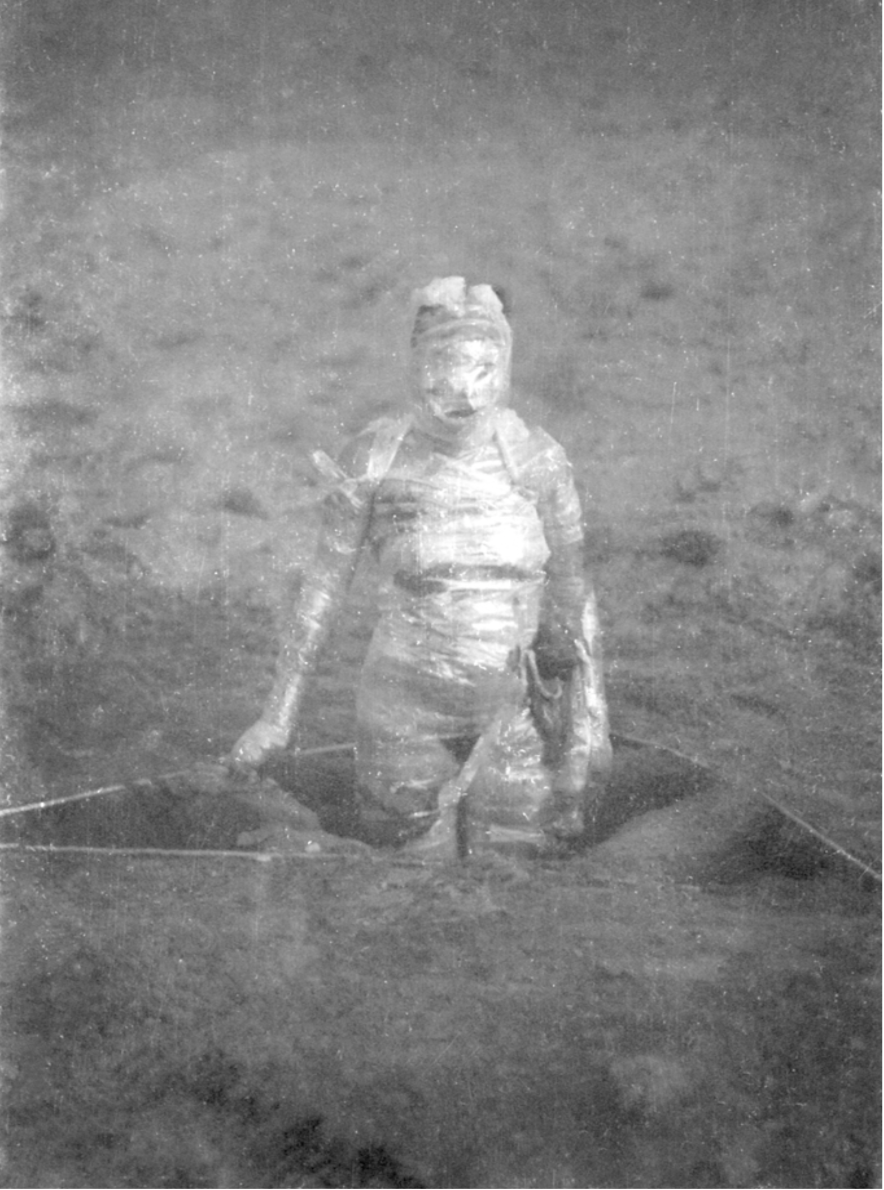
Maria Evelia Marmolejo. “Anónimo 4,” 1982. Performance. Photo by Nelson Villegas. Image courtesy of Maria Evelia Marmolejo.
Pioneering feminist artists from the early eighties also worked with the idea of the placenta as considered “medical waste” in Western medicine, while it is spiritual, such as Colombian artist Maria Evelia Marmolejo (who was included in the 2017-2018 exhibition Radical Women: Latin American Art 1960-1985 Hammer Museum and Brooklyn Museum). For Marmolejo’s 1982 performance, Anónimo 4, she dug a 1.5-meter triangular pit into the ground and filled it with sewer water and the placentas of all the babies born that day in hospitals near the performance site, in Cali, Colombia and Guayaquil, Ecuador. She wrapped her body in the placentas, and submerged herself in the hole, “embarking on a psychological and sociological self-exploration of the fear of being born in a society in which there is no guarantee of survival,” she explains in an interview. Artists like Marmolejo and Utamura observe the importance of the placenta by incorporating them into their performance rituals in meaningful, powerful, spiritual, and symbolic ways, whereas at the hospitals, they tend to be discarded.
Understandably, Utamura could not entirely let go of her partner. Because of these sudden extreme encounters with life and death, which now flow, in her words, “like the confluence of the river with raising Kai,” her perspective was instantaneously transformed, altering her artistic practice. Before Robert’s death, she created more geo-political artworks, often performances and films. One work Uncanny Valley – Study for Future Strata (see image below) raises questions around the dominant historical narrative of nuclear history by juxtaposing images of the elements that surrounded the atomic mushroom clouds of the bombing in Nagasaki, with the mining site in Congo where uranium was sourced for nuclear production – positioned above, and the military storage site near Niagara Falls where nuclear waste from the Manhattan Project was secretly disposed – positioned below. But, after she experienced the life-altering sequence of birth and death events, she felt compelled to turn inward to the body and spirit. Abstract painting helped her overcome “the unspeakable”—I immediately drew a parallel to the shift to abstraction in Western art after World War II. She believes in abstract painting as a powerful medium for channeling the energetic transitions relating to birth and death.
Hanae Utamura. “Uncanny Valley – Study for Future Strata,” 2022- Mixed Media. 21 x 16 inches. Courtesy of the artist.
“This has also very much been a collaborative process with Robert,” Utamura added, “Aur means ‘light’ in Hebrew. I feel that his symbolic composition, Aur, for string quartet and electronics, is the light that he transcended into. It transforms death into a departure. When painting, I hear his music inside my ear—his essence is expressed even more through his music in his physical absence. The music truly starts to live in eternity within me.” Having followed my mother’s journey to stay in touch with my grandmother after her death Utamura’s will to stay connected as a source of comfort resonated with my own experiences.
The first several paintings Utamura created exploring her feelings of grief were watery representations of a body, dissolving. After creating several of these more figurative paintings, she was invited to a séance by Tamar Gordon, a professor of Anthropology in the Communication and Media department at RPI, and a member of her doctoral committee. The séance would help her further shift her focus from grief to communication.
Hanae Utamura. “The Limb,” 2023. Acrylic on Paper. 24 x 18 inches. Courtesy of the artist.
At the séance, the physical medium Gary Mannion, headed a circle under controlled conditions, alternating between complete darkness and red light. Physical mediums, as opposed to mental mediums, produce materializations of spirits while mental mediums interpret and channel them. Physical mediums produce ectoplasms which are viscous manifestations of spirits that exude from their body taking on any form, including apparitions. Encircled by the participants and sitting in a cabinet, tied down to a chair, Mannion produced an ectoplasmic hand and invited members to touch and hold it. Utamura described the experience as having felt like “touching a wet hand.”
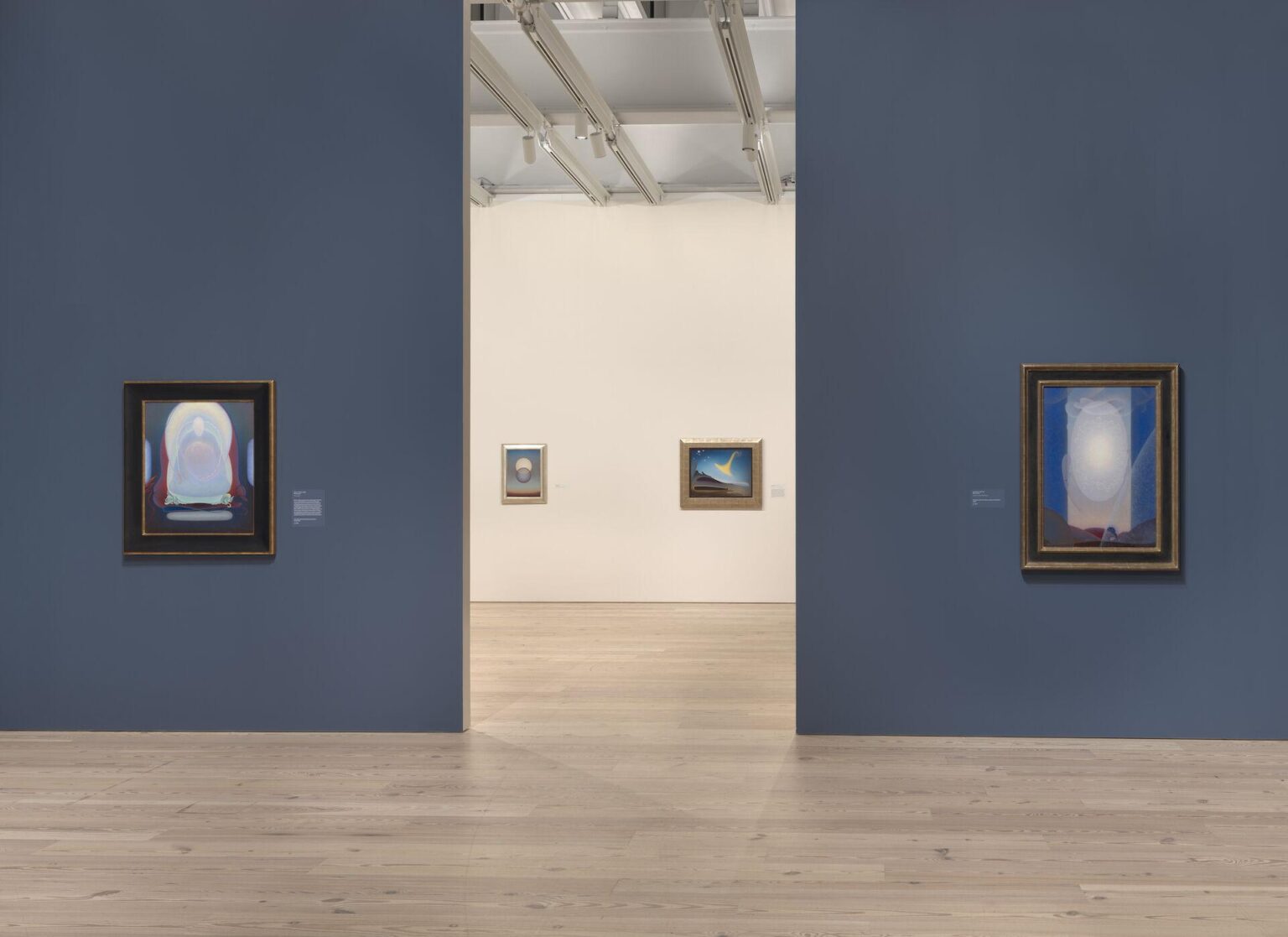
Installation view of “Agnes Pelton: Desert Transcendentalist” (Whitney Museum of American Art, New York, March 13–November 1, 2020). From left to right: Mother of Silence, 1933; Departure, 1952; Awakening (Memory of Father), 1943; Light Center, 1947-48. Photograph by Ron Amstutz. Courtesy of The Whitney Museum of American Art.
Séances were an American phenomenon popularized by the Spiritualist movement in the 1850s. They spread to Britain, other parts of Europe, Brazil, and Australia, and consisted of circles of sitters who gathered to channel the realm of spirits. Today, they are less common, but exist and Mannion is a leading figure in the field.
Utamura’s new work is also influenced by Shannon Taggart, a photographer and artist who authored a popular book depicting sitters in various states of transfiguration. Taggart recently had an exhibition of her work at the Opalka Gallery in Albany, NY. The two-day public opening included a dialogue between Taggart and Dr. Anne D. Braude, the director of Women’s Studies in Religion at Harvard Divinity School, and the author of the book,Radical Spirits: Spiritualism and Women’s Rights in Nineteenth-century America, which explores the close engagement of Spiritualism with the women’s rights movement. There is also a growing recognition in recent years of female artists like Hilma af Klint and Agnes Pelton, who employed art as a language to explore spirituality. Utamura considers her work as in alignment with these artists and thinkers.
Hanae Utamura. “Presence of Absence #3,” 2023. Acrylic on Paper. 24 x 18 inches. Courtesy of the artist.
After the séance with Mannion, Utamura created another series of paintings in which she began to depict the imaginary body that evolves to a more abstract state in its process, like energies and colors (rather than a dissolving figure), with rich, cosmic dark blues or brighter florals. Often she incorporates a bit of iridescent pigment “inspiring to channel, as it reflects light” she explains. The composition of Utamura’s new more abstract paintings on paper are vaginal and womb- or placenta-like. Some of these images incorporate a hand and a tree branch, perhaps referencing the tree under which she performed the ritual for Robert, or the sensation of touching a wet hand in the séance.
Serendipitously, a few months before Robert’s passing, she also found a book lying in a classroom at RPI titled The Perfect Medium: Photography and the Occult published by Yale University Press. It is the catalog from an exhibition in 2005 at the Metropolitan Museum of Art that showcased the history of photography on mediumship channeling with the spiritual realm, with imagery dating back to the nineteenth century. There is a page in the book that shows photography which captured ectoplasmic emissions, and the composition of these images have similarities to the composition of Utamura’s new paintings. She has a feeling that her spiritual involvement with the other realm was and is still being presented to her from many different angles.
Both of these newer series explore what comes before, what happens during, and what comes after, an extreme moment—global or personal. “We are living through dark times with a lot of death,” Utamura remarked sensitively in her studio, putting aside her personal loss and experience, knowing that this is going on all around us. “We’ve learned to accumulate, but we are not taught much about how to face loss. I think it is time for us to face this; exploring these spaces would also bring us more understanding of life in its complexity, and knowledge of how to nourish life. It will prepare us with strong grounds for the future to come. The more darkness that falls upon us, we also need light that illuminates our world.”
For the first time, I recently visited the Austrian Cultural Forum in New York City’s midtown. Situated on 52nd Street and 5th Avenue, it is close to the MoMA and is a special cultural site in an area filled with mainly retail stores and corporate offices. If you are in the area shopping, visiting the MoMA, or the south side of Central Park, I would recommend stopping in at ACFNY.
The ACFNY is a multi-faceted destination that offers many more than one reason to visit. First of all, the physical building stands at 24 stories and is a unique and known architectural achievement in the city. It is a very deep yet narrow building that soars high with walls of windows that provide a sweeping view of St. Patrick’s Cathedral, which will remain, because the air rights between the two structures are privately owned by a prominent New York family. To note, the building was originally a smaller, townhouse-style structure but was eventually re-done. Co-curator Prem Krishnamurthy of current ACFNY show “DIS – PLAY / RE – PLAY” comments,
“The ACFNY is a sliver of Austria inscribed within the complex real estate relations of Manhattan. The building is significant architecturally, as it negotiates a narrow 25-foot wide site and multi-tiered program. It’s the particularities of this architecture — both positive and challenging alike — that inspired the specific approach of the show I worked on there.”
Secondly, the ACFNY was founded in 1942 by Austrian Jewish families who fled Austria during World War II and were seeking to establish an institution to preserve Austrian culture in a place where it could flourish. In addition, there are a network of Austrian Cultural Forums globally, and the one in New York is a member of this group. I personally feel strongly about the survival of the arts during World War II, specifically the perseverance of Jewish artists who were persecuted or the recuperation of artworks seized by Nazis, like Austrian painter Gustav Klimt’s “Woman in Gold” which I mentioned in my previous article about Jewish Czech artist and concentration camp survivor Jan de Ruth, of whom I own a work titled “Daydream.”
But, the ACFNY is anything but a cultural relic from the 1940s. The institute is currently showcasing two contemporary art exhibitions, including Ulrike Königshofer, “Sense and Record,” on view until 7/28, and the previously mentioned “DIS – PLAY / RE – PLAY” put together by internationally revered curators including Krishnamurthy (of P! and Project Projects) and Walter Seidl, on view through 9/5. And, believe it or not, the next concert being held in the ACFNY’s petite, clean and modern theater will be a house music performance in September.
Additional features of the ACFNY institution include a full library filled with preserved Austrian literature (if you are a lover of “old book scent” like I am, this is the place for you!), and a friendly, engaging and passionate staff led by ACFNY Director Christine Moser. For a free guided tour of the space and current exhibits, stop by on a Wednesday at 4PM.
Many of you might have seen Jim Shaw’s recent multi-floor show, “The End is Near” at the New Museum, but what I’m hoping you had the chance to check out was queer feminist artist Wynne Greenwood’s smaller exhibit, “Kelly” which was open simultaneously on the fifth floor. Greenwood is an inspiring and unique creative talent who works with performance, video, object-making and music to practice what she calls “culture-healing.” From what I gathered at the exhibition, the idea of “culture healing” has to do with disrupting/debunking harmful, commonly held cultural beliefs that divide or misrepresent people, with the goal of healing relationships between different types of people.
Specifically, “Kelly” (which was also a 6 month artist residency for Greenwood at the New Museum) comprised Greenwood’s works from 1999 to 2015, during which time she concepted and acted out a variety of distinct characters for live performances and video recordings. To execute this, Greenwood would create partially improvised/partially scripted dialogues for these characters, generating profound conversations that questioned common beliefs and behaviors related to identity, gender and sexuality, and were frequently set to original music.
Greenwood’s main three works included in “Kelly” were Tracy and the Plastics (1999-2006), Strap-On TVs (2010), and her most recent project, More Heads, which she is still working on. For the purposes of this post, I’m going to shine the spotlight on the fascinating Tracy and the Plastics.
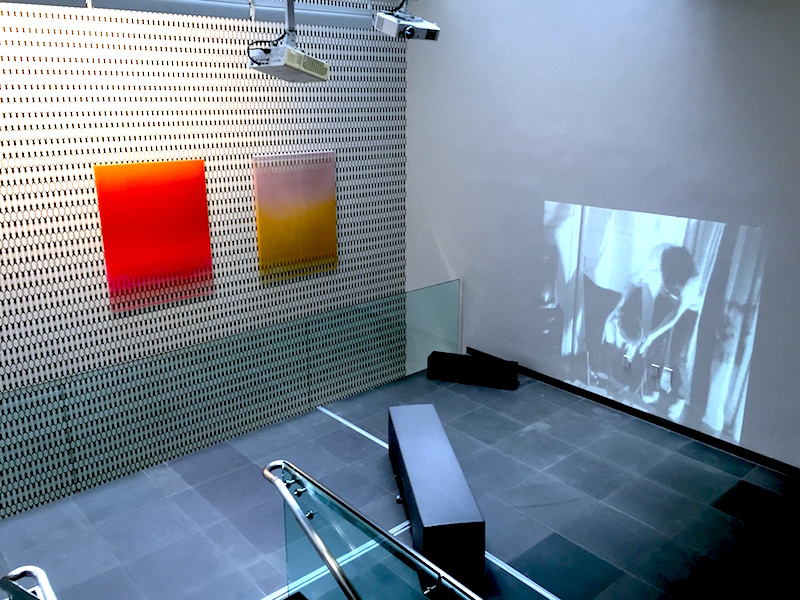
Tracy and the Plastics is a three-member punk girl band, created by Greenwood in her basement in 1999 in Olympia, Washington (birthplace of the Riot Grrrl movement). The Tracy and the Plastics project was presented at the New Museum in the form of a series of music videos displayed across about 20 individual TV screens. In terms of the band members, Greenwood would play all three of them herself (she would pre-record two of the band members and display them to either side of her on television screens – or project them onto the walls next to her – during performances). You can check out some official Tracy and the Plastics videos here and below to get a real idea of some of the interesting themes Greenwood brings up in the project and see it in action.
To note, Tracy and the Plastics went on tour in 2000, was featured at the 2004 Whitney Biennial, and joined forces with other bands and artists including Le Tigre, Bangs, and Fawn Krieger for a variety of shows, before it later “broke up” in 2006.
One of my personal favorite things about Tracy and the Plastics is that Greenwood developed complex relationships between each of the band members, Tracy (vocals), Nikki (keyboard), and Cola (drums), which resulted in potent conversations brought about in often subtle and unexpected ways regarding identity, perception, sexuality, and more. In addition, the dynamic between Tracy, Nikki, and Cola was never boring: like any rock band, the three members often had disagreements or misunderstandings, and would sometimes hurt each other’s feelings. For example, per written materials authored by New Museum curators Johanna Burton, Stephanie Snyder and Sara O’Keefe:
…while setting up for a show, Cola spray-paints the name of the band on a wall and then asks, “Hey Tracy, does that look straight?” When Tracy confirms that it does, Cola, concerned rather than reassured, spray-paints two women’s symbols beside it, in an attempt to make it look “less straight” after all.
In 2013, seven years after Tracy and the Plastics’ 2006 dissolution, Greenwood realized that she’d wished she’d documented all of their performances, so both privately and over the course of an artist residency, she completed recreating and documenting the majority of all of the Tracy and the Plastics performances so that they could be shown as they are in exhibits like “Kelly.”
A final point that I found interesting was that at the New Museum, “Kelly” was situated within the context of a larger exhibit called “Histories of Sexuality.” This was an interesting and enriching curatorial choice because the museum placed Greenwood’s work among that of other artists in the past who had worked with similar ideas about sexuality and gender, ultimately providing viewers with the possibility of a more full-circle experience of Greenwood’s work.
The two former New Museum programs that “Histories of Sexuality” focused on included: “Homo Video: Where Are We Now” (1986-87) curated by William Olander, and New Museum Founder Marcia Tucker’s “Bad Girls” exhibition (1994) curated by Cheryl Dunye. According to the New Museum’s archives, these programs:
…attempted to redress the reductive representation of homosexuality and gendered subjects that their curators perceived in art as well as in culture at large. Both were characterized by works concerned with the texture of individual subjects and communities rather than celebrating some uniform, idealized fantasy of either gay or female liberation.
In other words, with works like those featured in “Kelly,” Greenwood carries on the conversation about these critical ideas that Olander, Tucker and Dunye focused on in the ‘80s and ‘90s. Greenwood’s additions amplify and electrify the full conversation when compiled in one unified exhibit with the other artists’ works.
For more information about Greenwood, I encourage you to check out her official website. For more information about current exhibitions at the New Museum, click here.







 artifactoid