The Austrian Cultural Forum New York: A Hidden Treasure near the MoMA

For the first time, I recently visited the Austrian Cultural Forum in New York City’s midtown. Situated on 52nd Street and 5th Avenue, it is close to the MoMA and is a special cultural site in an area filled with mainly retail stores and corporate offices. If you are in the area shopping, visiting the MoMA, or the south side of Central Park, I would recommend stopping in at ACFNY.

ACFNY1

The ACFNY is a multi-faceted destination that offers many more than one reason to visit. First of all, the physical building stands at 24 stories and is a unique and known architectural achievement in the city. It is a very deep yet narrow building that soars high with walls of windows that provide a sweeping view of St. Patrick’s Cathedral, which will remain, because the air rights between the two structures are privately owned by a prominent New York family. To note, the building was originally a smaller, townhouse-style structure but was eventually re-done. Co-curator Prem Krishnamurthy of current ACFNY show “DIS – PLAY / RE – PLAY” comments,

“The ACFNY is a sliver of Austria inscribed within the complex real estate relations of Manhattan. The building is significant architecturally, as it negotiates a narrow 25-foot wide site and multi-tiered program. It’s the particularities of this architecture — both positive and challenging alike — that inspired the specific approach of the show I worked on there.”

Secondly, the ACFNY was founded in 1942 by Austrian Jewish families who fled Austria during World War II and were seeking to establish an institution to preserve Austrian culture in a place where it could flourish. In addition, there are a network of Austrian Cultural Forums globally, and the one in New York is a member of this group. I personally feel strongly about the survival of the arts during World War II, specifically the perseverance of Jewish artists who were persecuted or the recuperation of artworks seized by Nazis, like Austrian painter Gustav Klimt’s “Woman in Gold” which I mentioned in my previous article about Jewish Czech artist and concentration camp survivor Jan de Ruth, of whom I own a work titled “Daydream.”
ACFNY3

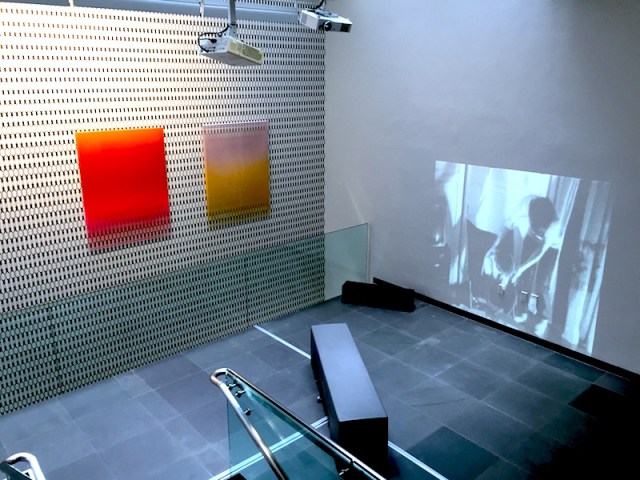
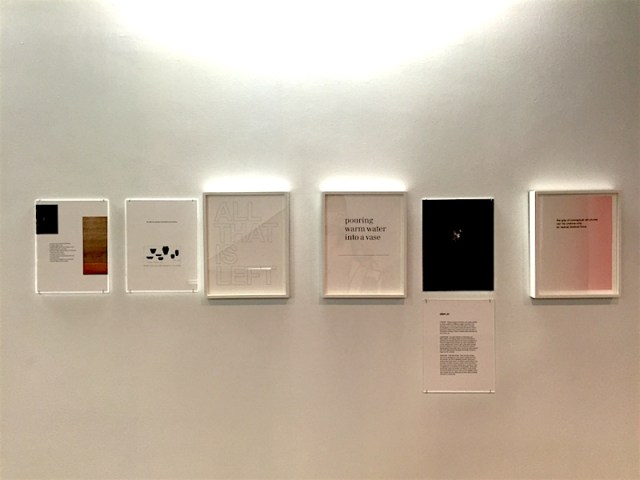
But, the ACFNY is anything but a cultural relic from the 1940s. The institute is currently showcasing two contemporary art exhibitions, including Ulrike Königshofer, “Sense and Record,” on view until 7/28, and the previously mentioned “DIS – PLAY / RE – PLAY” put together by internationally revered curators including Krishnamurthy (of P! and Project Projects) and Walter Seidl, on view through 9/5. And, believe it or not, the next concert being held in the ACFNY’s petite, clean and modern theater will be a house music performance in September.
ACFNY4

Additional features of the ACFNY institution include a full library filled with preserved Austrian literature (if you are a lover of “old book scent” like I am, this is the place for you!), and a friendly, engaging and passionate staff led by ACFNY Director Christine Moser. For a free guided tour of the space and current exhibits, stop by on a Wednesday at 4PM.

Marks of Permanence on Paper and Skin: In Conversation with David Sena

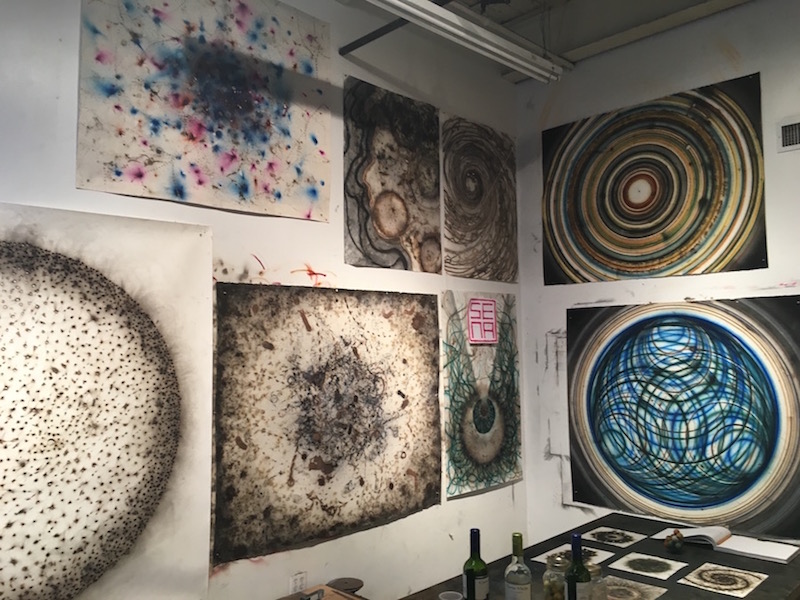
In NYC’s Little Italy, nestled into the west side of Centre Street near Grand Street, you’ll find one of the neighborhood’s cultural gems: David Sena’s tattoo parlor and art gallery, Senaspace. Sena, a world famous tattoo artist and fine artist known for using pyrotechnic techniques to create large-scale wall pieces, recently invited Artifactoid to his workshop at Brooklyn Art Studios to catch a glimpse of some of his latest projects and techniques. Check out our Q&A with exclusive video footage below, and stop by Senaspace for the latest show or some fresh ink.
 Sena2

Artifactoid: Tell me about your background using pyrotechnic techniques in your art. How did they evolve and lead to “Colored Smoke?”

DS: I began using the pyrotechnic techniques in my art work about 20 years ago… I was in art school at The Cooper Union and one day was at a gallery in SoHo where I saw an artist that had done some “paintings” or drawings on canvas with candle soot.  For one of my 2D Design assignments we were to do a self portrait using the grid system to breakdown the image into small squares and then assign a value to each square. Then, the portrait was made with the collection of values in the grid, similar to a Chuck Close painting.  Remembering the candle soot drawings, I thought to use a lighter to burn in different values from light to dark on the grid layout.  This was my first experience using fire to make art.
 Sena3

The following year I was in a drawing course, and was looking for new ways to make marks on paper.  Traditional mediums such as pencil, charcoal, and ink weren’t giving me the look or aesthetic I was looking for and my thoughts went back the lighter portrait.  As a child I had a big fascination with fire and always loved lighting off fireworks.  I remembered from experiences how the fireworks would sometimes leave behind burnt marks on the concrete or wooden surfaces I would light them off on.  So I had an idea to get some fireworks, light them off on a sheet of paper and see what happened.  I acquired some fireworks in Chinatown, did some experiments, and right away had found what I was looking for.  Since then I have built a large selection of techniques using fireworks and other volatile materials to make my art.

Sena4

Artifactoid: Describe how you created the mechanism you developed to make the “Colored Smoke” pieces. 

DS: The “Colored Smoke” pieces  were created by using a few different tools, i.e, a compass, which the colored smoke bombs can be mounted on, then used to draw lines on the paper with.  The smoke bombs emit colored smoke and saturate the paper when directed at the surface.

Artifactoid: What are some of the biggest challenges that come along with making this type of art, and how did you overcome them?

DS: I would say constantly being cautious and safe with using fire in a controlled environment is one of the biggest challenges.

This is constantly on my mind – to be aware of what I’m doing and not let any particular process or fire get out of hand to where an unwanted fire is started. Fire can obviously be dangerous, so I rigorously remain alert to any prevent any accidents.

Artistically, the challenge is to make art and not wind up with simply a burnt piece of paper. I am exerting different amounts of control over the process but not everything can be foreseen so I have to be open to the marks the fireworks make and use them to best accomplish the desired design and composition.  The process builds upon itself and I am always finding new techniques as I work with different pyrotechnics and tools.

Artifactoid: How does your career as a tattoo artist influence your additional artistic practices?

DS: My career as a tattoo artist has coexisted well with my studio work. I feel they are very similar in their very direct and permanent means of making marks on paper or skin,  just as I cannot erase a tattooed line, I cannot undo a burnt line on paper.  The tattoo imagery I work with has also come to be included in some of the more illustrative subjects of my fire drawings.  Luckily my career as a tattoo artist has provided me with the time and resources to keep making my fine art, all the while keeping my hand and mind in creative practice.

Artifactoid: What are some other ideas and techniques for pyrotechnic art you’re looking forward to testing out in the future?

DS: I would like to start doing larger-scale projects and installations with my pyrotechnic techniques.  I would also like to incorporate light and video projections as I did in some early work.

Tonight, Thursday, July 14th 2015 from 6PM-9PM, is the opening reception for “New Amsterdam, Photographs by Richard Koek” at Senaspace, 229 Centre Street, New York, NY. Look forward to seeing you there!