Jung Uk Yang, DOOSAN Gallery

One of the things I love most about going to art galleries without knowing what’s showing is that it feels like I’m on a treasure hunt: behind any gallery door, there is the possibility of finding unique creative treasures that carry inspiration and ideas.

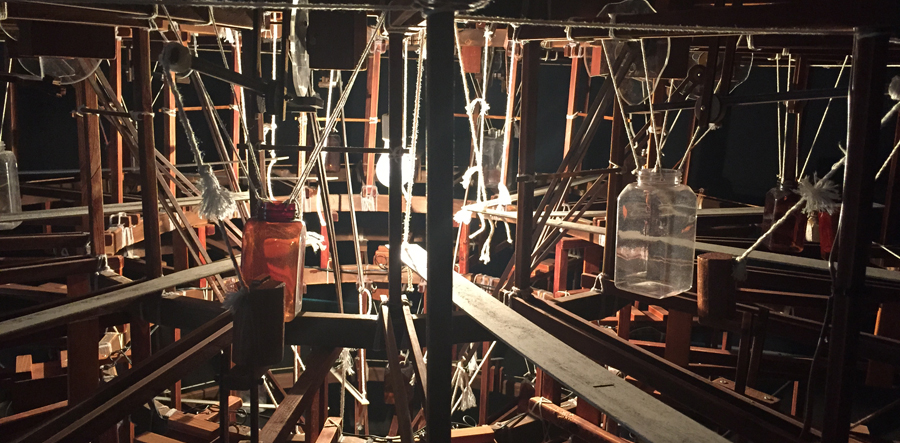
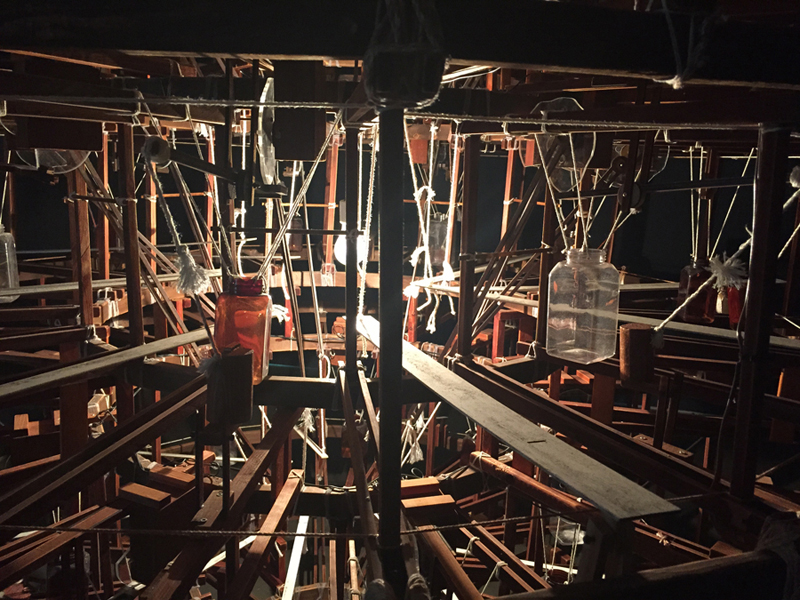
Recently in Chelsea, I found one of these treasures. I was walking down West 25th street on a sunny Friday afternoon and popped into the DOOSAN gallery. The second I walked through the door, I was confronted by a dark, frantic, monotonous, anxious, yet simultaneously quirky and upbeat, piece of mechanical art installed directly on the gallery wall.

The work was created by Korean artist Jung Uk Yang as a part of the exhibition “A Man Without Words,” which was on view from July 9th through August 27th 2015. Per the gallery’s description, “A Man Without Words” encompassed Jung Uk’s reflections upon the everyday, simple things that would occur in both his life and the lives of the individuals around him who seemed to lead monotonous, repetitive lives.

For example, the piece, “A Fatigue Always Comes with a Dream,” (featured above and below) was created as a metaphor for the lives of apartment security guards in South Korea, who, “must stay awake until dawn while most people are asleep.” Jung Uk’s work is independently visually powerful, but the unusual story behind it makes it even more provocative than the visuals alone.  junguk3
Through his work, Jung Uk provided me with an experience that ruptured the monotony of my life that day. He piqued my curiosity about DOOSAN, an incredible art space, as well. The DOOSAN Gallery New York is dedicated to the discovery of and support for young and emerging Korean artists. It also has a residency program. Its mission is to serve as a gateway to significant exposure and opportunities for the artists by nurturing their creativity and helping them share their work with a broader audience.

Learning about the South Korea-headquartered DOOSAN gallery and its mission in support of Korean creativity led me to think about it in contrast to a recent Huffington Post article I came across on my twitter feed titled, “North Korea’s Art Scene is Just as Mysterious as the Nation Itself.” In the article, writer Sara Boboltz notes that North Korea’s largest art institute, Mansudae, is government-run and is used “primarily to churn out work extolling the state’s leaders.” She concludes that, “For all the impressive skill of its talented pool of artists, artistic freedom in North Korea might only be an optimistic myth.”

JungUk4

It would be interesting to know what the DOOSAN gallery opines about this issue, especially within the context of the gallery’s mission to nurture the growth of Korean contemporary art. While Jung Uk Yang’s work is no longer currently on view at DOOSAN’s Chelsea space, I invite you to check out their current exhibition, Revelation, an equally inspiring solo installation featuring the work of artist Jungki Beak.
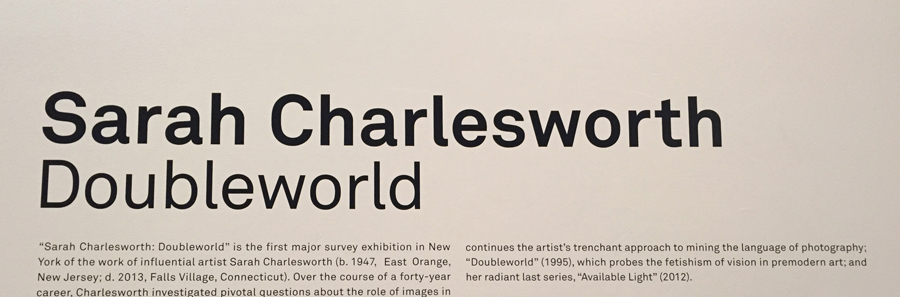
Sarah Charlesworth, The New Museum

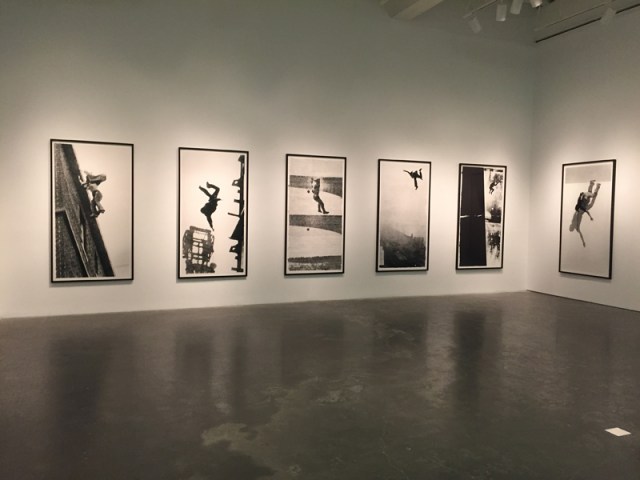
At the New Museum installation, “Sarah Charlesworth: Doubleworld,” I came upon Charlesworth‘s emotionally gripping 1980 photograph series, “Stills.” It was the type of exhibit where the moment I walked into the room and realized what I was looking at, something inside my core sank.

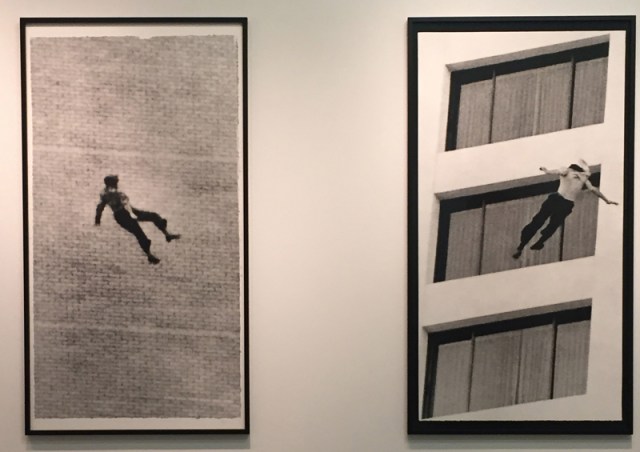
For “Stills,” Charlesworth collected newspaper clippings of photos depicting various individuals falling or jumping off of tall structures, presumably to their deaths.* Charlesworth re-photographed and enlarged the clipped images to measure 6’6” in height. The result is that viewers experience the visuals at a size larger than their own physical bodies.

Charlesworth1

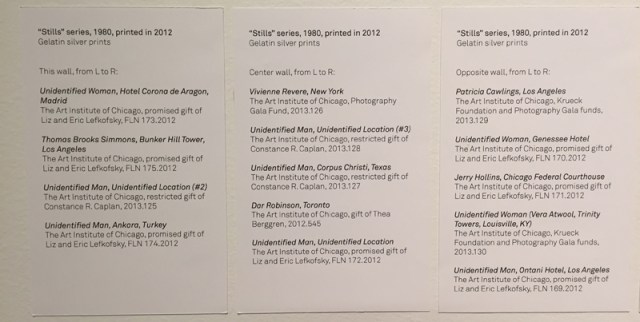
In the descriptions of each piece, the individuals depicted are identified with varying degrees of anonymity, depending upon the information that was available. They range in detail from completely unknown, i.e., “Unidentified man, Unidentified location,” to full name and location, i.e., “Patricia Crawlings, Los Angeles,” leaving viewers with infinite unanswered questions about each one.

Charlesworth11

For me, it was incredibly humbling to walk into a room surrounded by photographed portraits, larger than my physical body, which captured the last seconds of fourteen strangers’ lives. Their last breaths and the thoughts that were going through their minds during their final few seconds in the air live eternally inside these images.

Charlesworth4

It’s important to reiterate that Charlesworth didn’t take the original photographs herself. Her “photographing photos” technique for “Stills” wasn’t straightforward, and calls into question the definitions of “photographer” and “photography.” Upon looking into this further, I found out via a recent New York Times article that Charlesworth is known to be a part of the 1980s artist group dubbed, “The Pictures Generation.”** Per the article, “The Pictures Generation” is a loose title referring to a group of photo-based artists who gathered the imagery they worked with from the media. For reference, this group also includes other well-known artists Barbara Kruger, Jack Goldstein, Louise Lawler, Richard Prince, Sherrie Levine, Cindy Sherman, and Laurie Simmons.

CHarlesworth7

Notes:

*For the entirety of this post, I assume that the falls/jumps depicted in “Stills” resulted in death.

**Charlesworth’s connection to “The Pictures Generation” is also mentioned at the New Museum.

Theresa Byrnes, TBG

I’m privileged to have spontaneously met Australian performance artist Theresa Byrnes a few weeks ago while strolling down East 9th Street. What a remarkable person. I was walking home from an estate auction in Greenwich Village, and popped my head into what appeared to be an open gallery space called TBG (Theresa Byrnes Gallery). I entered the bright, colorful room, filled floor to ceiling with an abundance of kinetic paintings created by Theresa Byrnes and her mother and fellow artist Lorraine Byrnes.

Lorraine warmly welcomed me into the gallery. I felt like she was my mother, too! She and Theresa had recently debuted “Offspring,” their joint exhibition, with an opening reception that took place at TBG on July 30th.

Tbyrnes1

It wasn’t until I’d made my way to the back of the gallery that I met Theresa. She told me that the back portion of the space was her studio.

Theresa was one of the coolest-dressed people I’d seen all day. I immediately fell in love with her style and arresting smile. She was wearing a funky black hat, a pale pink punk-rocker style T-shirt, black jeans, and a set of badass red high-top kicks. Finally, there was her most unique accessory: her wheelchair.

Theresa and I spoke for close to an hour, getting to know each other. After reading more about her following our meeting, I found out that she has a degenerative disease called Friedrich’s ataxia, that causes progressive damage to the nervous system. I am incredibly inspired by how clear it is, from both meeting Theresa and reading about her, that she doesn’t allow the disease she lives with to define her or control her. She finds freedom in her work and nothing seems to hold her back from being her full, powerfully talented creative self. This fascinating article from The Villager can tell you a bit more about her story. I’m in awe of her.

IMG_7192

Theresa’s infant son, Sparrow, was with her in the gallery space. I loved the way her passion came through so clearly when speaking about art, creating, and her son. Her palpable joy and refreshing attitude toward life and art made me feel happy.

I am pleased to share a preview of her piece, “Being Two,” shown below.  I also invite you to watch this video interview, conducted with Theresa last year on ABC (Australia). It will give you a sneak peek of the amazing person and artist that I had the opportunity to meet face-to-face. Finally, I hope that if you’re planning to visit Alphabet City any time soon, you take a moment to stop by TBG at 616 East 9th St. between Avenues B & C to check out her work.

Tbyrnes3