One Hundred and Fifty Layers of Laura Owens

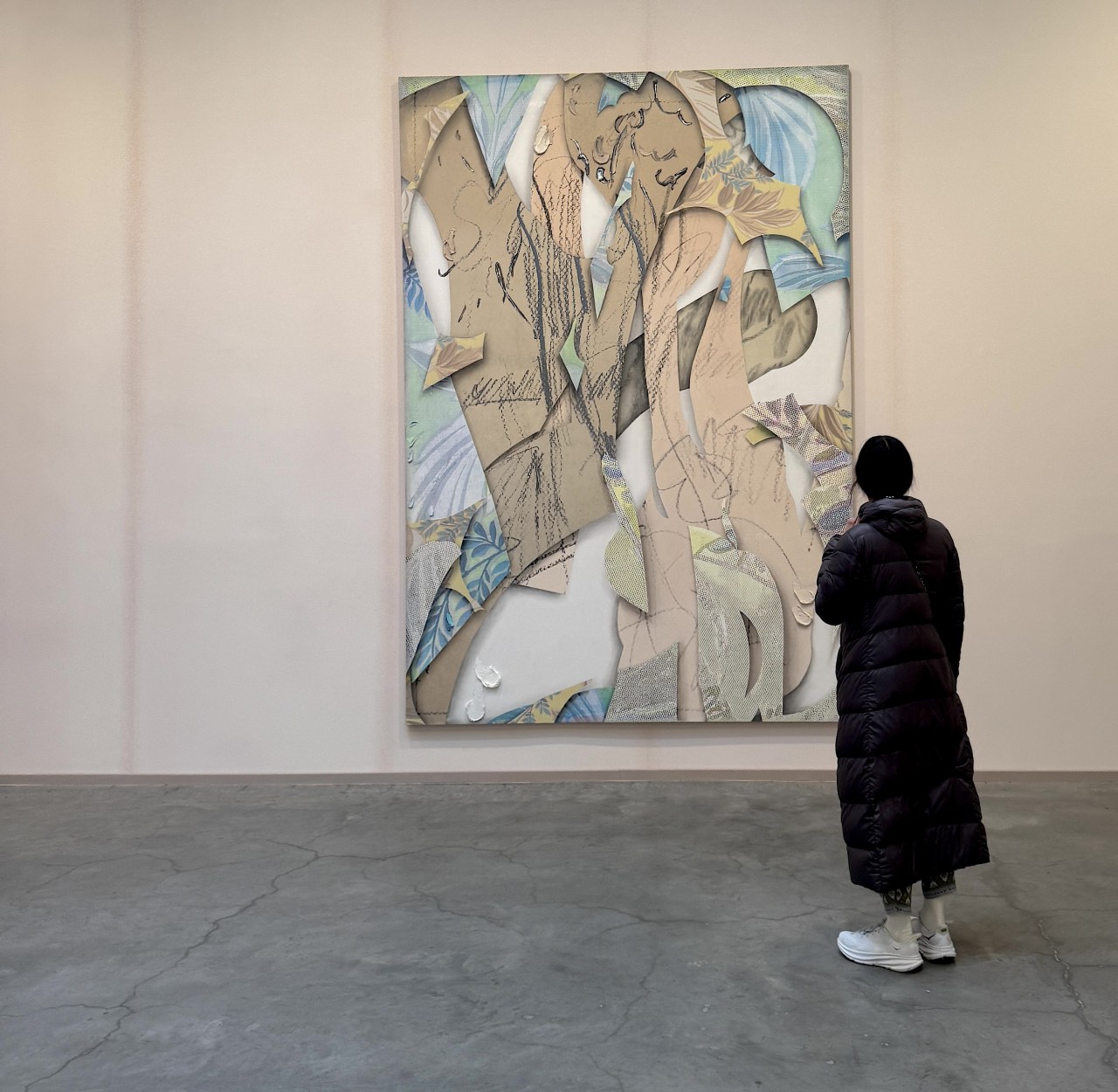
Above image: Installation view of Laura Owens, Matthew Marks Gallery, New York, February 13 – April 19, 2025. Photo by Bailey Coleman.

By Bailey Coleman

“Have you seen Laura Owens yet?”

Opening the door to the gallery I am welcomed by a nearly manic energy. Gallery goers are thrilled with themselves that they have finally made it to Chelsea to see the show everyone is talking about. Laura Owen’s eponymous exhibition at Matthew Marks has been widely lauded as a tour-de force of art making and I was just as excited as those around me to see what all the fuss was about. There is a swarm of people hovering around the gallery attendant’s desk with anticipation as the artist casts her first spell. An older woman with a fresh, blonde, blowout squeals with excitement, as a roll of tape magically moves across the desk. Suddenly, a drawer opens when her friend removes a pen from its holder. Having been witness to these moments of fantasy, we are baptized and free to pass through to the magical world of Laura Owens in her first solo show in New York City since her 2017 mid-career survey at The Whitney. 
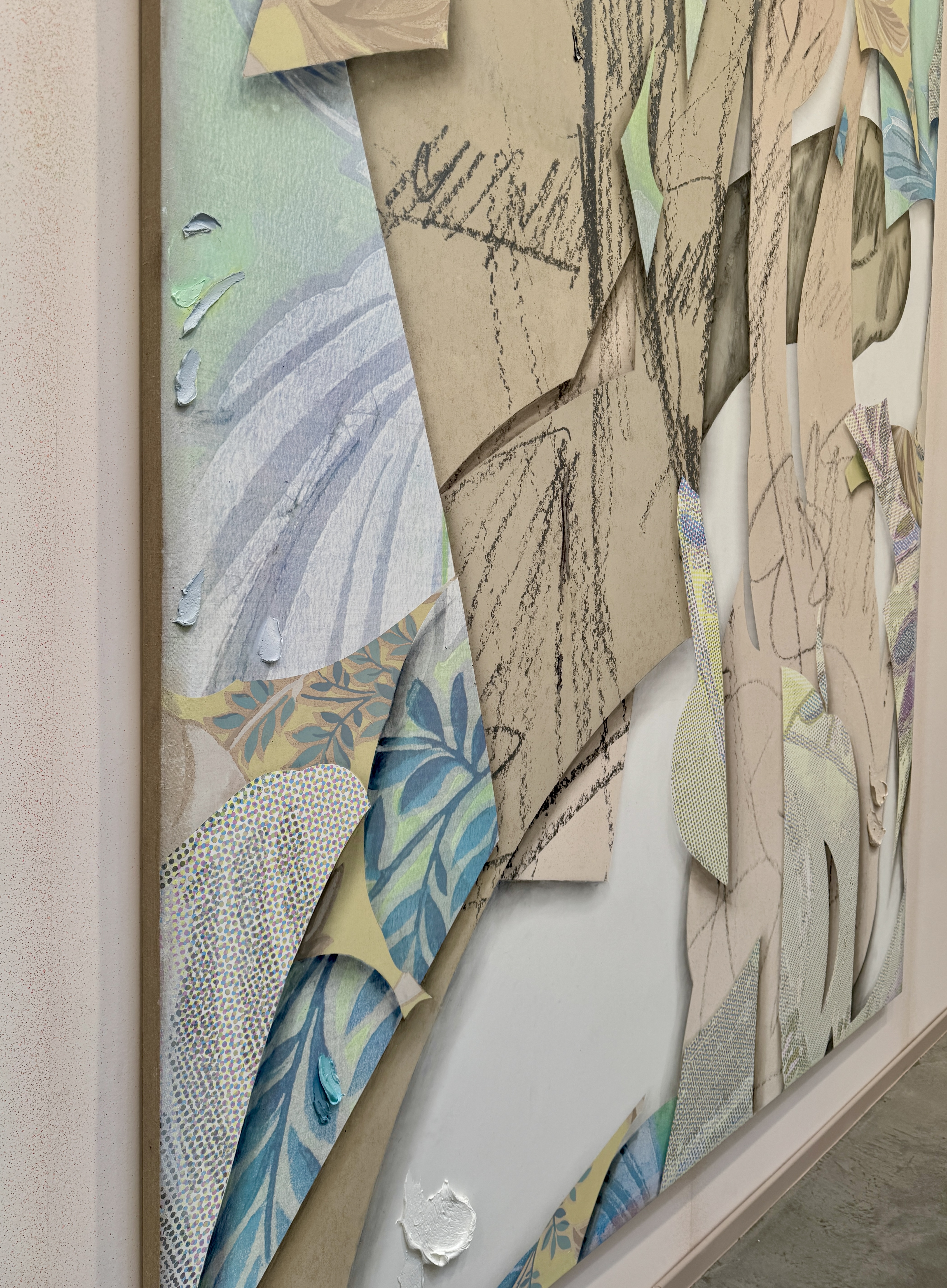
Laura Owens, Untitled (Detail), 2025, Oil, pastel, charcoal, graphite, and silkscreened Flashe on linen, 130 x 90 inches. Photo by Bailey Coleman. 

In the first gallery, ten-foot tall vertical pastel paintings hang in effigy of Laura Owens. Though not intended to burn in sacrifice, these impressive works on canvas are singular retrospectives of Laura Owens’s unique style. Collage, digital media, hand-made silk screen prints and heavy daubs of oil paint compete and complement one another in an effort to excavate the nature of contemporary abstraction. Articulated in light teal cubist forms, the painting on the gallery’s farthest wall is a combustive battleground of style and technique. The result is a soft pixelation of abstracted shapes that superimpose each other and create the illusion of material layering. Her work has been likened to artists such as Picasso and de Kooning by The New York Times and others. These artists were interested in the integrity of the picture plane and celebrating the medium specific flatness inherent to its two-dimensionality. Owens, of course, adheres to these Greenbergian ideals, however, her degloving of the picture plane goes one step further. By outlining formal elements of her composition in shadow, Owens emphasizes that these shapes, designs, and motifs are, indeed, painted, suggesting that qualities that contribute to the illusion of three-dimensional painting can extend to elements usually thought of as contributing to flatness.
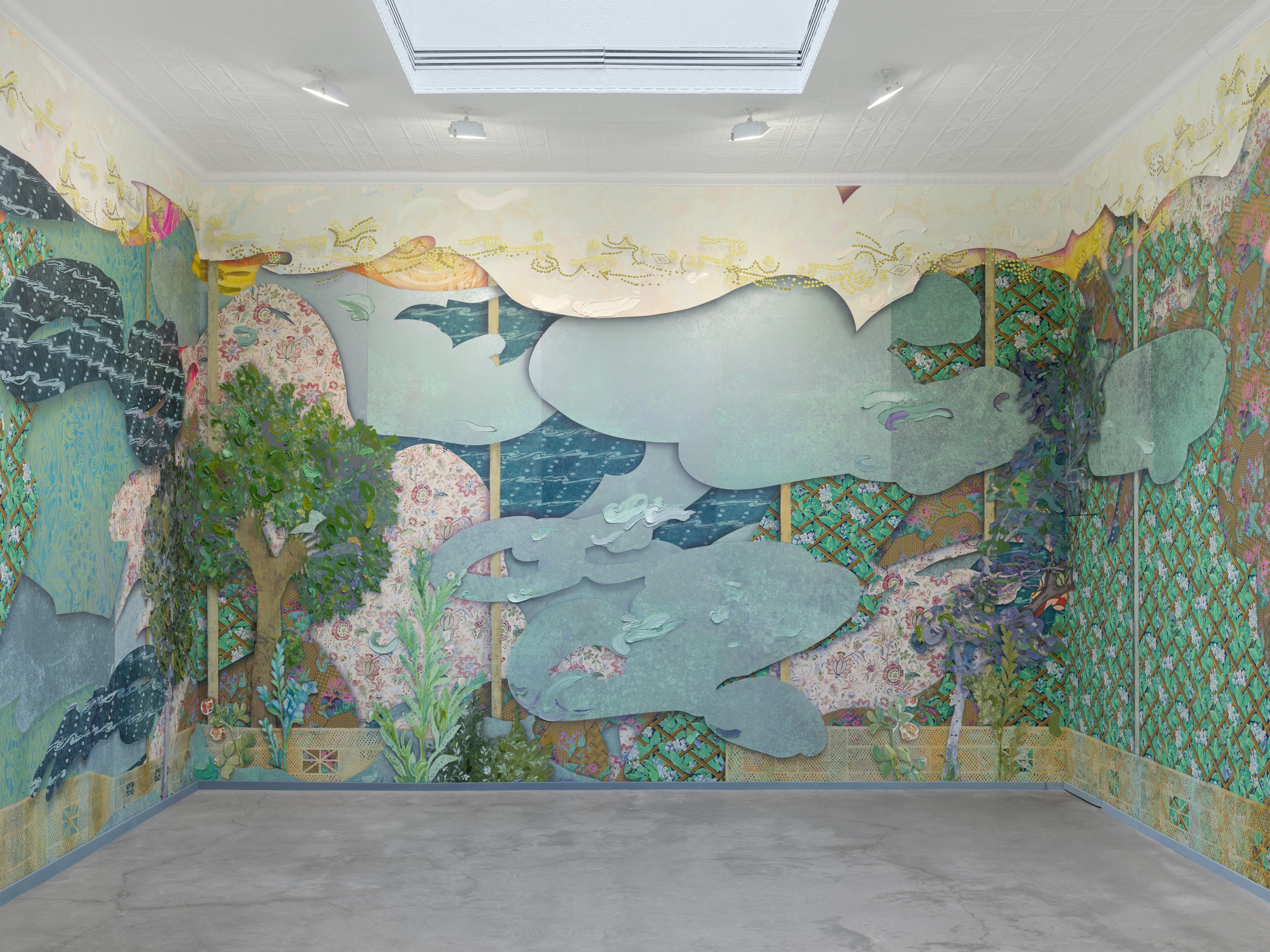
Installation view of Laura Owens, Matthew Marks Gallery, New York, February 13 – April 19, 2025. © Laura Owens. Courtesy the Artist and Matthew Marks Gallery. Photo: Annik Wetter.

Once ushered through the large vault-like doors at the rear of the first gallery, I entered into what appeared to be a secret garden with hide-and-seek mechanical pop-outs that reveal small paintings. This exhibition is a surprise departure from Owens’s previous solo shows in many ways. Owens’s 2017 Whitney mid-career retrospective featured her impressive paintings on typical white walls. Now, at Matthew Marks, Laura Owens invites the viewer into an immersive environment that the artist herself has dictated. Floor to ceiling aluminum panels boast one hundred and fifty layers of her silkscreen prints, oil painting, and clay-coated paper that showcases a complex botanical motif with a lattice gate and overflowing greenery. The intricacy of the design layers and subtle shifts in depth perspective become an enveloping environment of the artist’s imagination. Suddenly, a gallery attendant opens a final hidden door to reveal a video installation in a dark, tiny, 3 x 4′ closet-like room. Craning my head upwards in the claustrophobic cinema, I watch as two black crows wax philosophical on the fall of the Roman empire and the prevalence of misogyny throughout ancient history – acting as a subtext of sorts. It felt like type of fever-dream talk show I’ve always craved, but never realized was missing from my life until I saw it.

After a moment of surreal and comedic bird-watching, I exited the principal gallery space and went next door to the annex to catch the exhibition’s final act. There, large boxes with handles, pulls, and knobs hold books and other curios. Fingering through the objects, the printed matter tells a narrative of existential exploration and metaphysical interest beyond the scientific. To my nostalgic delight, I am reminded of show-and-tell in elementary school, sharing memories tied to objects. Overall, the exhibition affirms Laura Owens as an alchemist of painting. She melds painterly skill, an eagerness to adapt unique technologies, art history, and humor, to create something entirely new and wholly her own. 

Laura Owens” is on view at Matthew Marks Gallery through April 19th, 2025.
Bailey Coleman

Bailey Coleman is a contributing writer to Artifactoid and is the founder of her own art publication: Bin Day Art. She is an art advisor and writer based in New York working with clients to curate private collections that speak to both individual desire and market interest. She received her MA in the History of Art & Curating from the University of London and her BA in Art History from Barnard College of Columbia University. 

The image that condenses an event of history

(Above: Claudia Fontes, Reconstruction of the portrait of Pablo Míguez, Water reflections from the Río de la Plata on mirror-polished stainless steel figure, 170 x 50 x 70 cm, 2000/2010, Floating on Río de la Plata, coordinates: 34° 32, 3660 S / 58° 26, 2575 W)

By Syd Krochmalny

Translated from Spanish by Alexandra Goldman

New generations of artists are required to have an excessive confidence in order to achieve an image of the present that gives meaning to history. Just as living beings demand rights, so does the past. The artist, like the flowers that turn their corolla to the sun, turns into a flash of light that illuminates the sky of history. But more than the sun is a lightning bolt that flashes in the final moment before the truth vanishes. With the necessary tools and in the kairos, an image is produced that, in the instant of being revealed, looks toward the void. To capture the image of history is not to recognize it as it is, or has been, but rather to take ownership of it. To grasp the present is like going through the moment of danger of sudden death. The artist combs history against the grain.

There is a way of making art in which its procedure can be defined as the image that condenses an event of history. It is the image which is capable of capturing the state of exception as that of a catastrophe; that of a heartrending event. But this condensation is not a representation, nor an illustration, but an interpretation. It is not an understanding of an external derivative, but the ability to produce a visual event. It is in the articulation of historical forces, language and visibility when a significant work of art is produced. In turn, this image is not linearly related to the meaning of a historical fact, but rather, establishes a poetic in the relationship between the image, its materiality and its process.

Some examples of this type of work are the Reconstruction of the portrait of Pablo Míguez by Claudia Fontes that condenses the horror of forced disappearances, especially with the case of a 14-year-old adolescent named Pablo who was abducted on the morning of May 12, 1977 by an operative group of the Argentine army that went to look for his mother and her partner, militants of the People’s Revolutionary Army (ERP). Once they were all gathered in the clandestine detention center known as “El Vesubio,” in the Buenos Aires county of “La Matanza,” Pablo was transferred to the ESMA. Afterwards, his course was ignored. Nobody heard anything more about him. Pablo Míguez never appeared. To this day the Armed Forces must be accountable for an explanation.

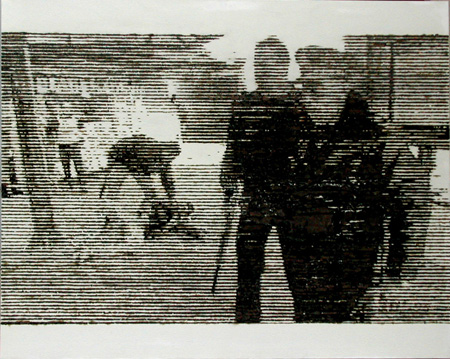
Tomás Espina, June 26, 2002 or Los Fusilados (Homage to Goya), Gunpowder on canvas, 2002.

Another example is June 26, 2002, or Los Fusilados (Homage to Goya), by Tomás Espina that recovers, in an instant, one of the worst moments of the history of Argentine democracy: the savage police repression of a demonstration by piqueteros groups that concluded with 150 detainees, four seriously wounded with lead bullets, another 90 injured with rubber bullets, and with the assassination of Darío Santillán and Maximiliano Kosteki at the Avellaneda railway station during the interim presidency of Eduardo Duhalde.

These works are the figurative condensation of an entire set of relationships between the aesthetics of materials, procedures and contextual elements that, like a kaleidoscope, produce new constellations of meaning. Images are not facts that exist by themselves, they are produced by artists who throw them into the sea as a message in the bottle that must be translated because each image is like a hieroglyph that must be interpreted. The image, as a constellation of meaning, can condense a “monad” that allows for the emergence of an object. The object needs to open itself in a monadological insistence that reveals the meaning of the story. The monad reveals the non-identity of the object, and the story expresses itself through its negative revelation. Images can disappear like dreams, or can be objectified to condense the singularity of a revealing historical event. This way, a memorable fact is constituted that articulates history with its anguish.

Syd Krochmalny is an artist and writer. He published “Journals of Hate” by n direcciones, “Weak” by Pánico el Pánico, and edited and introduced “Dreams” by Gino Germani in Idilio Magazine with photomontages by Grete Stern, Caja Negra, 2017. His recent exhibitions include Lo prometido es deuda at Centro Cultural de la Memoria Haroldo Conti, Museo de la Memoria y de los Derechos Humanos, Buenos Aires, Argentina, October 2019-February 2020; Proyecto Casamario at Subte, Montevideo Uruguay April-July 2019;  Hate in America curated by Alexandra Goldman, SENA Space, NYC; Arte Bebo, Gallery 50, New Jersey, August 2018; Assemblage #10 Engager le corps, Paris, February-March 2018;  Useless Landscapes, Gallery 50, New Jersey; Guiñadas Gráciles: Looking Out for the Queer in Latin American Video Art, organized by the David Rockefeller Center for Latin American Studies at Harvard (October 23, 2017 to April 10, 2018) and curated by Joaquin Terrones, Preceptor in Expository Writing at the Harvard College Writing Program and Lecturer in Literature and Women’s and Gender Studies at MIT; VIA VIVA, Los Angeles, Curated by Alina Perkins, etc.