Why Hasn’t James Lee Byars Been Exhibited at Dia?

By Alexandra Goldman

This article was originally published in Cultbytes.

Above: Installation view. “James Lee Byars: Perfect is the Question” curated by Vicente Todolí at Reina Sofia Museum Palacio de Velázquez, Madrid, Spain, May 10 – Sep. 1, 2024. Photo: Alexandra Goldman.

James Lee Byars occupies an interesting place at the intersection of minimalism and spirituality. Recalling the spiritual abstract painters Agnes Pelton and Hilma Af Klint who preceded him, there is this idea of the spiritual abstraction of the earlier half of the 20th century seeping into the conceptual minimalist sculpture of the latter half, which coalesces harmoniously in Byars’s work. Within it, he’s secured his unique position in art history, in a way that feels sincere.

Visiting “Perfect is the Question,” the American conceptual installation and performance artist Byars solo exhibition at the Reina Sofia Palacio de Velázquez in Madrid, I became interested in Byars’s unique ideas. I was excited that this was the “old stuff”—the good stuff. Even though his work is large and takes up space, it is quiet and pensive, rather than an overt visual spectacle. Presenting work from the 1950s-1990s, “Perfect Is the Question” at The Reina Sofia was curated by Vicente Todolí, and was the second iteration of a traveling exhibition that began at Pirelli HangarBicocca in Milan.

James Lee Byars. “A Dozen Facts,” 1967, in “James Lee Byars: Perfect is the Question” curated by Vicente Todolí at Reina Sofia Museum Palacio de Velázquez, Madrid, Spain, May 10 – Sep. 1, 2024. Photo: Alexandra Goldman.

The exhibition emphasizes Byars endorsement of the color gold, asserting it is not decorative, but rather, is spiritual, closer to god, like halos in fifteenth-century religious oil paintings. He also worked frequently with the colors white and red, also spiritual and powerful in their own ways – elemental colors. He works with the idea of the perfection of the circle, Da Vinci’s Vitruvian Man and “perfect proportions”, the “perfection” of death, and the physiological effects of minimalist sculpture on the viewer (think Tony Smith’s Die, 1962 as a six-foot gold pillar) He works with the ideas of myths, beliefs, transcendence, religious relics, architecture, and coveted objects. For example, he created a fantastical reliquary-like sculpture based on the once-held belief that narwhal tusks were unicorn horns. He combines the aesthetics of 1960s minimalism with Eastern philosophy, medieval Christianity, and the Renaissance interest in mathematical perfection in aesthetics.

Installation view. “James Lee Byars: Perfect is the Question” curated by Vicente Todolí at Reina Sofia Museum Palacio de Velázquez, Madrid, Spain, May 10 – Sep. 1, 2024. Photo: Alexandra Goldman.

Upon my return to New York, I looked at the “50 Years of Dia” webpage. I could not believe I did not see Byars’s name listed. He seems to fit in perfectly with this group of artists, and his spiritual twist to minimalism deserves recognition at this major establishment for installation art. It is not that Dia Art Foundation is the be-all and end-all of institutions, but for conceptual installation and large-scale minimalist sculpture (especially from the second half of the 20th century), it is hard to beat. Nor did I hear Byars’s name in my 2019 graduate-level Art History course on minimalism at Hunter College.

Michael Werner Gallery’s co-owner Gordon VeneKlasen, who represents the Byars estate, has been working on getting Byars into Dia for years. He thinks that Byars is excluded from the history of U.S. minimalism because of his interest in the immaterial: “Byars had a very different way of dealing with things than the minimalists because of his interest in the dematerial. He spent a ton of time in Japan and wanted to make immaterial work. He wanted to make the work disappear. The Minimalists would make an object and then would write a theory about it. He, conversely, would take an idea and make it concrete. No wonder he connected so closely with Beuys and Broodthaers. He was also really in with Rudi Fuchs and Harald Szeemann—the European curators.”

Byars had a retrospective at MoMA PS1 in 2014, 17 years after his death. Furthermore, he has had a significant exhibition history in the U.S. I might be the last one to the James Lee Byars party, or as the death-obsessed artist might have said—the last guest at his funeral. VeneKlasen emphasized: “He was a hero to so many artists. Dia artist Anne Truitt started every lecture of hers by saying: ‘We need to talk about James Lee Byars.’”

Installation view. “James Lee Byars: Perfect is the Question” curated by Vicente Todolí at Reina Sofia Museum Palacio de Velázquez, Madrid, Spain, May 10 – Sep. 1, 2024. Photo: Alexandra Goldman.

A versatile artist, Byars worked with a lot of natural and found materials; not only the narwhal horn, but dried roses, silk, wood, marble, paper, and sandstone. He was doing performances that involved choreography, geometry, and spirituality. He was experimenting with photography in the ‘60s and ‘70s, photo-documenting his performances as well as incorporating books and written ephemera into his practice. In 1969, his performance “The World Question Center” was broadcast on Belgian national television and comprised of intellectuals asking him significant questions—among them were Marcel Broodthaers and John Cage, writer Simon Vinkenoog, doctor Robert Jungk, and Knesset member Uri Avnery. The piece inspired The Reality Club, a New York-based group of intellectuals who met between 1981-1996.  And, the title of the Madrid retrospective. Byars’s inquisitive practice touched the lives of many artists and intellectuals across the world.

In one of Byars most famous performances, “The Death of James Lee Byars,” the artist symbolically staged his leaving the physical world. It ook place shortly after he had been diagnosed with terminal cancer in 1994. The performance was set in a gilded gold room with crystals configured in a five-point shape representing his body, himself physically absent. It incorporated his ideas of spirituality and Da Vinci’s “five points” theory to represent any human body, as well as Eastern ideas learned from his years spent in Kyoto, Japan in the late 1950s. A couple of years later, in 1997, he died in Cairo where he was making art with artisans.

Installation view. “James Lee Byars: Perfect is the Question” curated by Vicente Todolí at Reina Sofia Museum Palacio de Velázquez, Madrid, Spain, May 10 – Sep. 1, 2024. Photo: Alexandra Goldman.

Byars has been lauded and recognized worldwide for half a century. He was included in Documenta 5, 6, 7, 8, and 9 in Kassel, Germany, and the Venice Biennials of 1980, 1986, and 1999. Apart from “James Lee Byars: Back in Detroit” presenting the artist’s performances at Wayne State University, Byars work is mostly being reexamined in Europe. In Europe, the traveling show “Perfect is the Question” and a dual retrospective held during this year’s Venice Biennial at the Palazzo Loredan, the seat of the Istituto Veneto di Scienze, Lettere ed Arti, alongside works by Seung-taek Lee are incredibly dense in further contextualizing the multi-faceted artist. The exhibition in Venice was a follow-up exhibition to one organized in London by Michael Werner Gallery and Lee’s Seoul gallery, Gallery Hyundai.

Byars left the U.S. in the late 1960s upon an invitation from Anny De Decker to join her gallery Wide White Space Gallery in Antwerp, and he never moved back. Veneklasen, who is based in New York, explains: “He just didn’t really fit in here. His first [seminal] performance was in 1969 in Belgium. He made his career in Europe. He disconnected. He was the American artist who was never an American.” He is quick to add: “But he was and is truly an American artist; he was born in Detroit.”

Byars is more present in European institutions than in the U.S., even though he is American. Is it because he spent a long time living in Japan, or because he died in Cairo? Whatever the reason it is time to bring him back to New York.
“Agents” (2020) by Anastasia Sosunova: Covid-era Lithuanian Fantasy Film in a Dark Corner of The New Museum

Above image: Anastasia Sosunova, Agents, 2020 (still). Video, color, sound; 14:57 min. Courtesy the artist. Video commissioned for “Roots to Routes,” 2020, curated by Juste Kostikovaite, Maija Rudovska and Merilin Talumaa, with the support of the Baltic Culture Fund.

This article was originally published in Whitehot Magazine of Contemporary Art.

By Alexandra Goldman

17 August, 2021

The Screens Series, “a platform for the presentation of new video works by emerging contemporary artists,” is a hidden gem tucked in the basement of The New Museum. Its current iteration, “Screens Series: Anastasia Sosunova” curated by Gary Carrion-Murayari, comprises three videos by Sosunova (b. 1993, Ignalia, Lithuania). Her 14:26 minute video titled, “Agents”, 2020, looks critically at the idea of tradition, questions reality, and considers the role of the artist as filmmaker, philosopher, craftsperson, and creator of tradition.

The New Museum notes, “Sousnova’s recent works have explored popular folk traditions, post-Soviet national identity, and the tension between public and private space in the Covid-era, among many other topics. [Her videos] mix historical research and creative fiction to examine tenuously constructed feelings of community and belonging.” With “Agents”, Sosunova channels universal ideas through a hyper-local scenario.

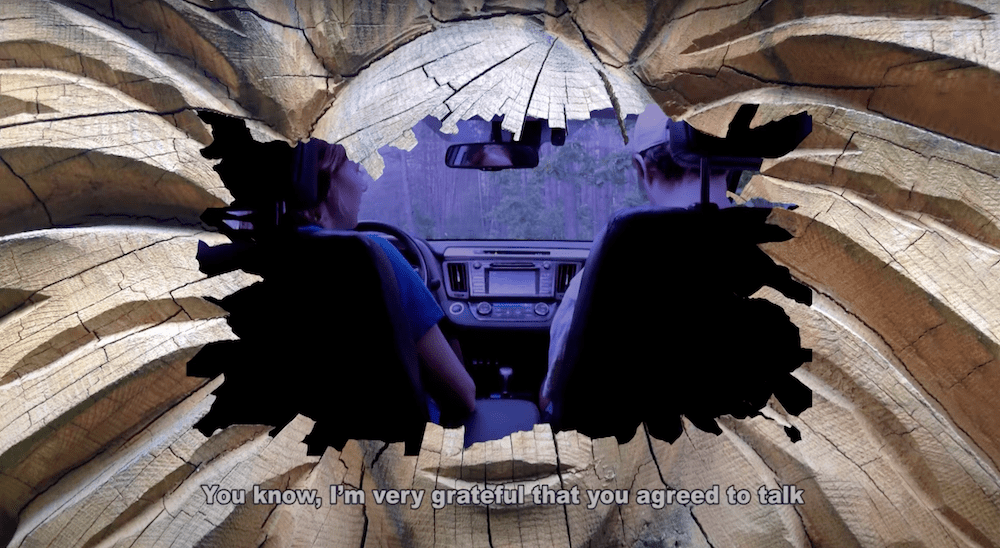
“Agents” opens with a scene of a woman and man driving a car slowly into the woods. They park amidst the trees, as if in a horror movie. The two engage in whispering a conversation in what I’d imagine is Lithuanian, with English subtitles. The conversation is noted at the start of the film to have been scripted for artistic purposes. Viewers find out later in the film that the forest was one of the only places people were allowed to go outside during Covid-19 quarantine in Lithuania. Music is playing.

Anastasia Sosunova, Agents, 2020 (still). Video, color, sound; 14:57 min. Courtesy the artist. Video commissioned for “Roots to Routes,” 2020, curated by Juste Kostikovaite, Maija Rudovska and Merilin Talumaa, with the support of the Baltic Culture Fund.

“We should turn it off, otherwise, we’ll scare them,” the woman says. While watching, I imagined the woman, who is in the driver’s seat, to be Sosunova. The man in the passenger’s seat seems to be a Lithuanian folk sculptor (or an actor playing one) – in other words, it could be argued that, in this filmed conversation, he, the craftsperson, is the “artist”, while the artist, Sosunova, is the “interviewer”. The woman continues, “You know, I’m very grateful that you agreed to talk in these circumstances. I thought at some point the things we create live their own lives, one can even say they come to life, and I begin to think of folk art conspiratorially.”

Anastasia Sosunova, Agents, 2020 (still). Video, color, sound; 14:57 min. Courtesy the artist. Video commissioned for “Roots to Routes,” 2020, curated by Juste Kostikovaite, Maija Rudovska and Merilin Talumaa, with the support of the Baltic Culture Fund.

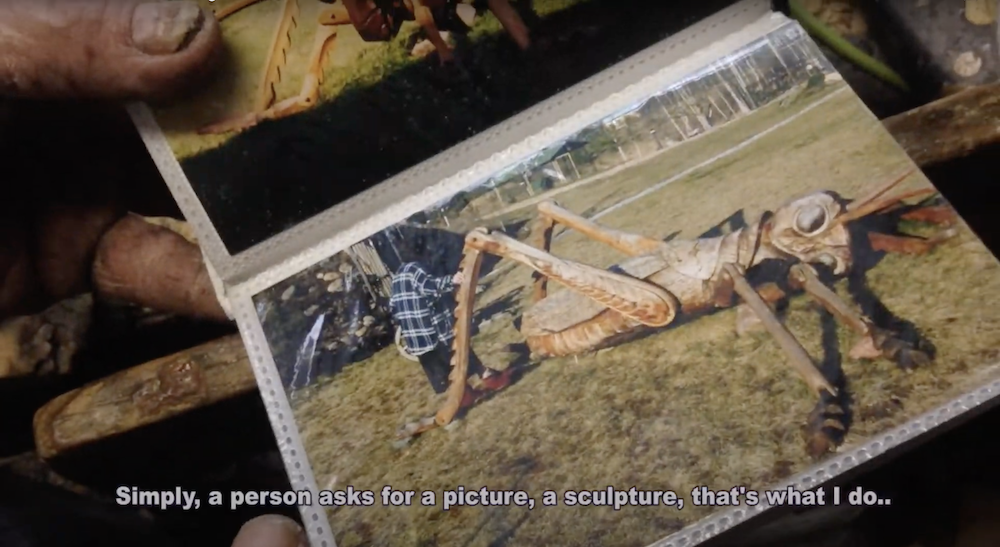
Sosunova immediately places the viewer in a cinematic vantage point mediated by fantasy, inducing a required suspension of disbelief. The protagonists are shot through what looks like a blasted hole in the middle of a strange animated wooden totem face framing their Socratic conversation. Both protagonists remain fairly anonymous throughout the duration of the film, as they are only shot with one camera angle from behind, revealing the backs of their heads and a slight profile at most, creating a disorienting effect. Viewers of the film get to know these characters mostly through their voices, dialogue, the deliberateness with which they speak, and their mutual respect for the conversation at hand. Viewers also get to know the sculptor through alternating camera shots of his weathered hands and dirty fingernails, that have surely been carving wood for decades, flipping through old photo albums of crafts and sculptures he either has created or references for inspiration.

Anastasia Sosunova, Agents, 2020 (still). Video, color, sound; 14:57 min. Courtesy the artist. Video commissioned for “Roots to Routes,” 2020, curated by Juste Kostikovaite, Maija Rudovska and Merilin Talumaa, with the support of the Baltic Culture Fund.

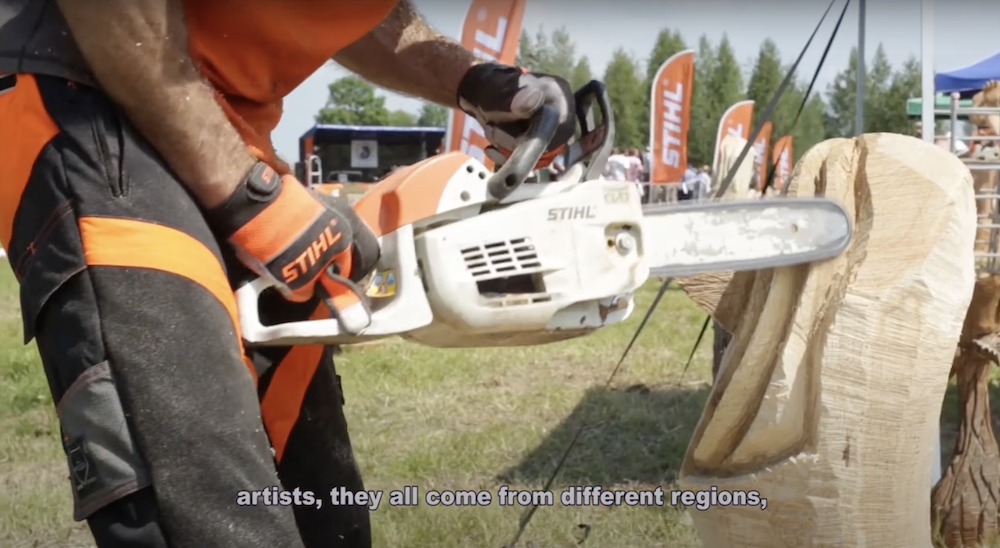
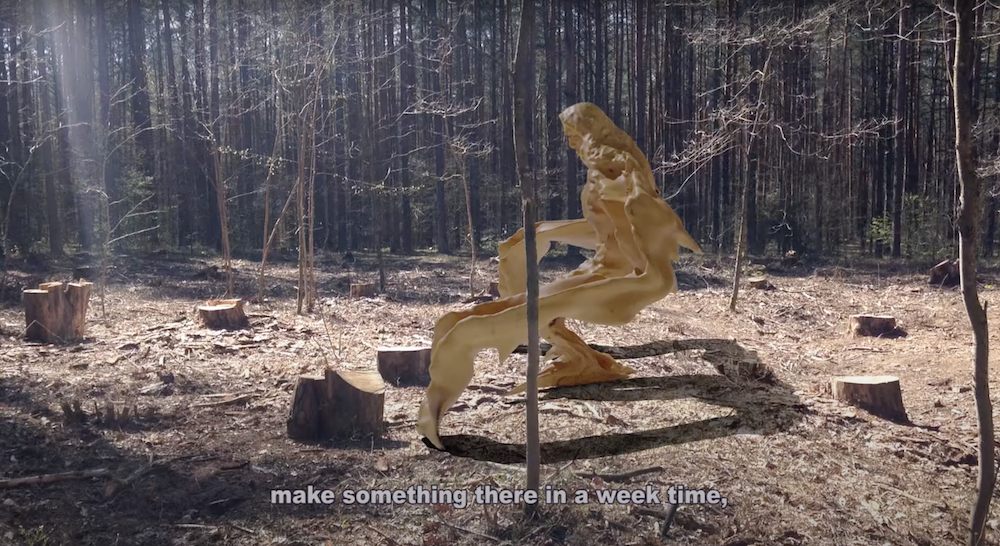
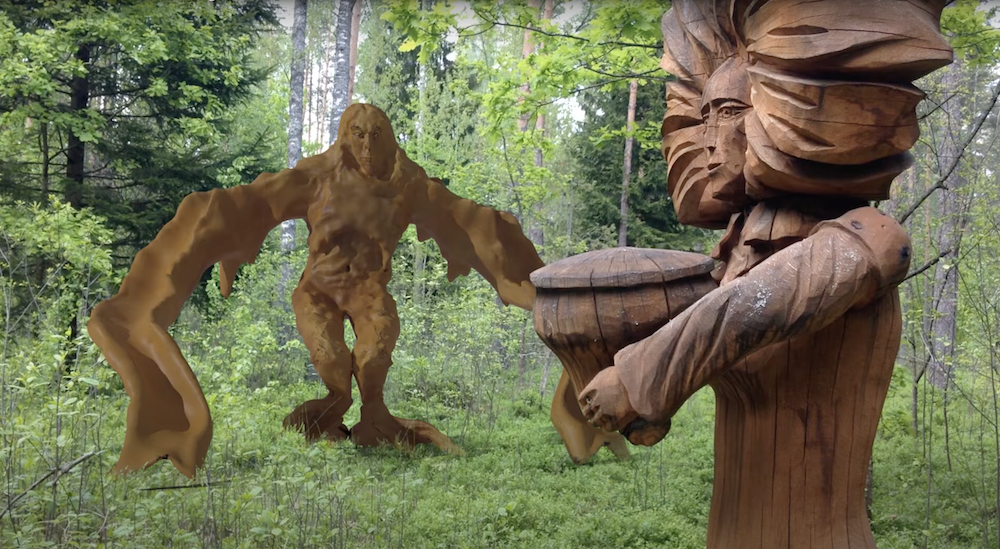
In the car, the pair seems intent on encountering what Sosunova describes as a “Golem” or “Cyclopse-like” living version of Lithuanian wooden folk sculpture: the embodiment of tradition taking on a life of its own after it is created. According to the sculptor, the original inanimate wooden folk sculptures are left in the forest every year following a week-long festival for which people come from all different regions to carve traditional wooden folk sculptures in the shapes of different woodland creatures, religious figures, or folkloric characters, and have them judged. After the festival they are abandoned in the forest, and because of this tradition, the forest is now filled with mythical man-made creatures.

But, is tradition good or bad? The interviewer (assumed to be Sosunova) proposes, “I am interested, you know, in learning how much we can give up primary meanings that are in these images, and how much the symbols themselves control us if we use them thoughtlessly…for instance, Ancient Greek legends about Cyclops were born after the Greeks found old elephant skulls who used to inhabit that peninsula, and thought those were one-eyed giants that actually lived there. This is how I also thought about the Lithuanian tradition of devil depiction, it is so mystified, but in fact it is for the most part an iconography of anti-Semitism. What should we do with those images?” The film examines where both religious and secular symbols come from, who is creating what, why, when, and for whom. 

Anastasia Sosunova, Agents, 2020 (still). Video, color, sound; 14:57 min. Courtesy the artist. Video commissioned for “Roots to Routes,” 2020, curated by Juste Kostikovaite, Maija Rudovska and Merilin Talumaa, with the support of the Baltic Culture Fund.

Later in the script, the sculptor shares a more vulnerable side of himself, adding another layer of openness and universality to the video. He comments, “Well, a few hundred years ago, when creating those folk sculptures, no one thought about traditions, a person did something from the heart. If a person creates a thing from the heart today, then after a few years there will be a tradition of some sort. The most important thing to do is make it from the heart. In the past, I was more critical, when I was younger, but now I think – let people make what they need. Sure, I don’t like it when people fool around, when it starts being all about fooling around it’s irritating. But otherwise, let the people do their thing, not my business, whatever people like should exist.” There is a relatable realness and resignation in this statement that rings very true after (and arguably unfortunately still during) the global pandemic, like a prophecy of the post(?)-pandemic art world: “Sure, I don’t like it when people fool around, [but]…whatever people like should exist,” with haunting simplicity.

The cloudy atmosphere and muted color palette of the setting of the video evoke an overall greyness, which reminds me of the abundance of grey architecture in Eastern Europe and the lingering evidence of communism and former Soviet control. However, with “Agents”, Sosunova emphasizes there is magic emerging within this greyish environment. What is unknown is if it is light or dark magic. To what extent are Sosunova’s CGI golems of tradition benign or treacherous? And what is the artist’s responsibility in the face of them?

The overall feeling of not being able to know what time of day it is in the video is also compelling. The setting seems to transition at different points from morning to afternoon, to twilight, in no particular order. There’s an oneiric sense of space and time throughout the film, enhanced by the abrupt stopping and starting of hypnotic video game music featuring tracks by Sro and Blear Moon. 

Visitors to The New Museum will note Sosunova’s CV to date comprises mostly exhibitions in Lithuania, Estonia, and Latvia. It’s incredible to see great emerging art like Sosunova’s from other global regions, here New York. The experience of this video is at once very familiar and an immersion into Lithuanian subconscious. 

“Agents”, 2020 by Anastasia Sosunova is on view at The New Museum from 30 June – 22 August, 2021. WM

Anastasia Sosunova, Agents, 2020 (still). Video, color, sound; 14:57 min. Courtesy the artist. Video commissioned for “Roots to Routes,” 2020, curated by Juste Kostikovaite, Maija Rudovska and Merilin Talumaa, with the support of the Baltic Culture Fund.